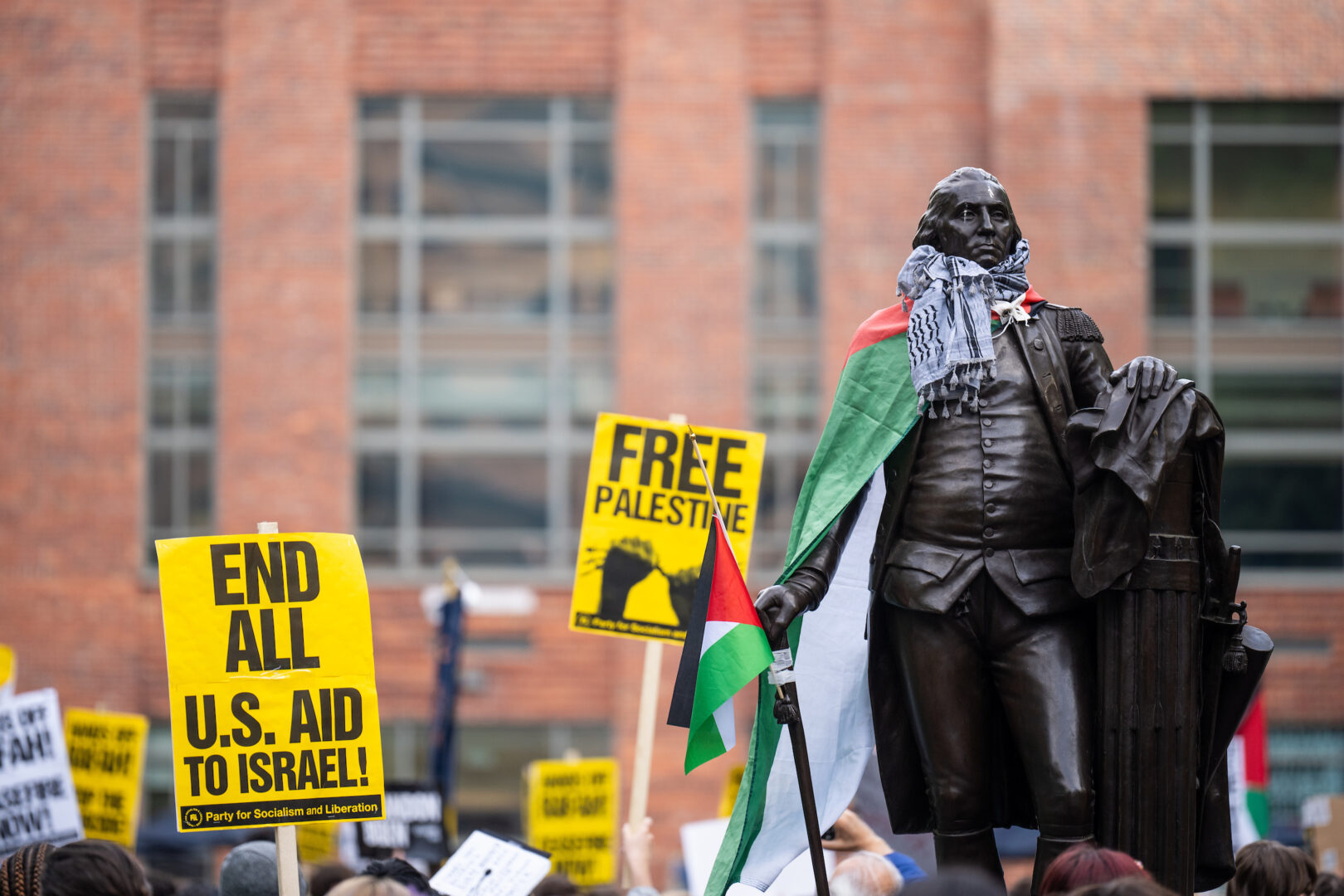
Is it biblically acceptable for a Christian to be an antizionist—not just skeptical about Israel’s conduct, but opposed to Israel’s existence as a Jewish-majority state? The answer to that question hinges on the Bible’s view of nationhood.
In his recent article for Mere Orthodoxy about the pro-Palestinian campus protests, Onsi Kamel distances himself from the protests themselves, rightly acknowledging some of their discreditable features. However, he defends “the cause for which [the demonstrators] are protesting.” At a minimum, this cause is opposition to America’s alliance with Israel. In the article, Kamel associates himself with the position held by “many Arab-Americans”: that America’s policy choices in the region are “morally indefensible.”
What are those policy choices? America has supported Israel politically, economically, and militarily, while also facilitating multiple Israeli offers of statehood to the Palestinians. Israel would find it difficult to survive if it lost American support. To oppose American policy in the region is, in effect, to oppose the ongoing existence of the world’s only Jewish state. The protests have made little secret of this stance.
The Antizionism of the Protests
The slogan chanted at protest after protest is “From the River to the Sea, Palestine Will Be Free.” In view of the violent forces currently attacking the Jewish-majority state located between the Jordan and the Mediterranean, that slogan expresses genocidal hostility against Jews. Hamas, Iran, and Hezbollah are all seeking to “free” Palestine by obliterating the Jewish state.
It’s hard to give credence to milder interpretations of the slogan, given the current realities. But even the mildest understanding of the slogan affirms a presumptive “right of return” for descendants of the 1948 Palestinian refugees. As Efraim Karsh has argued, this is “a euphemism for eliminating the Jewish state altogether, in this case through demographic subversion.”
From the protestors’ point of view, Israel’s so-called “settler-colonial” status warrants its elimination, whether by violent or demographic means. One Northwestern University faculty member, who urged her readers to “go out and speak the truth,” has summarized Israel’s history as “seventy-five years of assault on Palestinian life, displacing, maiming, and massacring people in a US-backed campaign of mass death.” (If that version of history were true, the Palestinians would have accepted one of the offers of statehood made to them—imagine how quickly the Jews in Nazi-controlled Europe, who genuinely faced a campaign of mass death, would have accepted any offer of Jewish statehood.) Such propaganda is standard fare among the demonstrators, which helps explain why they glorify terrorism—in their minds, it’s a legitimate form of resistance—at protest after protest.
So, whether Kamel fully intends it or not, by declaring his support for the demonstrators’ cause he’s upholding the cause of uncompromising antizionism. In light of the protests’ demands (no further U.S. assistance) and their rhetoric (the slogans glorifying terrorism, which are never disavowed by protest leaders), it would be foolishly naive to characterize the protests as seeking anything less than the elimination of Israel as a Jewish-majority nation state.
Acceptable Criticism of Israel
Before we turn to the Bible’s understanding of nationhood, it’s worth exploring what criticism of Israel might look like if it opposed Israel’s conduct while nonetheless supporting Israel’s right to exist.
It would begin by acknowledging that Israel was utterly compelled by its own security considerations, following “Israel’s 9/11,” to attack Hamas and dismantle its capacity to slaughter Israeli civilians—just as any other nation would do in truly comparable circumstances. For example, the British response to the IRA would surely have been more severe if the IRA had, on a single day, murdered 8,000 British citizens and kidnapped a further 1,750 (accounting for the population disparity with Israel); if the IRA had fired rockets indiscriminately at the British mainland; if it had hidden in a secret tunnel system throughout Northern Ireland; and if Britain had faced highly menacing enemies to the north and east (the equivalent of Hezbollah and Iran), allied to the IRA, and watching, hawk-like, for any sign of weakness.
Acceptable criticism would also acknowledge that, by provoking an inevitable reaction from Israel, Hamas is culpable for bringing death and destruction on its own people, and Hamas is further culpable for prolonging the conflict by refusing to return the kidnapped hostages. What’s more, such criticism would pay heed to the well-established evidence showing Hamas embeds itself among civilians, thereby exponentially increasing the likelihood of civilian casualties.
Only then would such criticism seek to discern whether Israel’s self-defense has gone above and beyond what was militarily necessary, causing excessive loss of life. (Such a calculation is difficult. Kamel cites a Times article purporting to show that civilian mortality in Gaza has been excessively high in comparison with other conflicts, but it made basic statistical errors and has been comprehensively debunked.)
None of the above concessions to Israel are found in Kamel’s article. He never once mentions the hostages held by Hamas. And when he lists a series of allegations against Israel’s conduct, he pays little or no attention to Israel’s responses to those accusations. His intention seems to be simply to demonize the world’s only Jewish state.
The demonization of Israel is a familiar feature of antizionist discourse. From the antizionist viewpoint, Israel shouldn’t exist in the first place, and so Israel—rather than Hamas—should be vilified for deaths resulting from a Hamas-provoked war. This is why antizionists don’t acknowledge the extraordinary precautions Israel has taken to avoid civilian deaths. It’s also why antizionists never acknowledge the mortal pressure on Israel, not only from Hamas, but also from Hezbollah and Iran. From their perspective, a state that shouldn’t exist deserves no sympathy.
Nationhood’s Theological Foundation
Antizionism depends on the supposition that a nation state should, if morally necessary, be deprived of its existence. It’s surprising how rarely Christian antizionists are challenged on this point.
The Bible is acutely conscious of the horrors that nations can perpetrate, and God does sometimes bring particular nations to an end. But Scripture treats nations as a divinely-ordained feature of life on earth (see, in particular, Acts 17:26–27). For that reason, where there is no specific divine decree, there is no biblical mandate for human powers to eliminate an established nation.
This is something we intuitively grasp, aside from the teaching of Scripture. No serious historian argues that Germany should have been deprived of its existence, even after its aggressive role in two world wars and its implementation of the Holocaust. (Germany’s forced separation into two nations in 1949 can hardly be considered cessation, as demonstrated by its relatively smooth reunification in 1990). Nor are there calls for Russia to be deprived of its existence now, despite Russia’s seemingly perpetual desire to extend its borders no matter how many lives are destroyed in the process.
Returning to the Bible, if nations have a biblical right to control their own borders—and powerful arguments have been made to that effect—then they have an a fortiori right to continue existing within those borders. That’s why ethnic self-determination can’t be considered a biblical right in situations where it would rearrange the borders of an unwilling nation state or threaten a nation’s ongoing existence. Such a conclusion shouldn’t seem alarming. There are many ethnic groups—the Scots and the Welsh among them—who prefer minority status to independent self-rule. Nuseir Yassin, the Palestinian founder of Nas Daily, has boldly stated that he wants to “stay within the confines of the Israeli country, and the borders of Israel.”
Therefore, in order for Christians to hold a biblically-defensible antizionism, they would need to construct a new theology of nationhood. Antizionists haven’t yet shown from the Bible why—from the human viewpoint, without any divine decree—an established nation state should lose its right to continue existing. In the absence of this exegetical step, antizionism is an anti-biblical position.
The Palestinians’ Worst Enemies
Contrary to what onlookers assume, the pro-Palestinian demonstrators aren’t the friends of those who are suffering in Gaza. The demonstrators are allied—in practice if not always in theory—with the Palestinians’ worst enemies: the Islamofascists of Hamas. The ceasefire that the demonstrators called for in the earliest months of the conflict would have allowed Hamas to re-entrench itself.
When Israel withdrew Jewish settlers from Gaza in 2005, there was optimism that Gazans would benefit from their new freedoms. Sadly, due to Hamas, those good prospects didn’t last for long. After fighting against their fellow Palestinians in the June 2007 Battle of Gaza, the terrorists of Hamas took sole control of Gaza and have ruled it ever since.
Hamas has always been committed to the violent destruction of Israel. In its 1988 founding charter, it described itself as “the spearhead” of the struggle with Zionism, adding, “Leaving the circle of struggle with Zionism is high treason, and cursed be he who does that.” More recently, in November 2023, Hamas leader Ghazi Hamad said, “Israel is a country that has no place on our land. We must remove that country, because it constitutes a security, military, and political catastrophe to the Arab and Islamic nation, and must be finished. We are not ashamed to say this, with full force. … On October 7, October 10, October 1,000,000 – everything we do is justified.”
As a result of its eternal war against Israel, Hamas has consigned the population it rules to the inevitable consequences of attacking a well-defended enemy. Hamas is perfectly open about this. As reported by the Guardian, Hamas spokesperson Sami Abu Zuhari has said: “Hamas despises those defeatist Palestinians who criticise the high number of civilian casualties. The resistance praises our people … we lead our people to death … I mean, to war.”
The global campus protests unquestionably serve the interests of Hamas, this death cult that has subjected its own people to an endless cycle of misery. It’s understandable that fashionably nihilistic students might be drawn to such a cause. But it’s baffling to watch Arab-American Christians make Israel the focus of their attack, rather than Hamas. May the Lord give all Arab Christians the moral vision needed for seeing the real persecutors of their people.
 sixty guilders
Leave a comment