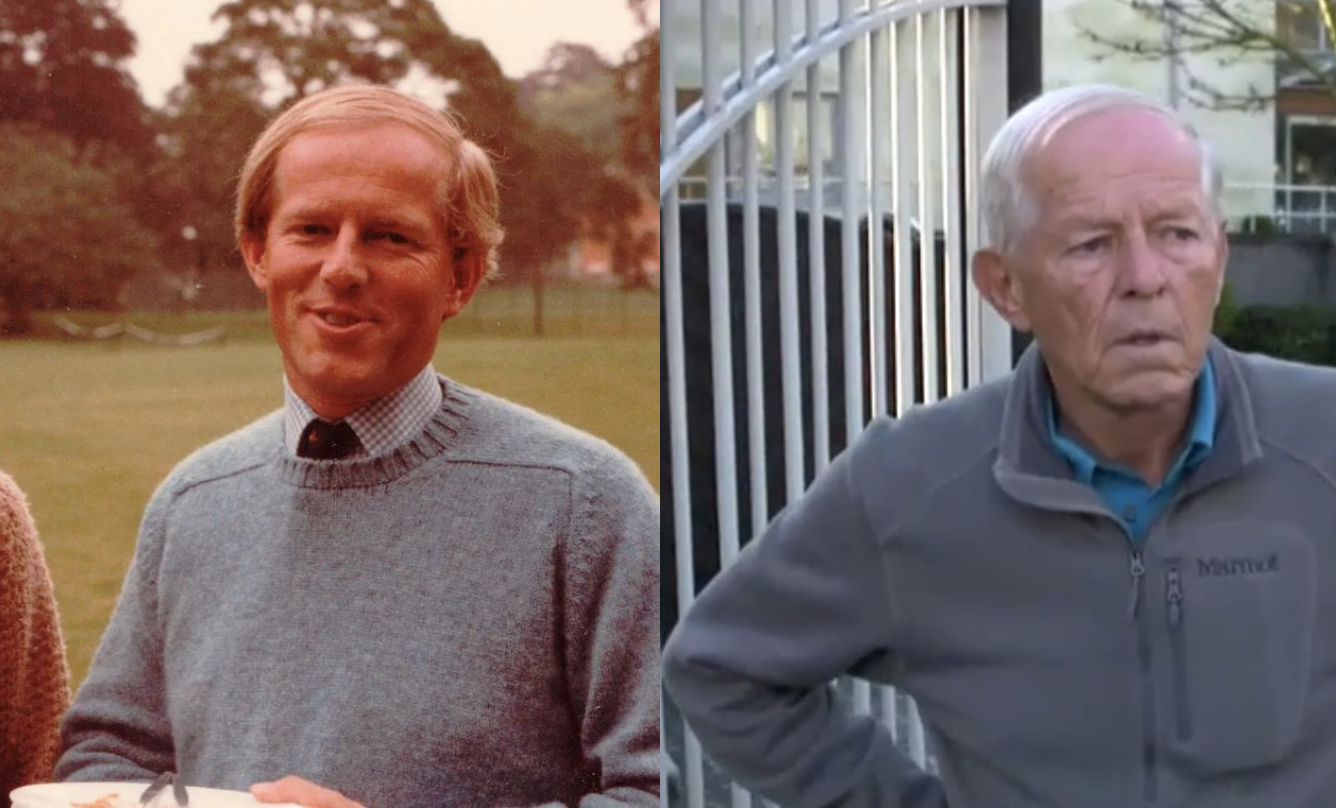
(L) John Smyth at a Iwerne camp in the 1970s (photo © Mark Stibbe, used with permission); (R) Image of Smyth during Cathy Newman’s interview, broadcast on 2 February 2017
The Makin Review, which was published one year ago, showed that many Christian leaders failed to act rightly in response to John Smyth’s abuse of boys and young men.
Smyth’s criminal misconduct is summarised in the review as follows: “His abuse was prolific, brutal and horrific. His victims were subjected to traumatic physical, sexual, psychological and spiritual attacks. The impact of that abuse is impossible to overstate and has permanently marked the lives of his victims.” The abuse was first disclosed in 1982, but the police weren’t informed until 2013. For three decades, Smyth was protected by the silence of Christian leaders.
The failure to report Smyth not only meant that he evaded justice, it also enabled him to abuse many additional victims after he moved to Africa. A 16-year-old boy named Guide Nyachuru died in highly suspicious circumstances at a Smyth-run camp in Zimbabwe in 1992. The Smyth scandal bears comparison with the worst examples of Roman Catholic abuse scandals, both in the nature of the abuse itself and in the negligence of leaders who knew about it but didn’t report it.
Unrepentant Christian Leaders
Since the Makin Review was published, very few – if any – British Christian leaders have publicly admitted personal wrongdoing in connection with the scandal. Although Justin Welby resigned as Archbishop of Canterbury following the review’s publication, he effectively protested his own innocence when he told the House of Lords, in a conspicuously lighthearted speech, that sometimes resigning is necessary “whether one is personally responsible or not”.
From a Bible-believing perspective, what’s most disturbing is that no evangelical leader has publicly apologised for failing to respond rightly to Smyth’s abuse. Public apologies are necessary because the identity of victims has been kept secret; the only way for repentant leaders to reach out to them is to make a public statement. Public apologies also have the beneficial effect of explaining to younger leaders what exactly should have been done differently.
Three organisational apologies relating to Smyth’s abuse are cited later in this article. However, such apologies don’t remove the obligation on individuals to admit their role in the scandal and apologise. From a Christian point of view, this obligation comes from the biblical imperatives of repentance and reconciliation. It’s the absence of personal apologies from British evangelical leaders that explains the title of this article.
John Smyth’s abuse is one of the worst scandals in the history of British Christianity, and it was first and foremost a conservative evangelical scandal. All evangelicals should agree that Christianity isn’t just about beliefs, it’s also about behaviour. Why, then, haven’t any of the leaders in question demonstrated contrite repentance? Part of the answer may lie in the absence of any community pressure from senior leaders, evangelical institutions, or publications such as Evangelicals Now. Surely the time has come for that to change.
This article will refer to the Makin Review (2024) as “MR”; the Appendices to the Makin Review as “AMR” (page numbers refer to the 245-page PDF file); the Ruston Report (1982) as “RR” (copied in MR, pp. 77–79); the Winchester College Review (2022) as “WCR”; the Titus Trust Documents (last updated in 2025) as “TTD”; the executive summary of the Scripture Union Review (2021) as “SUR”; the Coltart Report (1993) as “CR”; and Bleeding for Jesus (2nd ed.) by Andrew Graystone (2025) as “BFJ”. Section numbers are cited where possible.
A Conservative Evangelical Cover-Up
Smyth groomed his British victims through several connected conservative evangelical ministries: the summer camps held at Iwerne Minster (hereafter referred to as “Iwerne”); a Christian group at Winchester College; and university Christian unions. One of Smyth’s victims has explained that Iwerne was the common thread in Smyth’s abuse, even though some victims were recruited elsewhere. In the words of that victim, Smyth’s “position at Iwerne, his status as a leader at Iwerne, gave him the respectability, the platform” (TTD, p. 14).
The people to whom the abuse was first disclosed were all conservative evangelical leaders closely associated with Iwerne (MR, 12.1.33). Mark Ruston, vicar of the Round Church in Cambridge from 1955–87, compiled a report on the abuse and gave it to a group of his fellow Iwerne leaders in March 1982 (MR, 12.1.10.a). The Ruston Report stated that Smyth’s beatings were “technically all criminal offences under the Offences Against The Person Act of 1861, Sec. 47” (RR, 3). It established that Smyth had abused boys as well as young men (RR, 3, discussed in MR, 6.2.1), and it included graphic descriptions of Smyth’s savage brutality (RR, 6). The Iwerne group should have reported the abuse to the police, but they chose not to pursue justice.
One reason why criminal offences should be reported immediately is so the police can gather evidence. Smyth had time to remove incriminating evidence such as his canes and the adult nappies that stopped the victims’ blood from soaking their clothes (MR, 12.1.51). Another reason for swift reporting is to prevent offenders from leaving the country, as Smyth did in 1984. When the police were finally informed, 30 years later, their initial response was influenced by both of those considerations: “for legal reasons they felt there was insufficient evidence, especially after all this time, to get through the hoops for investigation and possible extradition” (TTD, p. 10, emphasis added). As a general rule, certainly applicable in this case, those most to blame for not reporting criminal abuse are those who fail to take the earliest opportunity to report it.
In September 1982, six months after the abuse was first disclosed, the non-evangelical headmaster of Winchester College was told what Smyth had done (MR, p. 70, entry for 13/9/82), and other people who weren’t conservative evangelicals were also informed in the years that followed. This wasn’t, therefore, a cover-up in the sense of a secret known only to a few insiders (see MR, 12.1.123). But, while known by relatively many, the information was kept secret from the police for 30 years, which more than justifies the term “cover-up”. And this cover-up was managed by the conservative evangelical leaders of Iwerne (see, e.g., MR, p. 62; 12.1.162; WCR, p. 72; and SUR, p. 7, 6.4–6.5, p. 11, 6.29).
To speak of a conservative evangelical cover-up isn’t to say that non-Christians or other Christian groupings were blameless. But in Christian scandals there’s often a tendency for different sub-cultures to protect their own reputation by blaming one another. It’s therefore necessary to identify the group most at fault, which in this case was the conservative evangelical circle of Iwerne leaders who originally received the Ruston Report (they’re named in MR, 12.1.33), along with other Iwerne leaders added to that circle in 1982, such as Jonathan Fletcher (MR, 12.1.120 et al), and Mark Ashton, who liaised between Iwerne and Winchester College (WCR, p. 61 et al).
Additional conservative evangelical groups later came to be implicated in the cover-up through the failings of their representatives. Leaders from Above Bar Church (which belongs to the FIEC), the Lawyers’ Christian Fellowship, and Church Society were told about the abuse during the 30-year period of silence, but none of them reported it to the police. Their conduct shows that conservative evangelicals from different social and ecclesiastical circles were just as willing to engage in secrecy as the circle at the scandal’s core. Those organisations haven’t even publicly acknowledged, let alone apologised for, the failings of their own representatives.
The novelist James Baldwin said, “Not everything that is faced can be changed; but nothing can be changed until it is faced.” I’m writing this article because I think conservative evangelicals should face our own scandals unflinchingly, and that hasn’t happened yet with the Smyth scandal. Evangelicals rightly love to speak about the forgiveness of sins through faith in Jesus, but we also need to speak about turning from sin (Romans 6:15–18), which may involve apologising and reaching out to others for forgiveness. Although this is a very long article, I hope readers will find each section to be necessary and as concise as possible.
Excuses Considered
The leaders who failed to report Smyth in 1982 were answerable to two organisations: the Iwerne Trust, whose work was later taken on by the Titus Trust; and Scripture Union. Both the Titus Trust and Scripture Union have accepted that Smyth’s abuse should have been reported to the police (TTD, p. 2; and SUR, p. iii; p. 7, 6.7).
However, despite those organisational admissions, individuals implicated in the scandal have often defended their inaction with excuses (see, e.g., SUR, p. 7, 6.7). Such excuses persist to this day, which may explain why none of the evangelical leaders at fault have personally apologised. It’s therefore essential to analyse the main excuses that have been offered.
When considering these excuses, it should be kept in mind that the failure to report Smyth allowed him to continue abusing young people when he moved to Africa. The camps he ran in Zimbabwe became notorious for nakedness and for the physical punishment of sins (CR, B. 33), echoing the earlier abuse in Britain. In this way, the excuses for inaction have a very high bar to clear: do they justify letting Smyth move to Africa with his crimes unreported and his reputation intact?
1. “The victims didn’t want the abuse to be reported.”
This excuse is baseless because the victims weren’t consulted. Commenting on the failure to report in 1982, the Makin Review says, “There is no attempt to consult with the victims as to their views on this. It is worth noting here that the victims were treated as ‘boys’ and are referred to as such. … These were, by this point not ‘boys’ but adult men, who were not given agency in this whole process” (MR, 12.1.10, point g).
The Makin Review further states, “The objective evidence … is that it is most likely that only three sets of parents were consulted about this [reporting to the police] and that one of those sets of parents took the view that the ‘authorities’ should be informed” (MR, 12.1.113, emphasis added). This shows that it’s also baseless to say that the victims expressed a wish for non-reporting via their parents. Very few parents were consulted, and even among those few, there wasn’t unanimous agreement.
The Winchester College Review similarly states, “The reviewers have seen no evidence that the College contacted any of the victims when the abuse was disclosed in 1982. There is evidence that John Thorn held discussions with the fathers of a limited number of victims about how to respond to the disclosure of abuse. However, all of the victims and some of their parents were not consulted and were excluded from the decision-making process” (WCR, 99).
Even in a hypothetical situation in which all the victims unanimously requested non-reporting, Smyth’s crimes should still have been reported (see the discussion in MR, 12.1.49–50). The necessity of reining in Smyth is proven by his later abuse of scores of African boys and young men. Any abuser has the potential to reoffend in the future and therefore must be constrained by the application of the law. The possibility of Smyth’s reoffending was explicitly raised in 1982 by a member of the Iwerne circle: “Dick and I talked about Smyth. His chief fear is that John could break out in this way again” (WCR, p. 56). Additional reasons for reporting an abuser regardless of the victims’ wishes include the importance of deterring others from committing similar abuse, and – from a Christian perspective – divinely-authorised punishment (see Rom. 13:3–4 and 1 Pet. 2:13–14).
2. “Without victims willing to report their experiences first hand, no criminal charges could have been brought.”
This excuse assumes that none of the victims would have provided evidence, even if they’d been urged to do so by the judicial authorities. The assumption is unproveable because we don’t know how the victims might have acted in that situation. It’s conceivable that some of them would have cooperated with the legal process.
What’s more, this excuse ignores the option of exposing John Smyth via the media, which most likely would have stirred up a reaction that led to legal proceedings, as it did in 2017. In such circumstances, with their institutions already at the centre of public attention, it’s conceivable that Winchester teachers and Iwerne leaders would have provided sufficient evidence, even if victims were unwilling to testify. At the very least, public exposure would have made it impossible for Smyth to raise the donations that he needed for funding his life and ministry in Africa.
There’s no reason to think the media would have declined to publicise Smyth’s abuse. Smyth was a QC who’d built a public reputation through his legal work on behalf of Mary Whitehouse (WCR, p.14), a high-profile campaigner for Christian moral standards. In the years beforehand, scandals involving public figures such as John Profumo and Jeremy Thorpe had been widely covered in the British press. Smyth’s abuse would undoubtedly have been considered newsworthy by the British media in the ’80s, ’90s, or 2000s, just as it was in 2017.
Informing the media was an option that occurred to at least one victim: “I wrote a very cursory letter to both of them [Smyth and David Fletcher] saying that I had become aware that John Smyth had been beating young men and that if it didn’t stop immediately the police and media would be told. I honestly thought that the threat of exposure would prevent John Smyth from beating me again” (12.1.15). While it’s very understandable that victims may not in practice have wished to expose Smyth to the media themselves, this victim’s testimony shows that exposure through the media was considered a viable option at the time.
Those who knew about the abuse – both at first and later on – could have gone to the media as a step towards bringing Smyth to justice, and as a means of stopping him from committing further harm. Although this might seem unrealistic (“Contacting journalists isn’t something Christian leaders usually do”), letting Smyth loose in Africa with his reputation intact should be considered far more shocking than exposing him to the media, which is a course of action that doesn’t break any civil or biblical law.
It should be remembered that the police’s initial response to Smyth’s abuse, in 2013–14, was lacklustre, and their attitude to the case only changed following Channel 4’s reporting in 2017 (MR, 14.3.71). To claim that exposing offenders via the media is inappropriate is effectively to say that it would have been better if Channel 4 had never broken the story. Such an argument serves the cause of injustice rather than justice.
3. “The consensual nature of the abuse meant Smyth wouldn’t have been convicted.”
It’s highly doubtful whether the victims’ submission to the beatings should be considered “consensual”. The Winchester College Review points out that “when Victim 005 agreed to visit Smyth’s garden shed, he believed he was agreeing to the kind of mild corporal punishment which was lawful at the time. He did not, and legally could not, consent to the brutal beating and long-term harm which Smyth inflicted, because a person must ordinarily understand the nature of the activity or conduct to which they are consenting” (WCR, p. 88; the reviewers cite case law from 1967 and 1872).
Furthermore, even if the victims were viewed as consenting, there would still have been a strong criminal case against Smyth. The Winchester College reviewers cite R v. Brown [1993], in which consent, although acknowledged, was explicitly rejected as a defence (WCR, p. 88; the relevant statute in that 1993 case was already in force at the time of Smyth’s abuse). The reviewers conclude, “if Smyth had been prosecuted for the offence of assault or assault occasioning actual bodily harm in the 1980s … there would have been a reasonable prospect of conviction” (WCR, p. 114).
Even the Ruston Report, compiled by and for those who went on to cover up the abuse, acknowledged that “These were technically all criminal offences under the Offences Against the Person Act of 1861, Sec. 47” (RR, 3; see also MR, 6.3.4–6).
Moreover, even if it were true that the victims’ supposed consent might have prevented a criminal conviction, this excuse for non-reporting fails to address the option of exposure via the media – something that could have been pursued without any need for criminal charges.
4. “We mustn’t apply today’s expectations and standards to earlier generations.”
It’s reasonable to point out that there’s now far greater awareness of the importance of reporting abuse than there was in the early 1980s. This observation may go some way towards explaining why none of the Iwerne circle seem to have argued in favour of reporting. However, explaining something isn’t the same as excusing it. Recently-established safeguarding norms have drummed in the importance of reporting, but it was already true – for moral and biblical reasons – that abuse should be reported.
The Iwerne circle knew that Smyth’s abuse was criminal (RR, 3), and, as seen above, at least one of them openly expressed his fear that “John could break out in this way again” (WCR, p. 56). The fact that they tried to get Smyth to give an “undertaking” that he’d never again work with young people reveals their concern that he might reoffend (MR, 12.1.25, 12.1.89, 12.1.128–129). The Iwerne circle didn’t need safeguarding training to know they were putting young people at risk by letting Smyth go free.
What’s more, the spread of safeguarding awareness actually began during the period of evangelical silence about Smyth’s abuse. A Titus Trust document dated 15 January 2003 says, “Since May 2002, there has been a new system in place to help organisations like the Titus Trust to safeguard the safety of the children on our holidays. As a result, we are now required to ask you to apply for an Enhanced Disclosure through the Criminal Records Bureau.” This information was sent to every volunteer leader and was impossible to ignore. Mandatory safeguarding training was also introduced in the early 2000s at the start of every Iwerne camp. This major cultural change for Iwerne happened at the same time as the unfolding global Roman Catholic abuse story. Therefore, while unfamiliarity with safeguarding principles may partially explain attitudes in the early 1980s, it must be noted that the leaders in question maintained their silence when the culture changed twenty years later.
Smyth’s Banishment to Africa
In a letter to Smyth dated 7 April 1982, John Eddison floats the idea that Smyth could move abroad, presenting it as something that would have been the perfect solution if Smyth had been younger and not “a family man” (AMR, p. 92). This had already become the settled aim of the Iwerne circle: “There is firm evidence that John Smyth was encouraged to leave the UK by senior Iwerne staff and alumni. Revd. Fletcher confirmed that this suggested action was discussed extensively and, with the support of mature ex-campers, included in a letter written to Smyth by Revd. Eddison” (SUR, p. 9, 6:19). Eddison probably presented the suggestion in an off-the-cuff way because Smyth wasn’t responding well to the Iwerne group’s oversight (see AMR, p. 97). But Eddison was implicitly telling Smyth three highly significant things: the Iwerne group had no desire to reintegrate him; they wanted him as far away as possible; and they would give him safe passage if he left.
After the Makin Review was published, further evidence came to light showing that the Iwerne group wanted Smyth to emigrate. In February 2025, a Channel 4 News report alleged that David Fletcher, who led Iwerne from 1967–86, was himself guilty of abuse. One of the details emerging from the programme was the existence of a plan to get Smyth to move abroad: “Ali has kept her diaries from 1982, recording her recollection of Fletcher’s role in the plan to get Smyth to leave Britain – allowing him to continue his abuse across Africa.”
The existence of a plan to send Smyth away fits with David Fletcher’s actions from 1982–84. During those years, whether directly or indirectly, he stopped Smyth from joining several UK-based Christian organisations: Above Bar Church (MR, p. 71); Mission England (MR, p. 73); and the Stewards’ Trust (AMR, pp. 164, 188). But when Fletcher was told – twice – that Smyth was joining Africa Enterprise, an evangelical missionary organisation headquartered in South Africa, he doesn’t seem to have given the organisation any warning (MR, p. 73, entries for 18/5/84 and 22–25/5/84). He certainly didn’t warn the trustees of the UK-based Zambesi Trust (MR, p. 125, entry for 25/4/89), which was set up in 1984 to fund Smyth’s work in Africa (BFJ, pp. 141–142). In brief, having made it impossible for Smyth to engage in ministry in Britain, Fletcher did nothing to stop him doing so in Africa. The strong implication is that he was actively seeking to dislodge Smyth from Britain, whatever the risks to boys and young men in his next location.
Everything said so far points to a banishment strategy that wasn’t directly coercive. But a 2003 Lawyers’ Christian Fellowship (LCF) memo reveals a much more aggressive strategy: “John Smyth gave a signed undertaking to the headmaster of Winchester College not to engage in further work with young men and also agreed to leave the United Kingdom which he did in 1984 when he went to Zimbabwe. In return he was not prosecuted for his activities” (AMR, p. 139, emphasis added). Makin’s claim that Eddison’s letter is “the only evidence we have found” that “pressure was put on John Smyth to leave the country” (MR, 12.1.86) is undermined by this LCF memo in the review’s appendices. Although the memo was written 19 years after Smyth’s departure, it nonetheless provides weighty evidence of coerced banishment.
The LCF memo implies that John Thorn, Winchester’s headmaster at the time of the abuse, was the main agent responsible for securing Smyth’s agreement to leave. That conclusion fits perfectly with a comment made by Thorn to The Times in 2017: “We got this bugger out of the country – excuse my language – into Africa and said: thank God that’s gone.” It’s hard to see why Thorn would use the pronoun “we” if he hadn’t personally been involved.
Peter Krakenberger, the Iwerne-linked Winchester teacher, has testified that a victim’s parent delivered the ultimatum: “Krakenberger stated in his police statement that … [Smyth] was offered an ultimatum by a parent of a victim, prominent in society at that time, that he should leave the UK by a certain time or he would be reported to the police and prosecuted for child abuse” (MR 12.1.133; again, it’s unclear why Makin overlooks this). Assuming the parent in question was acting with Thorn’s encouragement, Krakenberger’s statement fits with the claim in the LCF memo.
Neither the LCF memo, Thorn’s comment to The Times, nor Krakenberger’s police statement indicate Iwerne’s involvement in the banishment process. But – in addition to the above-mentioned letter from Eddison – there are multiple indications that Iwerne was involved behind the scenes.
After they’d told Thorn about the abuse, in September 1982, members of the Iwerne circle remained in contact with him. In a 17 October letter, Krakenberger says, “It’s been a very busy month with numerous chats to Thorn & Hewitson (who’ve been absolute bricks in my opinion) and endless phone chats with MHA & DCMF [Ashton and Fletcher, representing Iwerne] so that we were all abreast as to who knew what” (WCR, p. 68). It’s reasonable to think that during those conversations Smyth’s emigration was raised as a long-term solution to the risks associated with him. As we’ve seen, emigration had been “discussed extensively” by Iwerne leaders earlier in the year. It’s highly improbable that Thorn arrived at the same solution completely independently.
Other conditions that Thorn imposed on Smyth were copies of conditions that Iwerne had already sought to impose (WCR, p. 61), which indicates that Iwerne had fed them to Thorn. By that time, Iwerne leaders knew Smyth wasn’t complying with their demands (MR, 12.1.59, 12.1.71, and 12.1.77; WCR, p. 60), and they no doubt hoped Thorn would be more effective than they were at enforcing them. Given their aim of seeing Smyth emigrate, it would surely have occurred to them that Thorn, allied with an influential parent, might be more successful than Iwerne at pushing Smyth out of the country.
Thorn’s 1989 memoir, which doesn’t identify Smyth by name, gave the following account of his departure: “The world of conservative evangelicalism was reft in twain. Absurd and baseless rumours were circulated that he was an unhinged tyrant, the embodiment of Satan. He must be banished. And – quietly but efficiently – he was. He left the Winchester district and then the United Kingdom. He departed for Africa with his family and, by me, has not been heard of since.” The key sentence, “He must be banished”, comes in the context of conservative evangelicalism’s reaction to the abuse. In this way, Thorn implies that the Iwerne group was mainly responsible for Smyth’s departure. Thorn’s account may not be wholly reliable – he avoids mentioning his own role in the banishment – but that doesn’t necessarily mean he was wrong to place primary responsibility with conservative evangelicals.
There are two further reasons to think that Iwerne was involved in the banishment. First, there’s no sign that the LCF Committee was in touch with Thorn when its 2003 memo was written, but it was in contact with David Fletcher (see MR, p. 135, entry for 14–22/9/03). That means the relevant information in the memo most likely came from Fletcher. If so, his knowledge of the coercion suggests he was himself involved in it (otherwise, there would have been no need for Thorn to bring him into the loop).
Second, Jonathan Fletcher – whose brother, David, led the Iwerne group – helped obtain Smyth’s first job in Africa (BFJ, p. 137). David Jackman, a pastor who knew about Smyth’s abuse, also helped Smyth get the position (MR, p. 121). Jackman didn’t belong to the Iwerne group but, as Andrew Graystone notes, he “was close to the Iwerne network, and he was part of a growing network of young preachers gathered by Iwerne alumni Dick Lucas and Jonathan Fletcher” (BFJ, p. 136). In other words, Jackman’s assistance most likely resulted from the Iwerne group’s influence. Obtaining a position for Smyth with Africa Enterprise was a hugely important part of the banishment process.
One of the worst features of the Roman Catholic abuse scandals was the Vatican’s practice of relocating offenders, leaving them free to harm a new set of victims. The evidence above strongly suggests that Iwerne leaders did the same with Smyth. Even in the unlikely case that the final ultimatum was planned without Iwerne’s involvement, it’s indisputable that Iwerne wanted Smyth to emigrate, as demonstrated by David Fletcher’s testimony and Eddison’s letter. This increases Iwerne’s culpability. Not only did the Iwerne group fail to report Smyth, they also looked favourably on his departure, even though that would make it harder for anyone else to report him and easier for him to reoffend. They did this despite the fact that Smyth had already broken his pledge never to work with young people again (for the pledge, see MR, 12.1.25; for evidence that Smyth broke it, see MR, 12.1.91; p. 70, entry for Sept. 1982; and WCR, p. 102). They acted without any meaningful concern for the welfare of African boys and young men.
A Personal Apology from the Author
Speaking personally, I was a full-time member of the Iwerne staff team from 2000 to 2003, and I attended Iwerne events every year from 1993 to 2011. Throughout those years, Winchester College banned the school’s Iwerne-linked Christian group from meeting on school property. That prohibition was unique among all the Christian groups with ties to Iwerne. It called for an explanation, and occasionally we were told at prayer meetings that “something bad happened a long time ago” in connection with the Winchester group. When I myself started hosting prayer meetings, I was the one who repeated that explanation. I never knew anything more about what had happened than that short phrase, and since the Winchester group had experienced punitive consequences, I wrongly assumed justice had been done. When Smyth’s abuse was exposed in February 2017, I was astonished to discover that Iwerne was complicit in a scandal comparable with the worst Roman Catholic abuse cases.
Since the Makin Review was published last year, I’ve wondered what might have happened if I’d taken hold of the thread of knowledge I had and kept pulling at it, asking questions such as, “What was this bad thing at Winchester? Who did it? Where is he now?” I truly wish I’d pulled on that thread and kept pulling. It never occurred to me to ask those questions, but it should have occurred to me, and I’m very sorry that I didn’t ask them. I hope the victims of Smyth’s abuse will forgive me.
The Inadequacy of the Church of England’s National Safeguarding Team
The National Safeguarding Team (NST) has the task of deciding which Church of England officers should be disciplined as a result of the Makin Review. It’s part of the Church of England’s wider safeguarding system, which the review itself heavily criticised (see, e.g., MR, 22.1.1).
The Church of England’s safeguarding track record has also been criticised by Alexis Jay, who chaired the national Independent Inquiry into Child Sexual Abuse. In her view, “Church safeguarding, as it stands, falls below the standards of secular organisations, and I do not think that can continue”. Jasvinder Sanghera, who previously served as a survivor advocate on a Church of England safeguarding board, has similarly said, “The Church can no longer be trusted to manage safeguarding. The current system fails to prevent abuse and cover up.” As recently as 14 November 2025, the Charity Commission added its own serious criticisms.
In view of these criticisms, it would be extremely unwise to treat the NST’s decisions as the definitive guide to the guilt or innocence of church officers in connection with the Smyth scandal.
Conservative evangelicals have a particular duty to reach their own independent verdicts because the Church of England’s judicial process is systemically unbiblical. For example, when a minister is penalised for misconduct, in many cases regular church members aren’t told what the minister has done wrong. As a result, disgraced ministers can construct their own defensive narrative and resume ministry elsewhere. In stark contrast, biblical church discipline requires the whole church to be informed of the offence (see Matthew 18:17).
The Church of England also fails to meet the biblical requirement that church disputes should be judged by trustworthy believers (see 1 Corinthians 6:1–4). It’s overseen by a hierarchy that doesn’t uphold the Bible’s teaching – as demonstrated whenever bishops deny biblical truth without being rebuked. Evangelicals must therefore find a way to consider Smyth-related questions without relying on the judicial structures of the Church of England. It’s unevangelical for evangelicals to depend on the Church of England for justice.
In the case of Jonathan Fletcher’s abuse, evangelical leaders showed they could act outside the Church of England’s legal structures. A cross-denominational group was formed, letters were sent out, and the case was publicly addressed at the 2019 Evangelical Ministry Assembly. Although this particular activity may not have been beneficial (it was later criticised by external advisors), it nonetheless proves that evangelical leaders can act independently when they deem it necessary. The Smyth scandal is even more serious and extensive than the Fletcher scandal, but evangelical leaders haven’t engaged in comparable independent action.
The remaining sections of this article will discuss some of the evangelical organisations and leaders who haven’t yet apologised for their conduct in connection with the Smyth scandal. Unless I’m mistaken, no senior evangelical leader has called on any of these organisations or individuals to apologise.
Unapologetic Organisations
The Christian organisations most heavily implicated in the Smyth scandal are the Titus Trust (which succeeded the Iwerne Trust), Scripture Union, and the Church of England. They’ve all issued apologies for their roles in the scandal (see TTD, p. 2; SUR, p. iv; and the statement issued by Lambeth Palace on 1 February 2017). While it’s outside the scope of this article to analyse the adequacy of those apologies – an apology unaccompanied by suitable action can be worse than silence – on the surface level, they do at least acknowledge wrongdoing and express contrition. The following organisations, however, have done neither of those things.
Above Bar Church
The Makin Review includes the following information about Smyth’s involvement with Above Bar Church: “John and Anne Smyth start to attend the Above Bar Church in Southampton. Reverend David Jackman, a minister who presided over the Church, not ordained by the Church of England, was later contacted by Mark Ashton and David Fletcher who warned David Jackman about John Smyth. David Jackman described to Reviewers that David MacInnes later sent him a ‘memo’ about the abuse … David Jackman described to Reviewers that on hearing and reading of this, John Smyth was asked not to attend and described him being agitated at being rejected by Above Bar Church” (MR, 12.1.84). The Smyth family had attended the church for at least a year (see MR, p. 67, entry for 7/4/82, and 12.1.144–145).
This was a moment when a church with no allegiance to Iwerne or the Church of England had a wide-open opportunity to report Smyth’s abuse to the police. The church’s pastor, David Jackman, had received a summary of the Ruston Report (see 12.1.145), and, in his words, this “alerted me to the extent and very serious nature of [Smyth’s] actions” (ibid., emphasis added). Jackman rightly considered Smyth too untrustworthy to be allowed to stay at Above Bar, but instead of protecting other churches from Smyth by reporting him to the police, Jackman and Above Bar chose silence. Although they were not the first to receive the disclosure, this is a clear-cut case of the mishandling of abuse revelations and Above Bar Church should now apologise.
Someone might say in response that a church can’t be expected to apologise for misconduct that happened more than 40 years ago. But in the Bible and church history there are examples of present-day confession of long-ago sins, even when those sins were committed by other people. Daniel, for instance, confesses not only his own sin, but also “the sin of my people Israel,” including the sins of former kings and princes (Daniel 9:3–20). In 2016, the Presbyterian Church in America, known to British evangelicals through the ministry of Tim Keller and Kevin DeYoung, approved a resolution repenting of past sins such as segregating worshipers, excluding people from church membership because of their race, and teaching that the Bible discourages inter-racial marriage. In most cases, those sins had taken place at least five decades before 2016, but few Christians would argue that it was wrong for PCA leaders to, in their words, “recognize, confess, condemn and repent of” the sins of their predecessors.
Another possible objection is that Jackman may have acted secretly, without consulting anyone else at Above Bar Church. But even if that could be proven, the nature of representative leadership means the church would still be responsible for the actions of its pastor.
The Makin Review explicitly notes that Above Bar Church belongs to the Fellowship of Independent Evangelical Churches (p. 96, fn. 54). Why, then, didn’t John Stevens, FIEC’s National Director, comment on Above Bar’s role when he wrote extensively about the Makin Review, or when he spoke about it on the FIEC podcast on 15 November 2024 (during which he said he’d read the full review and its appendices)? Stevens has publicly addressed a separate case involving the very same church, so it’s hard to understand why he’s said nothing about Above Bar’s involvement in the Smyth scandal.
When Stevens discussed those “accused of responsibility for the subsequent abuse perpetrated by Smyth in Africa because they did not speak”, he said, “In my view, the clear responsibility for that lies firmly with the leaders of Iwerne, Scripture Union, and Winchester School at the time, and whoever provided financially to enable Smyth to move from the UK.” Why didn’t he attribute any responsibility to Above Bar Church? Not only did Jackman fail to report Smyth to the police, he also gave a positive assessment of Smyth when contacted by Africa Enterprise in August 1984, thereby making it easier for Smyth to emigrate (MR, p. 121).
As said above, Christian subgroups are far too quick to blame other subgroups while absolving themselves, with the result that lessons aren’t learnt. FIEC’s silence about Above Bar’s role in the Smyth scandal is a striking example of that tendency. In the FIEC podcast episode mentioned above, Adrian Reynolds, who personally co-edited the Teaching the Bible commentary series with David Jackman, also avoids mentioning Above Bar. FIEC’s willingness to overlook the failings of Above Bar and Jackman is a demonstration of the same self-protective instincts displayed by Christian groups throughout the scandal. It should put this right as soon as possible by urging Above Bar to apologise for its past failings.
Church Society
In February 2017, shortly after Channel 4 News exposed Smyth’s abuse, the Telegraph named Church Society as one of the organisations that failed to report Smyth: “It has now emerged that a number of senior figures at high-profile evangelical organisations were told of the claims but did not alert the authorities. David Fletcher, a Iwerne trustee who oversaw an investigation into the alleged assaults, said he told the Church Society, a powerful voice on the evangelical wing of the Church of England, about the claims in 1982.”
This was disputed by Lee Gatiss, Church Society’s Director, whose response was reported in the Church Times in March 2017: “The Revd Dr Lee Gatiss, however, said that he had ‘no reason to believe’ that the society was aware of the allegations against Mr Smyth. ‘We have found no mention of him at all in any of the minutes of our meetings over the period, and no payments ever made to him in our cash books,’ he said. Nobody at the society had even heard of Mr Smyth until Channel 4 broke the story last month, he said. ‘Our President, Chairman, Director, and the Council and Trust Directors know absolutely nothing about any involvement of John Smyth with Church Society.’”
What’s strange about Gatiss’s statement is that he doesn’t mention Church Society’s former president, Crispin Joynson-Hicks. According to a Church Society post, he’d stepped down “after decades of faithful service” in June 2016, just nine months earlier. If Gatiss had sincerely wanted to find out what his organisation had known about Smyth, surely it would have made sense to ask Joynson-Hicks what he knew? By failing to ask that question, Gatiss may have been choosing not to discover what he didn’t want to know.
If Gatiss had asked Joynson-Hicks what he knew about Smyth, he’d have learnt that Joynson-Hicks received a disclosure about Smyth in 1982.
At a 2014 “tell-all” meeting with a Titus Trust staff member (AMR, p. 186), David Fletcher revealed the following information about events in 1982: “[Smyth] got in touch with Stewards Trust to see if he could join them through his connection with Crispin Joynson-Hicks … who was a solicitor and president of the Church Society. [Fletcher] told Crispin J-H to be careful of [Smyth]” (AMR, p. 188). Fletcher was trying, through this meeting, to help the Titus Trust with its enquiries. Fletcher’s reputation wasn’t yet tarnished, so he had plenty to lose if he’d given false information and then been caught out. There’s no reason to doubt what he said about warning Joynson-Hicks. Later in 2014, the Titus Trust staff member told the Bishop of Ely’s safeguarding advisor, “[Fletcher] proactively informed and warned various people and organisations about [Smyth], including the Headmaster of Winchester College; SU; the Council of the Lawyers Christian Fellowship; the leader of a church [Smyth] tried to join; the Stewards Trust; and Church Society” (TTD, p. 11).
Fletcher wanted his warnings about Smyth to be effective, so they were typically strong and informative, often making use of a summary of the Ruston Report (see MR, p. 72, entry for 17/5/83; 12.1.150; and p. 130, entry for 27/5/93). Even if Joynson-Hicks never saw the Ruston Report, the warning from Fletcher had to be detailed enough to be persuasive. As the previous paragraph shows, Joynson-Hicks was associated with the Stewards’ Trust as well as Church Society. Like Iwerne, the Stewards’ Trust ran Christian holidays for boarding school pupils. Fletcher had to give Joynson-Hicks enough specific information about Smyth to overcome the rivalry between the two organisations, which would have made Joynson-Hicks reluctant to hear a warning about an ex-Iwerne leader who wanted to switch to the Stewards’ Trust. After attending a Stewards’ Trust houseparty in July 1982, Smyth apparently never attended one again, which David Fletcher attributed to his warning (AMR, p. 164).
When the Makin Review was published, Joynson-Hicks and Church Society were named in the appendices (AMR, p. 188). But, remarkably, Lee Gatiss seems not to have discovered this. Alternatively, he may have discovered it and chosen not to address it.
Gatiss responded to the Makin Review in “An Open Letter to Justin Welby”, which called for Welby to step aside or resign; a statement on Facebook, which said “There are other people named in the review who bear some responsibility for the mishandling of the case and the ongoing suffering of Smyth’s victims. They must also consider their own responses”; and in the lead article of Church Society’s magazine, which describes the Makin Review as “a call to deep reflection, repentance, and reform.” None of these responses to the review mention Church Society’s own involvement in the scandal via its former president.
Someone might say in reply that Fletcher warned Joynson-Hicks because of his role with the Stewards’ Trust rather than his role with Church Society. But the fact that Fletcher specifically mentioned Church Society in the 2014 tell-all meeting suggests he’d been conscious of the advantages of informing a Church Society leader. As seen above, Fletcher wanted to stop Smyth joining Christian organisations in Britain; warning a leader involved in two organisations was, therefore, killing two birds with one stone. Besides, Christian leadership demands across-the-board integrity, and a leader’s moral failure while representing one organisation reflects badly on any other Christian organisation he represented.
In his open letter to Justin Welby, Gatiss wrote, “The Church of England is, quite rightly, being judged by the world because of this case. It is horrific that such abuse could ever have been committed by a church officer. It is horrific that it was not reported to the police by other church officers who knew about it more than 40 years ago.” Presumably, Gatiss also thinks it was horrific that Church Society’s former president didn’t report Smyth’s abuse to the police. If so, shouldn’t Church Society now publicly apologise for the failings of its former president?
Joynson-Hicks is still alive, and perhaps he can tell Gatiss what he knew about Smyth, if Gatiss finally – nearly nine years after the Telegraph named Church Society in connection with Smyth – grasps the nettle and asks him. It would be hypocritical for Church Society to have told “the wider evangelical and Anglican community” to respond to the Makin Review with “reflection, repentance, and reform,” if it’s not willing to respond in that way itself.
The Lawyers’ Christian Fellowship
John Smyth belonged to the Lawyers’ Christian Fellowship for about 35 years (AMR, p. 136). He was formally excluded from membership in 2003 (MR, 13.1.160). The LCF is mentioned in multiple places in the Makin Review, but the reviewers expressly state that their terms of reference don’t allow them to judge its conduct (MR, 13.1.119).
The LCF’s blameworthiness stems from its financial support of Smyth and its failure to report him to the police. Those two areas of culpability will now be considered in turn.
The Makin Review states that a vote was taken in 1984 by LCF London members who “agreed to offer general, but not financial, support to John Smyth in his work in Africa” (MR, 12.1.167). However, it’s clear from the review’s appendices that the LCF did in fact provide financial support to Smyth. A 2003 LCF memo states, “It appears that the LCF has supported John ever since he left the UK and went to Zimbabwe in August 1984. … The funding has of course now been stopped.” (AMR, p. 141). In addition, Smyth himself says in a 2003 email, “I’m very grateful to LCF for helping with my financial support for many years” (AMR, p. 136).
The time period during which the LCF funded Smyth included the publication of John Thorn’s memoir, which ultimately led Smyth’s UK-based trustees to resign en masse (MR, 13.1.36, 13.1.48). As will be seen below, at least one senior LCF member was aware that Smyth was the abusive barrister in Thorn’s book. The LCF was also funding Smyth throughout the 1990s, when he was charged in Zimbabwe with culpable homicide and five counts of crimen injuria (13.1.77). If the LCF agrees that it’s unacceptable to continually send financial resources without any meaningful oversight of the recipient, it should now apologise.
The LCF’s other area of culpability is its failure to report Smyth on the three occasions when it had the opportunity to do so. Its first chance came in the early 1980s, when David Fletcher warned the LCF Council about Smyth before his departure to Africa (TTD, p. 11, entry for 29/9/14). While there’s no reason to doubt this information, it might prove hard to substantiate if Fletcher gave his warning informally.
The second opportunity, in contrast, is better documented. In 1989, Smyth knew his British supporters might find out he was the abusive barrister in John Thorn’s memoir, so he tried to limit the damage (MR, 13.1.36). One of the people he contacted was John Colyer (MR, 13.1.42), a QC and later a circuit judge, who served as the LCF’s chairman from 1981–89 and its vice president from 1989 onwards.
Colyer was a member of the UK Council of Reference of the Zambesi Trust, which was essentially a fundraising arm of Smyth’s ministry (MR, 12.1.155). After receiving a letter from Smyth about Thorn’s book, Colyer “rang John Smyth to confront him. John Smyth proceeded to disregard the allegations as … ‘completely exaggerated’, stating that no serious physical abuse had taken place” (MR, 13.1.43). Colyer apparently accepted that explanation. But some of those listed alongside Colyer on a Zambesi Trust leaflet (MR, 12.1.155; reproduced below) got hold of additional information about Thorn’s revelations and then resigned (see CR, 20–27). It was evidently possible in 1989 for people connected to Smyth to uncover the horror of his abuse, but Colyer failed to do that.
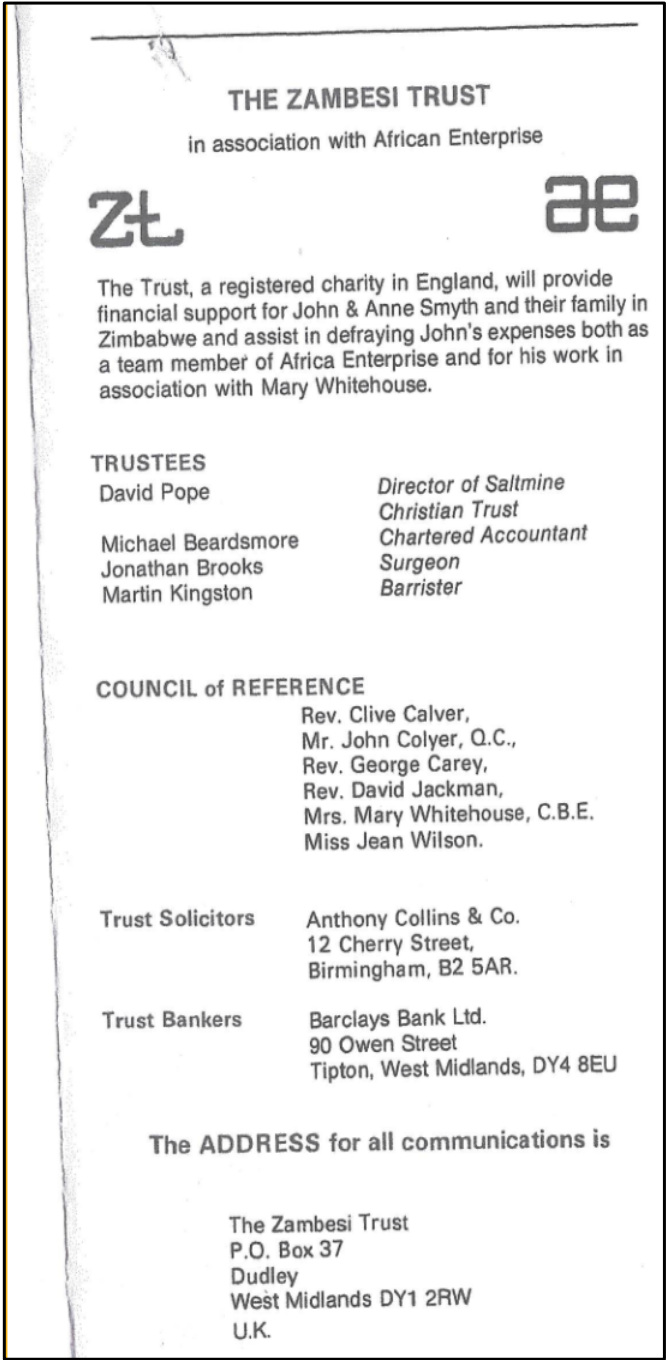
Colyer had a moral duty in his own right, as a public supporter of Smyth, to properly investigate Thorn’s revelations. But he also had a duty to do so on behalf of the LCF, because Smyth was scheduled to speak at an LCF conference later that year: “John Smyth … asked [Colyer] if he should still go ahead with a planned talk at an LCF conference in September 1989” (MR, 13.1.42). Colyer seems to have put that question to his fellow LCF leaders, because the Makin Review states, “The decision was made by the LCF to not go ahead with John Smyth as a keynote speaker at the conference, in light of the publication of [Thorn’s] book” (ibid., emphasis added).
It’s unclear how much Colyer and the other leaders of the LCF discovered about Smyth in 1989. (It would be interesting to know what was said at their meeting on 13 April 1989, which was when “LCF discuss[ed] John Smyth’s attendance at LCF conference in Birmingham in September”, MR, p. 125.) But they undeniably had sufficient alarm to cancel his upcoming talk at their conference, and they could have followed up those concerns by gaining detailed knowledge, which was within reach (see CR, 20). The LCF leaders now knew Smyth was the barrister named in Thorn’s memoir. They were high status evangelicals who could have worked their contacts in the small world of British evangelicalism to quickly arrive at David Fletcher and the Ruston Report (as the LCF would later do in 2003). Just five years after Smyth’s exit from Britain, and three years before the death of Guide Nyachuru, these legal insiders had an opportunity to pursue justice which they failed to take.
Fourteen years later, in 2003, the LCF had another chance to report Smyth to the police. Smyth had recently moved to South Africa, and the criminal charges in Zimbabwe seemed to be safely behind him. He initiated contact with an LCF leader, suggesting they could meet for lunch in three months’ time when he visited Britain (AMR, p. 136). Smyth had recently been appointed National Director of the Christian Lawyers’ Association of South Africa (AMR, p. 135), and he may have envisaged some kind of partnership between CLASA and the LCF (“have just taken a voluntary job which ties in with the UK LCF”, AMR, p. 136).
To begin with, these overtures had the desired effect. The LCF leader said, “I was initially very impressed with him and circulated his name to other members of the National Committee as a possible speaker at a future event. However I soon discovered that John Smyth was not who he seemed” (AMR, p. 137). Evidently, someone alerted the LCF National Committee to the abuse in Britain 20 years earlier. An investigative process then followed, which resulted in an internal memo titled “Individuals and Organisations That Bring the LCF into Disrepute” (AMR, 137–48).
The LCF memo includes a significant amount of information about Smyth’s abuse: “Mr Smyth would give beatings of 100 strokes for masturbation, 400 for pride and one of 800 strokes for some undisclosed fall. Although these beatings began with the victim semi naked the custom gave way to complete nakedness”. The memo notes that when Smyth moved to Africa he broke an undertaking not to work with young people again, and several details are included from the Coltart Report on Smyth’s abuse in Zimbabwe: “a. He made the boys swim in the nude at night; b. He would walk around the boys’ dormitory in the nude; he would stand watching boys’ showering in the nude, handing out soap. He would also pray in the nude; c. He administered beatings with table tennis bats: one boy reported being beaten 45 times with a [table tennis bat]; at least 2 boys had [table tennis bats] broken on their backsides.”
The purpose of the memo was to justify revoking Smyth’s membership of the LCF: “John is not a fit person to be a member of the LCF in the absence of any true repentance from these activities. John’s continued membership of the LCF can only damage the Fellowship in the eyes of anyone who is aware of John’s past.” Tragically, the memo doesn’t discuss whether Smyth should be prosecuted, even though it does note the possibility that he could have been prosecuted in 1982: “John Smyth gave a signed undertaking … not to engage in further work with young men and also agreed to leave the United Kingdom … In return he was not prosecuted for his activities.” Nor does the memo discuss the possibility of exposing Smyth via the media. It would take a further 14 years before media exposure finally brought about the decisive breakthrough.
By 2003, the LCF knew that Smyth had reoffended after he’d moved from Britain to Zimbabwe. He was then 62 years old and nothing was stopping him from abusing boys and young men all over again in South Africa. (Evidence gathered by Channel 4 News shows that, for the rest of his life, Smyth kept engineering voyeuristic situations such as skinny-dipping, where young men would be pressured to be naked in his company.) It’s also noteworthy that by 2003 the global cascade of Roman Catholic child abuse revelations was fully underway and impossible to ignore. The dangers of letting a child abuser go free were widely understood.
Protecting future victims is only one of the reasons why the LCF should have taken steps that might have led to prosecution. It’s deeply disappointing that the leaders of this group of Christians engaged in legal work didn’t see the need for justice. The Bible expects Christians to bring “the fragrance of life” (2 Cor. 2:16) to all they do. It’s a fragrance that comes from diligently serving other people in accordance with Christ’s will. When that hasn’t happened, the fragrance of life is restored through humble repentance, not defensiveness. The LCF should address its failings and publicly apologise.
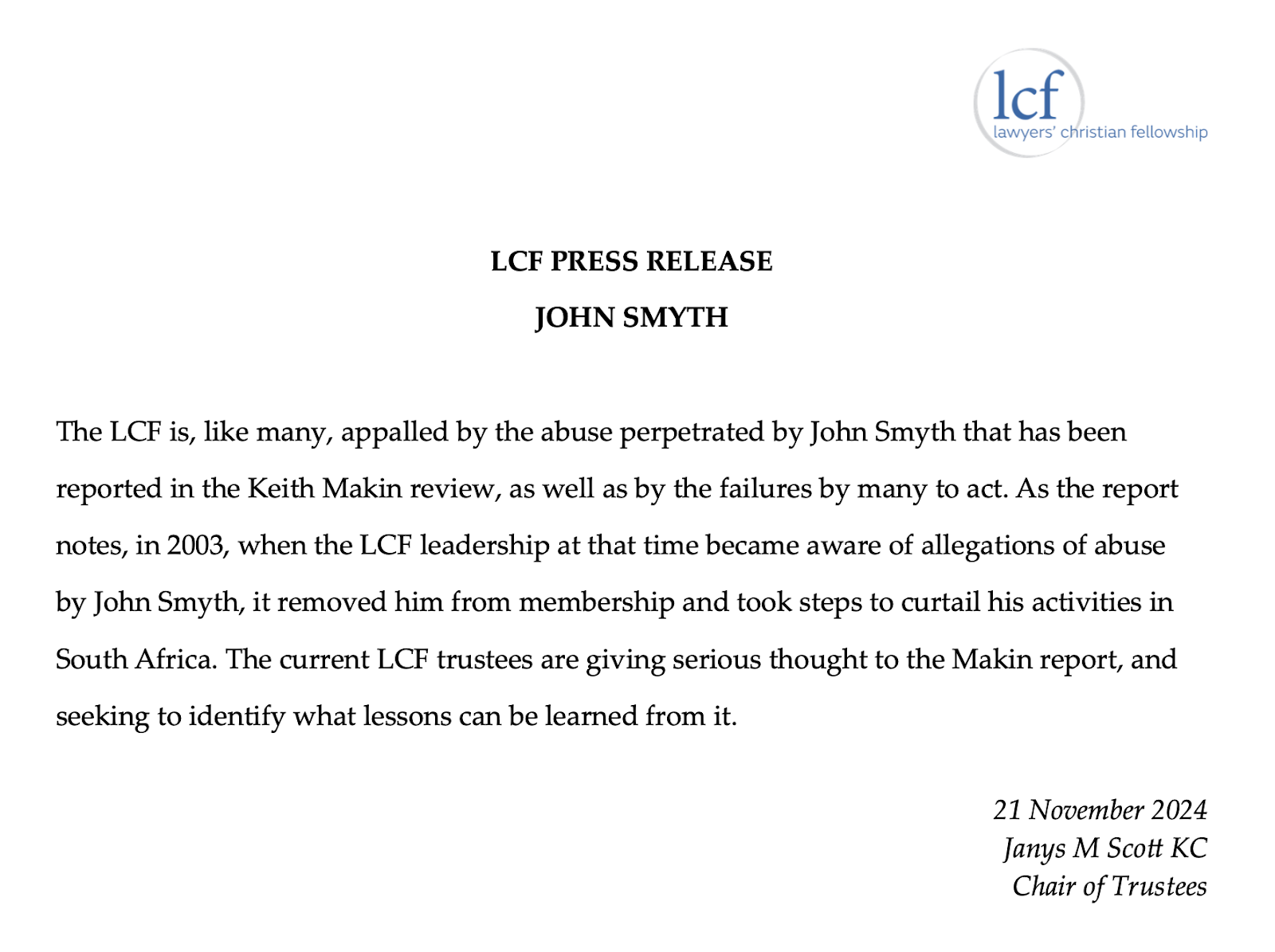
Note: In a 2017 Telegraph article about the Smyth scandal, the LCF denied any knowledge prior to 2003 of Smyth’s abuse, and failed to apologise for its insufficient actions in 2003. In a 2024 statement, the LCF remained unapologetic and completely ignored the information in the Makin Review about LCF decision-making in 1989.
Before publishing this article, I corresponded with the LCF and received an additional statement, which was also entirely unapologetic. The statement says, “It is evidently a mistake to draw a line between what may or may not have been known by a small number of individuals in the LCF, and what was known or should have been done by the membership at large”. That’s true, and I corrected the draft of this section on the LCF accordingly. However, the LCF as an organisation is accountable for the actions of its representatives. The most recent LCF statement also cites several actions taken in 2003 to “curtail [Smyth’s] activities in South Africa”. While commendable, those actions weren’t adequate because Smyth wasn’t reported to the police.
Both the 2024 and 2025 statements say the LCF is “appalled … by the failures by many to act.” Why isn’t it appalled by its own demonstrable failures to act?
Unapologetic Individuals
The leaders who initiated the cover-up are now deceased, with the exception of Jonathan Fletcher (who was himself disciplined for abuse, and is due to stand trial in May 2026, charged with eight counts of indecent assault and one of grievous bodily harm); and Roger Combes (who claims he “held [the Ruston Report] unopened on his knee, realised the seriousness and the nature of the report and chose not to read it, handing it back to Mark Ruston, unread [MR, 12.1.34]” – thereby abdicating his responsibility to handle the disclosure rightly, which effectively made him complicit in the cover-up).
Later in the 30-year period of silence, other conservative evangelical leaders gained knowledge of Smyth’s abuse and also failed to respond rightly. There’s an important sense in which the cover-up wasn’t their cover-up. They didn’t make the original choice not to report Smyth. They’re not as guilty as the Iwerne inner circle that made the key decisions in 1982. But they could and should have acted differently, and they should now apologise.
The main reason for apologising is to seek reconciliation with the victims. As said above, apologies would need to be made in a public statement in order to reach the British and African victims whose identity has been kept secret. A proper apology will acknowledge specific wrongdoing, whether intentional or unintentional, and ask for forgiveness. Biblically speaking, before the sinned-against person forgives the offender, the offender should personally express repentance (Luke 17:3–4). The offender should drop everything to actively seek reconciliation (Matt. 5:23–24). A good introduction to biblical forgiveness is Kevin DeYoung’s article “Following Up on Forgiveness”.
Apologising is also necessary so the individuals at fault can maintain their Christian integrity. The gospel calls for faith and repentance. How can these Christian leaders preach the gospel with integrity if they’re not willing to demonstrate repentance themselves?
A third reason for publicly apologising is to explain what ought to have been done differently. An apology has educative power because it shows others what they should do if they ever find themselves in a similar situation. In contrast, refusing to apologise sends the false, dangerous message that failing to report abuse is an insignificant oversight.
The three individuals below don’t represent an exhaustive list. They’re discussed because they’re well known in the conservative evangelical movement and because they exemplify the lack of apologetic contrition that’s such a deeply troubling feature of the scandal.
David Jackman
In assessing David Jackman’s role in the scandal, it’s helpful to bear in mind comments from John Stevens (the most senior figure on evangelicalism’s nonconformist wing) about the culpability of Justin Welby. After the Makin Review was published, Stevens strongly implied that Welby should resign as Archbishop: “It is hard to see any justification why he should remain in post given the loss of his moral authority. His account of his knowledge prior to 2013 is unconvincing, and his failure to act appropriately after he was fully aware of the nature of Smyth’s abuse indefensible.”
After Welby resigned, Stevens told FIEC’s podcast, “[In] 2013, victims were beginning to come forward and the church did not do enough to pursue that, and actually Makin concludes that the Archbishop of Canterbury had a responsibility to do more, that he in a sense was morally, personally accountable. … Makin finds that essentially Smyth continued to abuse from 2013 up until even his death in 2018 so the failure to act in 2013 in and of itself perhaps potentially enabled that to happen and I think that that made [Welby’s resignation] inevitable.”
That verdict on Welby’s failure to act appropriately is surely also applicable to David Jackman (about whom Stevens has said nothing). Jackman received a summary of the Ruston Report in mid-1983, which alerted him “to the extent and very serious nature of [Smyth’s] actions” (MR, 12.1.144–5). If Welby was culpable for not taking sufficient action in 2013, how much more culpable was Jackman in 1983, when responsible action could have prevented all of Smyth’s abuse in Africa? What’s more, Welby was actually told in 2013 that the police were “handling” the Smyth case (MR, p. 174, entry for 9/8/13). Jackman, on the other hand, had no such assurances, and he smoothed Smyth’s path to Africa by commending him to Africa Enterprise (MR, p. 121, entry for August 1984) and joining the Council of Reference for Smyth’s fundraising charity (MR, 12.1.155), even though he’d banned Smyth from attending his own church (12.1.84).
To continue the parallel between Welby and Jackman, Welby’s account of his pre-2013 knowledge of Smyth’s abuse was, according to Stevens, “unconvincing”. But Jackman’s testimony to Andrew Graystone, the author of Bleeding for Jesus, is even less plausible: “When interviewed, he told me that he cannot remember seeing or hearing anything about John Smyth’s abuse, and that he was not involved in facilitating his move to Zimbabwe” (BFJ, 1st ed., p. 272). Jackman later gave completely different testimony to Keith Makin, presumably because evangelical leaders who hadn’t spoken to Graystone were now cooperating with Makin, and their evidence made it all but impossible for Jackman to continue claiming ignorance.
Jackman remains active in evangelical ministry – his book Proclaiming the Word was published in September 2024 and he serves as one of two “overseers” for a central London church. I recently exchanged emails with him, and he confirmed that I had the correct email address. When I then asked, in a very respectful way, if he was willing to apologise for his role in the Smyth scandal, he never replied.
It’s difficult to speak critically about a man in his old age who’s widely admired throughout conservative evangelism. I can easily understand why John Stevens and FIEC have preferred silence. But silence serves no one’s interests, least of all the victims of the abuser whom Jackman helped to emigrate.
Stevens says he has read both Bleeding for Jesus and the Makin Review, and he must surely have paid close attention to the role played by Jackman, a renowned nonconformist leader. It’s hard to avoid the conclusion that Stevens and the wider evangelical establishment aren’t willing to criticise Jackman because he – unlike Welby – belongs to their own circle. This is the kind of objective inconsistency that causes non-evangelicals to accuse evangelicals of hypocrisy. It must be addressed by John Stevens and the FIEC council members to whom he’s accountable. As it says in Proverbs 20:23: “The Lord detests differing weights, and dishonest scales do not please him.” The test facing the British conservative evangelical movement is whether it will pursue righteousness, purity, and godliness, even when that means criticising eminent leaders.
Vaughan Roberts
The cover-up of Smyth’s abuse can be pictured as a circle containing a series of concentric rings. The innermost core represents those who didn’t report Smyth in 1982. Around that core, there are rings representing all those who came to know of the abuse, and yet didn’t expose Smyth or report him to the police. Those with the most knowledge and the most power belong in the ring closest to the centre; those with the least knowledge and least power belong in the outermost ring. It obviously wouldn’t be right to attribute the same blame to everyone in the circle. Blameworthiness increases the closer someone is to the centre.
Discussing Vaughan Roberts’s blameworthiness in the Smyth cover-up is difficult because it’s hard to know where to place him in the circle. Roberts indisputably knew that a lawyer had caused a scandal at Winchester College by combining Christian discipleship with physical punishment. That knowledge was gained from John Thorn’s memoir, which Roberts has admitted reading. He’s also admitted having “vague” conversations about the abuse before 2017. Moreover, Roberts’s testimony to the Makin Review indicates he already knew, before 2017, that the lawyer’s name was John Smyth (MR, 15.1.94), a point that’s never been denied by Roberts or St Ebbe’s. Lastly, Roberts knew the Iwerne-linked group at Winchester was banned for decades from meeting on school property, which was both an ongoing reminder of Smyth’s abuse and an indication of its seriousness. As for power, Roberts was a trustee of the Titus Trust from 2001 to 2007, and by 2001 he was the senior minister of St Ebbe’s Church.
Roberts, therefore, was well positioned to track down information about Smyth and take action. Readers who aren’t old enough to remember the early 2000s may not appreciate how, in the words of the Guardian, “the magnitude and repercussions of abuse in the Catholic church … created shock waves around the world”. With those shock waves in the background, Roberts should have made sure Iwerne had properly reported Smyth’s abuse. It’s profoundly disheartening that he hasn’t yet apologised for failing to do that.
Roberts might say it never occurred to him to raise questions about Smyth with his fellow trustees. That’s an explanation, but it’s not an excuse. Unawareness of our own moral shortcomings – such as responding negligently to abuse – doesn’t stop them being shortcomings. When we’re made aware of them, we should repent, apologise, and pray for help. Spiritual growth comes when we realise we’re probably committing many sins that we’re not yet aware of (Psalm 19:12).
Everything said above is already enough to show that Roberts is one of the unapologetic leaders who need to address their failings. But Roberts’s knowledge of the abuse may have been more extensive than he’s admitted, which would place him even closer to the innermost circle and would also raise doubts about his honesty. Evangelicals instinctively wish to trust their leaders without questioning their conduct, but that’s the mindset that maintained the Smyth cover-up for more than 30 years. In the wake of that scandal and others, no one should be ashamed to call for greater transparency and openness in our movement. For that reason, it’s not wrong to question Roberts’s account of his knowledge of the abuse.
Roberts was a pupil at Winchester College. He began his final year at the school in September 1982, which was when Smyth was banned from the premises (MR, p. 70, entry for 13/9/82). So, while not a victim himself, he understood the context of the abuse. At least two of his close associates have publicly acknowledged being victims. Roberts was also on close terms with some of the leaders most at fault for the cover-up: the Fletcher brothers, David Wilkinson, Peter Wells, and Mark Ashton. Perhaps most significantly, Roberts served from 1991–98 as the Curate of St Ebbe’s Church while David Fletcher was the Rector. In 1993, Fletcher corresponded with David Coltart, a lawyer who investigated the abuse at Smyth’s Zimbabwean camps; Fletcher also allegedly visited Smyth in Zimbabwe that year (MR, p. 130, entry for 27/5/93). It would have been natural for Fletcher, who didn’t keep information about Smyth tightly guarded (MR, 12.1.123), to share the Zimbabwean developments with Roberts, a Iwerne man working alongside him, who already knew some of the facts about Smyth’s abuse in Britain.
A year ago, I asked Roberts what, if anything, David Fletcher had told him about Smyth, along with a number of other questions about his knowledge of Smyth’s abuse. He brought his churchwardens into the correspondence, and they said, “We have encouraged Vaughan not to engage with bilateral questions outside of the formal channels [i.e., the National Safeguarding Team].” This meant Vaughan wasn’t just refusing to answer questions from me, he was refusing to answer questions from anyone outside the Church of England authorities. The questions he wouldn’t answer can be seen at the end of a post titled “St Ebbe’s and the Smyth Scandal: An Inadequate Response”. A year later, they remain unanswered.
The response from St Ebbe’s was disappointing for two reasons. First, it’s disappointing that St Ebbe’s privileged the non-evangelical NST above Roberts’s fellow evangelicals. As discussed above, the Bible expects Christian judicial matters to be handled by trustworthy believers.
Second, it’s suspicious when someone refuses to answer clarifying questions. Generally speaking, if people have nothing to be ashamed of, they don’t mind fielding questions about their conduct. The Bible says the “open statement of the truth” is commendable “to everyone’s conscience” (2 Corinthians 4:2).
Sadly, Roberts’s silence is particularly problematic because evidence already exists suggesting he’s not sufficiently careful in his communication about the scandal. In 2024, after the publication of the Makin Review, St Ebbe’s released a statement about Roberts’s knowledge of Smyth’s abuse. Roberts didn’t write it, but he was ultimately responsible for it as the church’s senior minister. It says, “Vaughan read his headmaster’s autobiography, which … implied the facts were already widely known by those in authority.” In reality, Thorn’s book implied the opposite. As the Winchester College Review had observed in 2022, “It is clear from the description in The Road to Winchester that John Thorn was aware that Smyth had left the UK after the disclosure, that he had not been referred to the authorities by the school, that his abuse was not generally known to the public and that he was operating without any restrictions on his future involvement with children” (WCR, p. 104). What would the members of St Ebbe’s have thought if that sentence from the Winchester Review had been included in their church’s post-Makin statement?
Trusting our leaders without asking uncomfortable questions is what allowed the Smyth cover-up to go on for as long as it did. Roberts should accept that such questions are necessary and answer them.
Rico Tice
Rico Tice is a well-known evangelist and author. At the age of 20, he was told about Smyth’s abuse by the Winchester College teacher Peter Krakenberger, whom Tice knew through Iwerne: “Reverend Rico Tice (prior to his ordination) was told of the abuse by Peter Krakenberger in 1987, when he came to see him at his flat, with four to five flatmates present. Peter Krakenberger said that he wanted the abuse ‘out’ and known and he went into some detail about the scale and the nature of the abuse” (MR, 13.1.25, emphasis added).
Several years later, in 1991, Tice took part in a Church of England selection conference, where he was “asked by Reverend Martin Seeley … about John Smyth” (MR, ibid.). The Makin Review doesn’t include Tice’s response to Seeley, but Tice has indicated in a personal statement that he told Seeley what he knew. It was commendable for him to give information about the abuse to a Church of England clergyman, but it should be noted that Seeley never said he would pursue the case.
Tice also says in his personal statement that in the years preceding the selection conference, “I had reported what I knew to senior people in the Iwerne camp hierarchy more than once.” Again, this was commendable. However, far from promising him that they would take suitable action, those Iwerne leaders made it clear to him that he was expected to stay silent.
When I spoke with Tice about these things in a three-way video call with Kevin Appleton, the Chairman of Christianity Explored Ministries, Tice said he’d found out in the 1990s that Smyth had continued his abuse after moving to Zimbabwe. This showed that no one had stopped Smyth. But Rico made no further disclosures about the abuse until Channel 4 broke the story in 2017.
In sum, Tice had never received assurances that his disclosures would be followed up, and he knew Smyth had kept on abusing. Wouldn’t any safeguarding expert say he should have done more with the information he had?
I’m writing with a heavy heart, because Rico was very kind to me when I was a teenager and at other times in the years since. I take no pleasure in criticising him. But sometimes, out of loyalty to Christ, it’s necessary to criticise friends. When the Makin Review was published, evangelicals rushed to criticise Justin Welby for his conduct relating to Smyth, without criticising Rico for his failure to pursue the case. Doing the former but not the latter can justly be described as hypocrisy.
John Stevens’s criticisms of Welby, quoted above, bear repeating: “Makin concludes that the Archbishop of Canterbury had a responsibility to do more, that he in a sense was morally, personally accountable. … Makin finds that essentially Smyth continued to abuse from 2013 up until even his death in 2018 so the failure to act in 2013 in and of itself perhaps potentially enabled that to happen and I think that that made [Welby’s resignation] inevitable.” Welby, it should be remembered, had been assured that the police were handling the Smyth case (MR, p. 174, entry for 9/8/13). He was at fault for failing to pursue justice with the necessary tenacity. How is it possible to criticise Welby for that and not criticise Tice? The parallel between the two leaders isn’t exact, so I don’t necessarily think Tice should resign, but surely he should at least apologise for dropping the matter instead of tenaciously pursuing it.
Another way to think about Tice’s involvement in the scandal is to ask what kind of precedent evangelicals want. If Tice continues in ministry without apologising, the takeaway for evangelicals would be that disclosing abuse is sufficient in itself, even without any assurances of follow-up, and even when the abuse is known to have continued. That’s not how safeguarding should work. Tice’s denomination and his fellow evangelical leaders should urge him to apologise so that a health-giving precedent is set.
In the Makin Review, a safeguarding adviser called Yvonne Quirk offers the following apology for dropping her efforts to contact counterparts in South Africa: “I recognise now that what I should have done was step back, take a proper break from the case and then return fresh to my part of the fight. But I did not. I fully accept the criticism levelled at me in that regard. To the victims of JS, I apologise directly and unreservedly for that. I am so very sorry. You deserved better” (MR, 14.3.16). That’s the kind of precedent-setting apology we need to hear from Rico Tice.
Final Thoughts
Sol Price, the American businessman who pioneered Costco-style discount shopping, once wrote to employees, “You must feel confident that you are working for a fine and honest company.” How much more important is it for British evangelicals to feel confident that we belong to a fine and honest movement? But it’s doubtful whether that’s currently true. To take the Smyth scandal alone, evangelical leaders have: criticised Justin Welby while not mentioning the comparable misconduct of fellow evangelicals; avoided seeking key information from the one organisation member most likely to have it; communicated misleading information about their own knowledge of Smyth’s abuse; and, in numerous cases (more than the few discussed above), failed to apologise for what everyone knows they got badly wrong. Who would describe this state of affairs as fine and honest?
The saying “See no evil, hear no evil, speak no evil” – usually paired with a picture of three monkeys covering their eyes, ears, and mouth – isn’t biblical. The kingdom of God doesn’t benefit when Christians avoid awareness of our fellow believers’ wrongdoing. In fact, that unbiblical approach is associated with some of the worst periods of church history, such as the centuries-long brutal racism that marked America’s southern states, where Christian faith was widely professed. When everyone says, “It’s not my responsibility to do something about it,” nothing gets done about it. The sad irony here is that the “see no evil” mindset keeping evangelicals from tackling our shameful response to the Makin Review is the same mindset that sustained the 30-year cover-up of Smyth’s abuse. We cannot allow this to continue.
This is an “in-house” article for evangelicals, but I’m conscious that some of Smyth’s victims may read it. Once again, I’m personally very sorry that I didn’t raise questions about the information I was given. Week after week, as I’ve written this article, you’ve been in my thoughts. Evil engulfed you, through no fault of your own. I hope and pray for your continued healing.
Revd Nick Howard
Note: In Matthew 18:15–20, Jesus calls for personal interaction between believers in a private dispute. This article, in contrast, is about the public response of conservative evangelicals to the Makin Review. For that reason, I haven’t corresponded personally with every individual mentioned in this article (I did contact Vaughan Roberts, David Jackman, and Rico Tice). The rights and wrongs of publicly criticising fellow Christians are helpfully discussed by D. A. Carson in his article “Editorial on Abusing Matthew 18”.
I welcome any corrections that readers might wish to send me, either by commenting on this post or by using the Contact page of this site. All corrections made will be noted at the end of the article.
Correction
Following correspondence with Church Society after the publication of this article, I’ve adjusted one paragraph.
The previous version said: “If Gatiss had sincerely wanted to find out what his organisation had known about Smyth, surely it would have made sense to ask Joynson-Hicks instead of the new president who’d only been in the role for nine months? By excluding Joynson-Hicks from his enquiries, Gatiss may have been choosing not to discover what he didn’t want to know.”
The new version says: “If Gatiss had sincerely wanted to find out what his organisation had known about Smyth, surely it would have made sense to ask Joynson-Hicks what he knew? By failing to ask that question, Gatiss may have been choosing not to discover what he didn’t want to know.”
The reason for this change is that Church Society states that it did contact Joynson-Hicks in 2017, asking him: “Are you aware of any association CS may have had with Mr Smyth, especially in the late 70s and early 1980s – whether financial dealings or membership/committees etc? In particular, for those who have been around a while, do you know whether Church Society was made aware of Mr Smyth’s behaviour at any time by members of the Iwerne Trust?” He replied that he had “no recollection of Church Society being involved with John Smyth.”
However, it’s never been alleged that Church Society had dealings with Smyth or that its council or membership were collectively made aware of Smyth’s conduct. The allegation has always been that its representative, Crispin Joynson-Hicks, was told about Smyth’s abuse and didn’t report it. Church Society hasn’t denied that, and so the allegation still stands.
Due to the nature of representative leadership, Church Society should address this. By virtue of his leadership role in the organisation, Joynson-Hicks has undeniably brought Church Society’s name into the scandal. It’s extraordinary that even after Church Society was explicitly named in the 2021 Titus Trust documents and in the 2024 Makin Review appendices, it still hasn’t addressed the question of its former president’s knowledge of Smyth’s abuse.


 sixty guilders

Leave a reply to Bob Cancel reply