This is a completely updated version of a previously published article.
The Makin Review, which was published in November 2024, showed that many Christian leaders failed to act rightly in response to John Smyth’s abuse of boys and young men.
Smyth’s criminal misconduct is summarised in the review as follows: “John Smyth was an appalling abuser of children and young men. His abuse was prolific, brutal and horrific. His victims were subjected to traumatic physical, sexual, psychological and spiritual attacks. The impact of that abuse is impossible to overstate and has permanently marked the lives of his victims.” The abuse was first disclosed in 1982, but the police weren’t informed until 2013, and Smyth died in 2018 shortly after he was summoned for questioning. For three decades, he had been protected by the silence of Christian leaders.
The failure to report Smyth not only meant that he evaded justice, it also enabled him to abuse many additional victims after he moved to Africa. A 16-year-old boy named Guide Nyachuru died in highly suspicious circumstances at a Smyth-run camp in Zimbabwe in 1992. The Smyth scandal bears comparison with the worst examples of Roman Catholic abuse scandals, both in the nature of the abuse itself and in the negligence of leaders who knew about it but didn’t report it.
Unrepentant Christian leaders
Since the Makin Review was published, very few British Christian leaders have publicly admitted personal wrongdoing in connection with the scandal. Although Justin Welby resigned as Archbishop of Canterbury following the review’s publication, he effectively protested his own innocence when he told the House of Lords, in a conspicuously lighthearted speech, that sometimes resigning is necessary “whether one is personally responsible or not”.
From a Bible-believing perspective, what’s most disturbing is that none of the conservative evangelical leaders who failed to report Smyth have apologised. It’s the absence of their personal apologies that explains the title of this article.
Apologies don’t remove the need for due discipline. An apology unaccompanied by necessary discipline is worse than silence. Nevertheless, the absence of apologies from conservative evangelical leaders is in itself a striking phenomenon. It instantly shows the lack of true accountability in what is primarily a conservative evangelical scandal.
This article will refer to the Makin Review as “MR”; the Appendices to the Makin Review as “AMR” (page numbers refer to the 245-page PDF file); the Winchester College Review as “WCR”; the Titus Trust Documents as “TTD” (page numbers refer to the 26-page PDF file); the Titus Trust Culture Review as “TTCR”; the executive summary of the Scripture Union Review as “SUR”; Bleeding for Jesus (2nd ed.) by Andrew Graystone as “BFJ” (page numbers refer to the Kindle edition); the Coltart Report as “CR”; and the Ruston Report as “RR” (I don’t know who wrote the introductory note in the linked copy). Citations refer to section numbers where possible.
These sources – like any sources – may not always be accurate. For example, I think the Makin Review is mistaken when it says there’s little evidence that Smyth was forced to emigrate (see the relevant section below). But the sources listed above, together with national media reports and the documentary See No Evil, constitute the public record. For that reason, we must assume they’re accurate unless evidence exists to the contrary. Anyone with evidence disproving claims made in this article is welcome to send it to me via my contact page. I’ll then revise the article accordingly and note any major corrections at the end.
A previous version of this article can be read via this link. It was replaced by this updated version in June 2026. Among many other changes, the article now includes a section about the Titus Trust and a completely rewritten section about Church Society. Although the article is long, I hope readers will find each section necessary and as concise as possible. The following links can be used to jump to particular sections.
A Conservative Evangelical Cover-Up
A Personal Apology from the Author
The Inadequacy of the Church of England’s Judicial System
Unapologetic Conservative Evangelical Organisations (Introduction)
The Lawyers’ Christian Fellowship
Unapologetic Individuals (Introduction)
A Conservative Evangelical Cover-Up
Smyth groomed his British victims through several connected conservative evangelical ministries: the summer camps known as “Iwerne” (pronounced “U-ern”); a Christian group at Winchester College; and university Christian Unions.
While Smyth had no formal role in the latter two ministries, he did hold an appointed position within Iwerne. During the years of his British abuse (1977–82), he chaired the Iwerne Trust, a charity that funded the salaries of Iwerne staff members (TTD, p. 3). One of Smyth’s victims has explained that Iwerne was the common thread in Smyth’s abuse because his “position at Iwerne, his status as a leader at Iwerne, gave him the respectability, the platform” (TTD, p. 14). The Makin Review similarly concludes, “There is little doubt that his leadership role in the Iwerne Trust provided him with an opportunity to groom and abuse his victims. He used his position in the Iwerne Trust and camps to influence others to allow him to have uncontrolled, regular contact with victims. … The connections, the networks, the opportunities, and the power he obtained through Iwerne gave him licence to operate in the way that he did and helped as a cover to legitimise his actions” (MR, 11.3.57; see also WCR, pp. 148–149).
The people to whom the abuse was first disclosed were all closely associated with Iwerne (MR, 12.1.33). Mark Ruston, vicar of the Round Church in Cambridge from 1955–87, compiled a report on the abuse and sent it to a small group of his fellow Iwerne leaders on 6 March 1982 (MR, p. 65). The Ruston Report stated that Smyth’s beatings were “technically all criminal offences under the Offences Against The Person Act of 1861, Sec. 47” (RR, 3). It established that Smyth had abused boys as well as young men (RR, 3; see also MR, 6.2.1), and it included graphic descriptions of Smyth’s savage brutality (RR, 6).
The leaders who received the report didn’t minimise the horror of the abuse. One member of the group, John Eddison, replied to Ruston on 8 March, “Your letter reads like some mediaeval report from the Inquisition. I have never heard anything like it” (AMR, p. 96). However, right from the start, they chose to cover up the abuse, rather than pursuing justice by reporting it to the police.
In that 8 March letter, for example, Eddison said, “Did [Smyth] never pause to ask himself what effect his actions would have if they ever became known on the men themselves, on camp and on his own career? … We still don’t know how far this matter has spread … there is always the risk (which again John must have been mad not to have foreseen) that one of these young men would backslide and spill all the beans.” Eddison was plainly alarmed about the possibility of the facts coming to light, rather than wanting justice to be done.
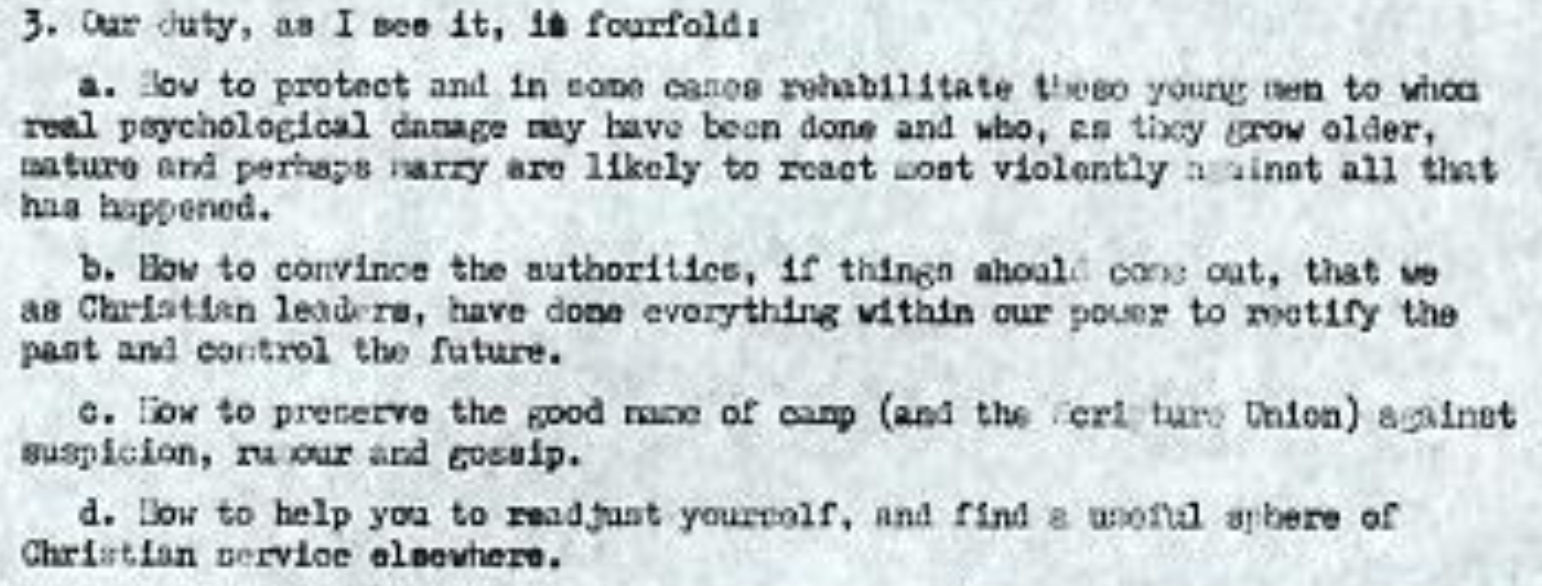
A month later, on 7 April, Eddison wrote to Smyth himself, telling him what he considered to be the Iwerne group’s fourfold duty (AMR, 110; excerpt copied below). Among other signs that a very deliberate cover-up was by then underway, Eddison raised the possibility that they would need to defend themselves “if things should come out”. Later in the letter he discussed a possible “excuse for your non-appearance at camp”, which of course would only be necessary because the Iwerne group had decided to conceal the real reason.
Dick Knight, another member of the Iwerne group, proposed on 23 March that the abuse should be kept secret from “parents, Scripture Union Council, even school authorities” on condition that Smyth cooperated with restrictions on his activity (AMR, p. 107).
On 25 March, six members of the Iwerne group signed a letter to Smyth saying, “We are genuinely concerned to help you: but you will, we are sure, realise that in remaining silent about this matter we are taking a risk: for by failing to report what has happened to parents or school authorities or the S.U. Council, we could be accused of covering up something which is actionable. It is, therefore, imperative that you agree to abide by the conditions we have outlined” (MR, 12.1.79). This admission that silence could be seen as “covering up” Smyth’s abuse is highly significant. The Iwerne leaders’ description of the abuse as “actionable” – a technical term for misconduct worthy of legal action – is also an important indication of their awareness of what they were doing.
By April, the Iwerne circle had evidently decided it was necessary to inform Scripture Union, the organisation that was nominally in charge of Iwerne. But the Scripture Union Review casts doubt on whether that disclosure was “full and frank” (SUR, p. 7, 6.5).
At a meeting on 29 June, nearly four months after receiving the Ruston Report, the Iwerne circle agreed not to tell Winchester headmaster John Thorn about Smyth’s abuse unless a particular victim’s father sought information from a certain Iwerne leader (WCR, p. 56). This was despite the fact that Smyth’s access to Winchester College had allowed him to groom multiple victims, and he was still living near the school. The Makin Review says, “The entire concentration of effort at this point is seemingly preventing a ‘leak’ of information” (MR, 12.1.110; see also 12.1.112).
Plainly, these Iwerne leaders were committed to covering up the abuse. It’s also clear that protecting “camp” – their shorthand for the Iwerne ministry – was one of their chief concerns. The letter sent to Smyth on 25 March said “We are acting not only in the interests of the men concerned and camp generally, but also in your own interest” (MR, 12.1.79, emphasis added). Eddison’s 7 April letter spoke of the importance of preserving “the good name of camp” (AMR, 110). A memo written shortly after the 29 June meeting justified the ongoing secrecy by saying “we felt that such information would soon be passed around and would damage Camp” (WCR p. 56).
At some point during these early months, a senior Iwerne leader treated Andy Morse, one of Smyth’s victims, to a meal at an Indian restaurant. In the documentary See No Evil, Morse says, “Towards the end of the meal he suddenly became quite serious, and he leant forward, and he said to me, ‘Andy, I want you to know that John Smyth will be held to account for what he has done. But the reputation of Iwerne is sacrosanct, so let’s keep this between ourselves.’”
One reason why criminal offences should be reported immediately is so the police can gather evidence. Smyth had time to remove incriminating evidence such as his canes and the adult nappies that stopped the victims’ blood from soaking their clothes (MR, 12.1.51). Another reason for swift reporting is to prevent offenders from leaving the country, as Smyth did in 1984. When the police were finally informed, 30 years later, their initial response was influenced by both of those considerations: “for legal reasons they felt there was insufficient evidence, especially after all this time, to get through the hoops for investigation and possible extradition” (TTD, p. 10, emphasis added). As a general rule, certainly applicable in this case, those most to blame for not reporting criminal abuse are those who fail to take the earliest opportunity to report it.
Knowledge of the abuse spreads
Six months after the abuse was first disclosed, events finally forced the Iwerne group to tell John Thorn about Smyth. Peter Krakenberger, a Iwerne-linked teacher at Winchester, had been obliged to disclose the facts to one of the Winchester housemasters. A letter from Eddison to Ruston sent on 13 September 1982 explains what happened next: “This meant that Thorn too must be told, the only question was by whom. In the event Mark Ashton was the obvious man, and he goes there today” (WCR, p. 61). Ashton was a clergyman associated with Iwerne who had served as a Winchester College chaplain from 1977 to 1981 (WCR, pp. 20, 53).
A contemporaneous letter from Krakenberger shows that Thorn was persuaded to cooperate with Iwerne’s cover-up: “Thorn was put in the picture by MHA [Ashton] and myself, and I informed Hewitson [a housemaster]. Basically everyone’s reaction was magnificent & just what we could have hoped for. After the initial shock & horror, all parties are agreed that discretion is by far the best policy and that there is no merit in the information being spread any further” (WCR, p. 67).
Thorn wasn’t an evangelical, and other non-evangelicals were also informed in the years that followed (see MR, 12.1.122). But since the police were kept in the dark, it’s accurate to speak of a cover-up (MR, 1.5, 16.22–4, 16.29). That cover-up was chiefly managed by the conservative evangelical leaders of Iwerne (see, for example, MR, 12.1.10.l–m; 12.1.79; 12.1.162; WCR, p. 72, para. 2; SUR, p. 7, 6.4–6.5; p. 11, 6.29).
Additional conservative evangelical groups later came to be implicated in the cover-up through the failings of their representatives. Leaders from Above Bar Church (which belongs to the Fellowship of Independent Evangelical Churches) and the Lawyers’ Christian Fellowship were told about the abuse during the thirty-year period of silence, but didn’t report it to the police. The President of Church Society was most likely also informed and similarly kept silent. Their conduct, discussed in further detail below, shows that conservative evangelicals from different social and ecclesiastical circles were just as willing to engage in secrecy as the group at the scandal’s core. Those three organisations haven’t even publicly acknowledged, let alone apologised for, the alleged failings of their own representatives.
The novelist James Baldwin wrote, “Not everything that is faced can be changed; but nothing can be changed until it is faced” (a saying quoted by Dr Elly Hanson in her psychological profile of Smyth [AMR, pp. 67–84]). I’m writing this article because I think conservative evangelicals must face the Smyth scandal unflinchingly, and, as the rest of this article will show, that hasn’t yet happened.
Excuses Considered
The leaders who failed to report Smyth in 1982 were answerable to two organisations: the Iwerne Trust, whose work was later taken on by the Titus Trust; and Scripture Union. Both the Titus Trust and Scripture Union have accepted that Smyth’s abuse should have been reported (TTD, p. 2; SUR, p. iii; p. 7, 6.7).
However, despite those organisational admissions, individuals implicated in the scandal have often defended their inaction with excuses (see, for example, SUR, p. 7, 6.7). Such excuses persist to this day, which may explain why none of the evangelical leaders at fault have personally apologised. It’s therefore essential to analyse the main excuses that have been offered.
When considering these excuses, it should be kept in mind that the failure to report Smyth allowed him to continue abusing young people when he moved to Africa. The camps he ran in Zimbabwe became notorious for beatings that echoed the British abuse. As one Zimbabwean victim told the New York Times in 2017, “He would strip us naked and hit us with wooden bats to purge us of sin” (see also CR, B.33). So the excuses for inaction have a very high bar to clear: do they justify letting Smyth move to Africa with his crimes unreported and his reputation intact?
1. “The victims didn’t want the abuse to be reported.”
This excuse is baseless because the victims weren’t consulted. Commenting on the failure to report in 1982, the Makin Review says, “There is no attempt to consult with the victims as to their views on this. It is worth noting here that the victims were treated as ‘boys’ and are referred to as such. … These were, by this point not ‘boys’ but adult men, who were not given agency in this whole process” (MR, 12.1.10.g).
The Makin Review further states, “The objective evidence … is that it is most likely that only three sets of parents were consulted about this [reporting to the police] and that one of those sets of parents took the view that the ‘authorities’ should be informed” (MR, 12.1.113, emphasis added). This shows that it’s also baseless to say that the victims expressed a wish for non-reporting through their parents. Very few parents were consulted, and even those few weren’t unanimously in favour of non-reporting. Indeed, according to the Coltart Report, “Fathers of two of the boys involved … intended to instigate criminal proceedings. … The fathers were persuaded not to do so by the good efforts of ‘senior Christians’ who made personal visits” (CR, B.11).
The conclusion that victims weren’t consulted is backed up by the Winchester Review: “The reviewers have seen no evidence that the College contacted any of the victims when the abuse was disclosed in 1982. There is evidence that John Thorn held discussions with the fathers of a limited number of victims about how to respond to the disclosure of abuse. However, all of the victims and some of their parents were not consulted and were excluded from the decision-making process” (WCR, p. 99).
Even in a hypothetical situation in which all the victims unanimously rejected reporting, Smyth’s crimes should still have been reported (see the discussion in MR, 12.1.49–50). The need for reporting is demonstrated by Smyth’s later abuse of scores of African boys and young men. Any abuser has the potential to reoffend in the future and therefore must be constrained by the application of the law. The possibility of Smyth’s reoffending was understood at the time and explicitly raised in 1982 by a member of the Iwerne circle: “Dick and I talked about Smyth. His chief fear is that John could break out in this way again” (Letter from John Eddison to David Fletcher, WCR, p. 56).
Additional reasons for reporting an abuser regardless of the victims’ wishes include the importance of deterring others from committing similar abuse, and – from a Christian perspective – the need for divinely-authorised punishment (see Rom. 13:3–4 and 1 Pet. 2:13–14).
2. “Without victims willing to report their experiences first hand, no criminal charges could have been brought.”
This excuse presumes that none of the victims would have provided evidence, even if they’d been urged to do so by the judicial authorities. But we don’t know how the victims might have acted in that situation. It’s more than possible that some of them would have cooperated with the legal process. In a segment of See No Evil about the immediate aftermath of the 1982 disclosures, Mark Stibbe, one of Smyth’s victims, says that he expected to be interviewed by the police: “I assumed that I would at some point be asked by the police to give a testimony of my own experience as a victim but that never happened.” There’s no indication that he would have refused to cooperate.
What’s more, this excuse ignores the option of exposing John Smyth through the media, which most likely would have stirred up a reaction that led to legal proceedings, as it did in 2017. In such circumstances, with their institutions already at the centre of public attention, it’s conceivable that Winchester College teachers and Iwerne leaders would have given evidence, even if victims had been unwilling to testify. At the very least, public exposure would have made it impossible for Smyth to raise the donations that he needed for funding his life and ministry in Africa.
There’s no reason to think the 1980s media would have declined to run the story. In the years beforehand, scandals involving public figures such as John Profumo and Jeremy Thorpe had been widely covered in the British press. Smyth was a Queen’s Counsel known for his legal work on behalf of Mary Whitehouse, a high profile campaigner for Christian moral standards (WCR, p. 14). Any scandal involving “Mary Whitehouse’s lawyer” would undoubtedly have been considered newsworthy. There was huge national interest in the case in 2017, and the same interest would surely have been generated whenever the case came to light.
Informing the media was an option that occurred to at least one victim: “I wrote a very cursory [pseudonymous] letter to both of them [Smyth and David Fletcher] saying that I had become aware that John Smyth had been beating young men and that if it didn’t stop immediately the police and media would be told. I honestly thought that the threat of exposure would prevent John Smyth from beating me again” (MR, 12.1.15; the letter is reproduced in 12.1.22). While it’s understandable that victims may not in practice have wished to approach the media themselves, the victim’s letter shows that a media exposé wasn’t inconceivable at the time. The same conclusion can be drawn from a note sent to Iwerne group member Tim Sterry in 1988. The author, whose name is redacted in the Makin Review, says, “Miscreants should be brought to justice not sent abroad to save face; there they will no doubt find other victims. I am tempted to go public” (MR, 13.1.29–31).
The leaders who knew about the abuse – both at first and later on – could have gone to the media as a step towards bringing Smyth to justice, and as a means of stopping him from committing further harm. Although this might seem unrealistic (“Contacting journalists isn’t something Christian leaders usually do”), letting Smyth loose in Africa with his reputation intact should be considered far more shocking than exposing him to the media, which wouldn’t have broken any civil or biblical law. In 1993, a coalition of concerned pastors in Zimbabwe actually did expose Smyth in this way, paying to have a summary of the Coltart Report published in two Zimbabwean newspapers, which immediately produced beneficial results (see BFJ, pp. 184–5).
The police’s initial response to Smyth’s abuse, in 2013–14, was lacklustre, and their attitude to the case only changed following Channel 4’s reporting in 2017 (MR, 14.3.71). To claim that exposing offenders through the media is inappropriate is effectively to say that it would have been better if Channel 4 had never broken the story. Such an argument doesn’t serve the cause of justice.
Commenting in See No Evil on the exposure of Smyth in 2017, Andy Morse says, “I sat and I watched the news report. I felt almost overwhelmed that I was alive to see this happen.” Mark Stibbe summed up the news report’s transformational effect: “The secrecy had ended and now the truth was being told.” These comments show the great value of Smyth’s exposure and what was lost by the decades-long delay.
3. “The consensual nature of the abuse meant Smyth wouldn’t have been convicted.”
It’s highly doubtful whether the victims’ submission to the beatings should be considered “consensual”. The Winchester College Review says, “The reviewers have concluded on the balance of probabilities that none of the victims consented to the abuse perpetrated by Smyth” (WCR, p. 88). It points out that “when Victim 005 agreed to visit Smyth’s garden shed, he believed he was agreeing to the kind of mild corporal punishment which was lawful at the time. He did not, and legally could not, consent to the brutal beating and long-term harm which Smyth inflicted, because a person must ordinarily understand the nature of the activity or conduct to which they are consenting” (WCR, p. 88; the reviewers cite case law from 1872 and 1967).
According to the Winchester College Review, even if the victims were seen as consenting, there would still have been a strong criminal case against Smyth. The reviewers cite R v. Brown 1993, in which consent, while acknowledged, was explicitly rejected as a defence (WCR, p. 88). Although the legal precedent established by R v. Brown postdates Smyth’s British abuse, the reviewers point out that “the judgment relied upon the analysis of three cases, all of which pre-dated 1982” (WCR, p. 113, fn. 355). The reviewers conclude, “If Smyth had been prosecuted for the offence of assault or assault occasioning actual bodily harm in the 1980s … there would have been a reasonable prospect of conviction” (WCR, p. 114).
The Ruston Report, which was compiled by and for those who went on to cover up the abuse, never claims that consent would make prosecution impossible. Instead it says the victims had been subject to “pressure” (RR, 7) and, as seen earlier, it acknowledges that “These were technically all criminal offences under the Offences Against the Person Act of 1861, Sec. 47” (RR, 3; see also MR, 6.3.4–6). Similarly, Smyth himself objected to signing a certain document because he was concerned it might later be used against him in court (MR, 12.1.129). Such a fear wouldn’t have arisen if the supposedly consensual nature of the abuse gave him a cast-iron defence and would have prevented a court case.
A further indication that Smyth’s conduct was seen as criminal at the time, regardless of supposed consent, is the evidence showing that two of the victims’ fathers wanted to instigate criminal proceedings against Smyth. These fathers were “persuaded not to do so by … ‘senior Christians’ who made personal visits” (CR, B.11). The fathers evidently did not see any legal barrier to prosecution. (What the memo says about “senior Christians” – who presumably belonged to the Iwerne circle – is yet another sign of a vigorous cover-up.) Partial confirmation of this claim in the Coltart Report can be found in the Makin Review: “David Fletcher told us that ‘One parent was keen that the whole thing should go to court’” (MR, 12.1.48).
Lastly, even if it were true that the victims’ supposed consent might have prevented a criminal conviction, this excuse for non-reporting fails to address the option of exposure through the media.
4. “We mustn’t apply today’s expectations and standards to earlier generations.”
It’s reasonable to point out that there’s now far greater awareness of the importance of reporting abuse to the police than there was in the early 1980s. This may go some way towards explaining why none of the Iwerne circle seem to have argued in favour of reporting. However, explaining something isn’t the same as excusing it. Recently-established safeguarding norms have underlined the importance of reporting, but it has always been true, for moral and biblical reasons, that abuse should be reported. The Makin Review says of these Iwerne leaders that “a crime had been uncovered and law identified … Even within the context of the time and the policies in place, both within the Church and in wider society, their clear responsibility was to report serious crimes to the police … our firm conclusion is that a serious crime was covered up” (MR, 12.1.8, 12.1.10.k, 12.1.10.m; see also 6.1.4 and 13.1.1.h).
In See No Evil, the Zimbabwean lawyer David Coltart recalls his response when he read the Ruston Report in 1993: “My reaction then was the same as it is now: of deep annoyance institutionally … I was outraged that criminal proceedings had not been initiated in Britain against this man. And that’s when I started recording affidavit statements from boys right across the country.” This was just 11 years after the abuse was first disclosed, and safeguarding had not yet become a global Christian concern. Coltart’s reaction shows it was perfectly possible, in that time period, to expect abuse to be reported to the police.
According to the Makin Review, the Iwerne group consulted a psychiatrist, Dr Ian Lodge Patch, who concluded that Smyth was still dangerous and shouldn’t work with young men again. The Iwerne circle evidently absorbed this, because they wanted Smyth to guarantee that he’d stop working with young people (MR, 12.1.25, 12.1.89, 12.1.128–129). As seen above, at least one Iwerne leader openly expressed his fear that “John could break out in this way again” (WCR, p. 56). All this was understood without the aid of contemporary safeguarding training.
When it became clear in 1982 that Smyth wasn’t observing “what we thought was his undertaking to steer clear of boys” (WCR, p. 60), Mark Ruston asked the following questions: “At what point do we expose John to responsible people? Can we persuade him even now to change his ways?” (WCR, p. 60). Ruston went on, “It may well be that the time is coming when we must act, but we have very much wanted … to give him every chance of changing.” As those words show, the problem wasn’t so much naivety about the possibility of reoffending, it was more that the Iwerne leaders kept avoiding the necessity of acting.
Even after the spread of safeguarding awareness had begun, it didn’t prompt informed leaders to speak up. A Titus Trust document dated 15 January 2003 says, “Since May 2002, there has been a new system in place to help organisations like the Titus Trust to safeguard the safety of the children on our holidays.” The system involved “enhanced disclosure” and was compulsory for all leaders. Mandatory safeguarding training was also introduced at each Iwerne camp. These changes to Iwerne’s culture happened around the same time as the unfolding Roman Catholic abuse story. By then, some of the leaders responsible for the cover-up had become aware that Smyth was reoffending (see BFJ, p. 185; MR, 13.1.33, 13.1.62–64). But codified safeguarding principles, a worldwide scandal, and evidence of Smyth’s abuse in Africa made no difference to these leaders. They maintained their silence.
Smyth’s Banishment to Africa
In his 7 April 1982 letter to Smyth, John Eddison told him that if he’d been younger and not “a family man” it would have been “helpful” for him to move abroad (AMR, p. 92). Although Eddison communicated this suggestion as if it were purely hypothetical, Smyth’s emigration was in fact the settled aim of the Iwerne circle. The Scripture Union Review says, “There is firm evidence that John Smyth was encouraged to leave the UK by senior Iwerne staff and alumni. Revd. Fletcher confirmed that this suggested action was discussed extensively and, with the support of mature ex-campers, included in a letter written to Smyth by Revd. Eddison” (SUR, p. 9, 6:19).
Eddison probably chose to raise the idea in such a tentative way because Smyth wasn’t responding well to the Iwerne group’s oversight (see Smyth’s letter dated 8 March, AMR, p. 97). But there was iron in the velvet glove. Eddison was implicitly telling Smyth three highly significant things: the Iwerne group had no desire to reintegrate him; they wanted him as far away as possible; and they would give him safe passage if he left.
After the Makin Review was published, further evidence came to light suggesting that the Iwerne group had wanted Smyth to emigrate. In February 2025, a Channel 4 News report alleged that David Fletcher, who led Iwerne from 1967–86, was himself guilty of abuse. The report also claimed that there had been a plan to get Smyth to move abroad: “Ali has kept her diaries from 1982, recording her recollection of Fletcher’s role in the plan to get Smyth to leave Britain – allowing him to continue his abuse across Africa.”
The existence of a plan to compel Smyth to emigrate fits with David Fletcher’s actions from 1982–84. During those years, whether directly or indirectly, he stopped Smyth from joining several UK-based Christian organisations: Above Bar Church (MR, p. 71); Mission England (MR, p. 73); and the Stewards’ Trust (AMR, pp. 164, 188). But despite being told – twice – that Smyth was joining African Enterprise, an evangelical missionary organisation headquartered in South Africa, Fletcher doesn’t seem to have given the organisation any warning (MR, p. 73, entries for 18/5/84 and 22–25/5/84). Fletcher certainly didn’t warn the trustees of the UK-based Zambesi Trust (MR, p. 125, entry for 25/4/89; 13.1.171), which was set up in 1984 to fund Smyth’s work in Africa (BFJ, pp. 141–142).
In brief, having made it impossible for Smyth to engage in ministry in Britain, Fletcher did nothing to stop him doing so in Africa. The strong implication is that he was actively seeking to dislodge Smyth from Britain, whatever the risks to boys and young men in his next location.
Everything said so far points to a banishment strategy that wasn’t directly coercive. But a 2003 Lawyers’ Christian Fellowship (LCF) memo reveals a much more aggressive strategy: “John Smyth gave a signed undertaking to the headmaster of Winchester College not to engage in further work with young men and also agreed to leave the United Kingdom which he did in 1984 when he went to Zimbabwe. In return he was not prosecuted for his activities” (AMR, p. 139, emphasis added).
This memo, which is included in the Makin Review’s appendices, undermines the reviewers’ claim that Eddison’s letter is “the only evidence we have found” that “pressure was put on John Smyth to leave the country” (MR, 12.1.86; see also 16.26). Although the memo was written 19 years after Smyth’s departure, it can’t be brushed aside on that basis alone. Assuming it’s based on reliable sources, it presents notable evidence that Smyth’s emigration was coerced.
The LCF memo implies that John Thorn, Winchester’s headmaster at the time of the abuse, was the main agent responsible for securing Smyth’s agreement to leave. That conclusion fits with a comment made by Thorn to The Times in 2017: “We got this bugger out of the country – excuse my language – into Africa and said: thank God that’s gone.” It’s hard to see why Thorn would use the pronoun “we” if he hadn’t personally been involved.
Thorn’s involvement is also suggested by a comment made by Smyth himself in 1989. It followed the publication of Thorn’s autobiography, which had unexpectedly given a brief, but telling, account of the abuse. Smyth knew that even though his name hadn’t been included, he was still identifiable. He told a group of British contacts, “This is a most extraordinary example of a man utterly breaking his word” (MR, 13.1.42). Smyth’s testimony is often false (which is why he can’t be trusted when he himself says he wasn’t forced to emigrate), but this burst of outrage seems genuine. According to the LCF memo, Thorn had pledged that Smyth wouldn’t be held to account so long as he left Britain. Smyth would have seen Thorn’s memoir as a breach of that agreement, and his vexation seems to have spilled out in the comment quoted above.
Peter Krakenberger, the Iwerne-linked Winchester teacher mentioned earlier, told the police that a victim’s parent was responsible for actually delivering the ultimatum: “Krakenberger stated in his police statement that … [Smyth] was offered an ultimatum by a parent of a victim, prominent in society at that time, that he should leave the UK by a certain time or he would be reported to the police and prosecuted for child abuse” (MR 12.1.133; again, it’s unclear why the reviewers overlook this evidence of coercion). Assuming the parent in question was acting with Thorn’s encouragement, Krakenberger’s statement fits with the claim in the LCF memo and Thorn’s comment to The Times.
The evidence discussed in the preceding paragraphs doesn’t indicate Iwerne’s involvement in this coerced banishment. But there are multiple reasons to think Iwerne was involved behind the scenes.
Members of the Iwerne circle remained in contact with Thorn after telling him about the abuse. In a letter dated 17 October 1982, Krakenberger says, “It’s been a very busy month with numerous chats to Thorn & Hewitson (who’ve been absolute bricks in my opinion) and endless phone chats with MHA & DCMF [Ashton and Fletcher, representing Iwerne] so that we were all abreast as to who knew what” (WCR, p. 68). It’s reasonable to think that during those conversations Smyth’s emigration was raised as a long-term solution to the risks associated with him. As we’ve seen, emigration had been “discussed extensively” by Iwerne leaders earlier in the year. It’s highly improbable that Thorn arrived at exactly the same solution completely independently.
We know that Thorn sought to impose other conditions on Smyth, and they were copies of conditions that the Iwerne group had already tried to impose (WCR, p. 61). This indicates that Iwerne leaders had fed them to Thorn. They knew by then that Smyth wasn’t complying with their demands (MR, 12.1.59; WCR, p. 60), and they no doubt hoped Thorn would be more effective at enforcement. The Iwerne group had little leverage over Smyth because they’d told him they wanted to protect Iwerne (MR, p. 93; 12.1.81; AMR 110), which meant they wouldn’t publicly expose him. It could easily have occurred to them that Thorn, allied with an influential parent, might be the best choice for the task of pushing Smyth out of the country.
There are three further reasons to think that Iwerne was involved in the banishment. First, there’s no sign that the LCF Committee was in touch with Thorn when it compiled the 2003 memo mentioning Smyth’s enforced departure, but it was in contact with David Fletcher (see MR, p. 135, entry for 14–22/9/03). That means the relevant information in the memo most likely came from Fletcher. If so, his knowledge of the coercion suggests he was himself involved in planning it. (If the ultimatum had been entirely Thorn’s idea, Fletcher wouldn’t necessarily have known about it.)
Second, Thorn’s 1989 memoir hints at Iwerne’s involvement. It gives the following account of Smyth’s departure: “The world of conservative evangelicalism was reft in twain. Absurd and baseless rumours were circulated that he was an unhinged tyrant, the embodiment of Satan. He must be banished. And – quietly but efficiently – he was. He left the Winchester district and then the United Kingdom. He departed for Africa with his family and, by me, has not been heard of since.” The key sentence, “He must be banished”, comes in the context of conservative evangelicalism’s reaction to the abuse. Thorn thus implies that the Iwerne group had a significant part to play in making Smyth leave.
Finally, Bleeding for Jesus includes compelling testimony from Chris Hingley, a Christian leader in Zimbabwe, which points to Iwerne’s forceful involvement in Smyth’s departure. Hingley had studied at Wycliffe Hall in Oxford, where he’d met ordinands linked with Iwerne, and he himself had visited Iwerne (BFJ, p. 170). He later worked as a chaplain at Whitestone School in Bulawayo, where he was approached by boys upset by their experience of beatings and compulsory nudity at Smyth’s Zimbabwean camps. Hingley was aware of the connections between Smyth, Iwerne, and David Fletcher, and he phoned Fletcher to find out more. According to Bleeding for Jesus, “Fletcher told him in great detail the reasons why Smyth had left for Zimbabwe. ‘We told him he had to go,’ Fletcher said” (BFJ, p. 170).
One of the worst features of the Roman Catholic abuse scandal was the Church’s practice of relocating abusive priests, which became known as “priest shuffling”. It meant they were free to harm a new set of victims in a new location. The evidence above strongly suggests that Iwerne leaders did the same with Smyth. At the very least, it’s indisputable that they wanted him to relocate, as demonstrated by Eddison’s 7 April 1982 letter and Fletcher’s testimony to the Scripture Union Review. This increases Iwerne’s blameworthiness. Not only did the Iwerne group fail to report Smyth, they also looked favourably on his departure, even though it would make it harder for anyone else to report him and easier for him to reoffend. They did this despite the fact that Smyth had already broken his pledge never to work with young people again. (For the pledge, see MR, 12.1.25; for evidence that Smyth broke it, see MR, p. 70, entry for Sept. 1982; 12.1.64, 12.1.91, 12.1.114, 17.1.16, and WCR, p. 102.)
It might be assumed that the banishment reveals racial prejudice on the part of the Iwerne group, and yet the evidence suggests otherwise. While it’s certainly true that Iwerne leaders acted without any meaningful concern for the welfare of African boys and young men, it’s also true that they failed to protect young men from Britain and Canada who went out to work with Smyth. The Makin Review says that in or around 1987, “Young men from the UK (and possibly Canada) began to visit John Smyth, staying in the house in Harare. One tells of witnessing disturbing behaviour – nakedness and ‘grooming’” (MR, 13.1.144). A later note shows that these visits continued into the 1990s: “Young men from independent schools in the UK and Canada continue to stay with the Smyths and in Zambezi House, working on the camps and in the Mission” (MR, 13.1.156; see also 13.1.127, 13.1.164, and BFJ, p. 161).
The fact that these young men came from independent schools means that Iwerne leaders – with their extensive contacts in those schools – would undoubtedly have known what was happening. According to the Coltart Report, a “senior Christian leader” became aware in 1988 “that Mr Smyth was continuing to work amongst young people in Southern Africa and increasingly was involving young men from the United Kingdom on a short term basis” (CR, B.17, emphasis added). Rico Tice – a junior Iwerne leader during the early 1990s – told me he was aware at that time that a young British man had spent time with Smyth in Zimbabwe.
The existence of this Britain-to-Africa pipeline didn’t cause the Iwerne circle to end their cover-up and report or expose Smyth. So the Iwerne group was apparently willing to tolerate the ongoing danger posed by Smyth to young men regardless of their race. The motivation behind the banishment was to get Smyth as far away as possible – out of sight and out of mind (MR, 13.1.139). The location happened to be Africa, but any distant place would have been acceptable.
A Personal Apology from the Author
Speaking personally, I was a full-time member of the Iwerne staff team from 2000 to 2003, and I attended Iwerne events every year from 1993 to 2011. Throughout those years, Winchester College banned the school’s Iwerne-linked Christian group from meeting on school property. That prohibition was unique among all the Christian groups with ties to Iwerne. It called for an explanation, and occasionally we were told at prayer meetings that “something bad happened a long time ago” in connection with the Winchester group.
When I myself started hosting prayer meetings, I was the one who repeated that explanation. I never knew anything more about what had happened than that short phrase, and since the Winchester group had been forced off campus, I wrongly assumed that the facts had come to light at the time and that justice had been done. When Smyth’s abuse was exposed in February 2017, I was astonished to discover that Iwerne was complicit in a cover-up comparable to the worst Roman Catholic cases.
Since the Makin Review was published, I’ve wondered what might have happened if I’d asked questions such as, “What was this bad thing that happened at Winchester? Who did it? Where is he now?” I was an insider, and if I’d asked those questions relentlessly I could perhaps have got at the truth and then done something about it. It never occurred to me to ask those questions, but it should have occurred to me, and I should have asked them. Iwerne had a skeleton in the cupboard; I didn’t know what was inside, but I should have tried to open the door. I’m very sorry, and I hope the victims of Smyth’s abuse will forgive me.
The Inadequacy of the Church of England’s Judicial System
After the Makin Review was published, the Church of England had to decide which of its personnel should be disciplined (MR, 18.4.9). This multi-stage task is being overseen by the National Safeguarding Team (NST).
The NST is part of the Church of England’s wider safeguarding system, which has been heavily criticised by independent experts. Alexis Jay, who chaired the national Independent Inquiry into Child Sexual Abuse, has said, “Church safeguarding, as it stands, falls below the standards of secular organisations”. Jasvinder Sanghera, who previously served as a survivor advocate on a Church of England safeguarding board, has similarly said, “The current system fails to prevent abuse and cover up.” The Charity Commission added its own weighty criticisms in November 2025.
In view of those rebukes, and the specific failings identified by the Makin Review (see, for example, MR, 22.1.1), the Church’s safeguarding system cannot be regarded as fit for purpose. It would therefore be extremely unwise to treat the NST’s disciplinary decisions as the definitive guide to the guilt or innocence of the relevant individuals.
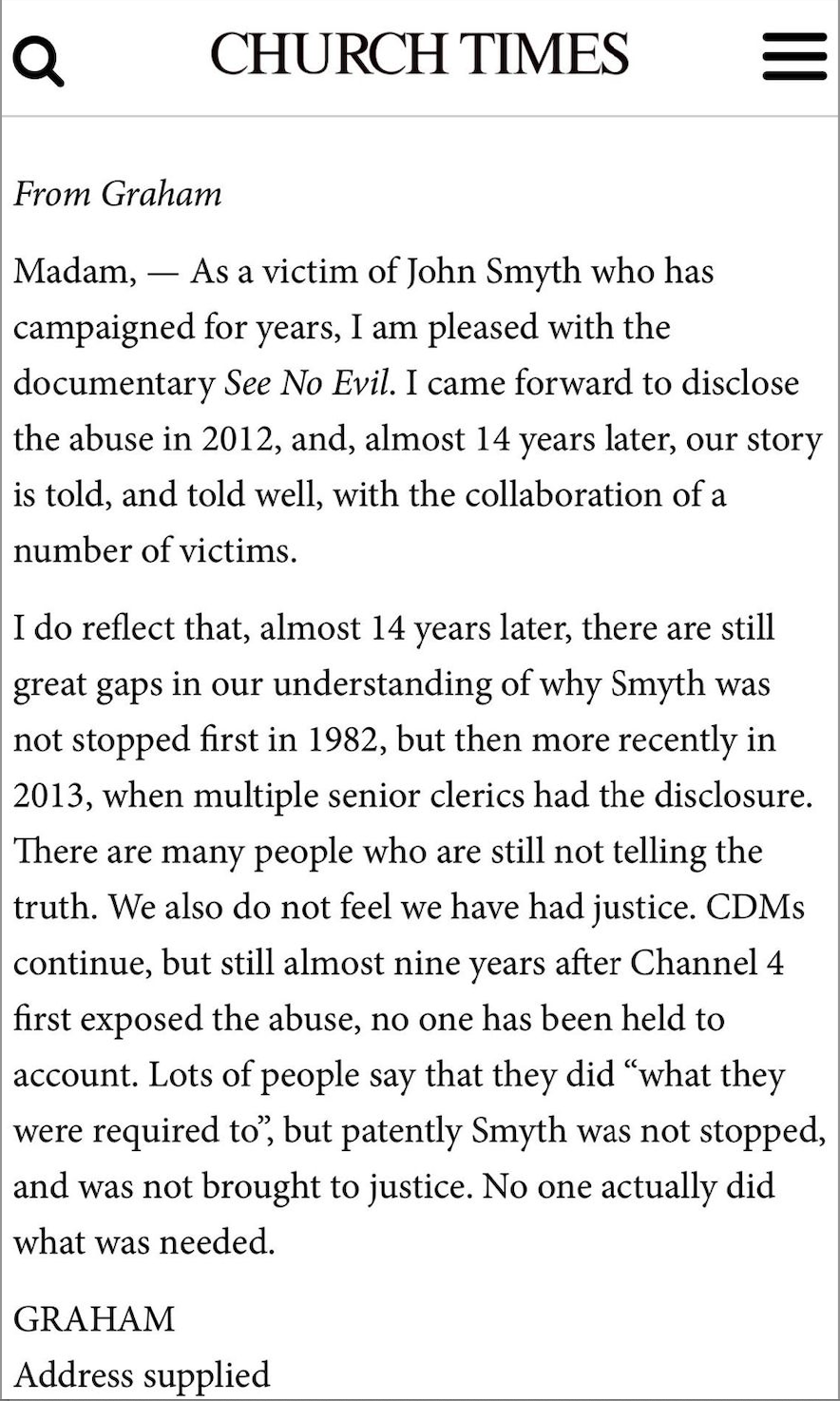
One measure of the Church’s judicial incompetence is the length of time taken over decision-making in this case. The letter to the Church Times reproduced below shows how frustrating the long wait for accountability has been for one Smyth victim. More than nine years after the 2017 Channel 4 News exposé, it’s still true to say that not a single Church officer has been officially censured by the Church of England for participating in the Smyth cover-up. (Justin Welby, it will be remembered, resigned of his own accord, effectively protesting his innocence. He has never been subject to church discipline in relation to Smyth.)
The decisions that have already been made seem astoundingly lenient. After the Makin Review, it was thought that more than thirty Church officers might be disciplined for their conduct during the Smyth scandal. But the Church announced in February 2025 that only ten officers would face disciplinary proceedings, with another name added in October. Then, in a series of further statements (in June 2025, December 2025, January 2026, and February 2026), the Church revealed that seven of those officers would no longer face proceedings. At the time of writing, therefore, just four officers still face the prospect of disciplinary consequences for Smyth-related conduct: Bishop Paul Butler, Revd Sue Colman, Revd Andrew Cornes, and Revd Nick Stott.
There might be a financial explanation for this leniency. Elsewhere in the Anglican Communion, experience has shown that redress payments to abuse victims can vastly exceed budgeted sums. So, from a financial point of view, it’s in the Church of England’s interests to minimise eligibility for its own scheme. That scheme isn’t yet open, but the Church has already cast doubt on the eligibility of Smyth’s victims. Ian Paul, a member of the Archbishop’s Council, told Channel 4 News that Smyth’s abuse “is not abuse that happened in the Church of England” (a claim he repeated five times in the same interview). If dozens of Church officers had been disciplined in connection with the Smyth cover-up, the Church’s liability would have been impossible to deny.
A core judicial principle is that justice should be seen to be done. One side may find the final verdict disappointing, but it’s imperative that the process is objectively even-handed. In this case, that principle isn’t being honoured because the financial implications of the Smyth scandal have created objective grounds for suspicion. It can’t be right for the organisation overseeing the case to be the same organisation that may need to make restitution payments. The suspicion could have been avoided by entrusting the case to an external body.
Evangelical justice
Evangelicals have a particular duty to reach their own independent verdicts about the leaders accused of wrongdoing in the Smyth scandal. That’s because the Church of England’s judicial process is objectively unbiblical. For example, when a minister is penalised for misconduct, in many cases regular church members don’t get to know what their minister has done wrong. All they’re told is the stock phrase “Conduct unbecoming and inappropriate to the office and work of a clerk in Holy Orders”. In stark contrast, biblical church discipline requires the whole local church to be informed of the offence (see Matthew 18:17).
The Church of England also fails to meet the biblical requirement that church disputes should be adjudicated by trustworthy believers (see 1 Corinthians 6:1–4). The governing hierarchy of the Church of England cannot be considered trustworthy by evangelicals because bishops are free to reject biblical truth without being rebuked. For that reason, it shouldn’t surprise evangelicals when judicial outcomes in the Church’s disciplinary cases fall far short of biblical standards.
Evangelicals must, therefore, find a way to consider Smyth-related questions without relying on the judicial structures of the Church of England. It’s unevangelical for evangelicals to depend on the Church of England for justice. (To say this isn’t to say that evangelicals should disregard judicial rulings from the Church of England; it’s to say that we shouldn’t treat them as sufficient.)
In the case of Jonathan Fletcher’s abuse, evangelical leaders showed they could act outside of the Church of England’s legal structures. A cross-denominational group was formed, letters were sent out, and the case was publicly addressed at the 2019 Evangelical Ministry Assembly. Although this particular activity may not have been beneficial (it was later severely and persuasively criticised), it nonetheless proves that evangelical leaders can act independently when they deem it necessary. The Smyth scandal is even more serious and extensive than the Fletcher scandal, but evangelical leaders haven’t engaged in comparable independent action. Perhaps they’re too worried about what they would find out.
The remaining sections of this article will discuss some of the evangelical organisations and leaders who haven’t yet apologised for their role in the Smyth scandal. Unless I’m mistaken, no evangelical leader, institution, or publication has called on any of these organisations or individuals to apologise.
Unapologetic Conservative Evangelical Organisations
One of the organisations implicated in the Smyth scandal is the Church of England, and its role is analysed at length in the latest edition of Andrew Graystone’s book Bleeding for Jesus. Almost all the Iwerne leaders who managed the cover-up in 1982 were Anglican clergymen. What’s more, according to the Makin Review, many other serving and former Church of England officers, including six bishops and two archbishops (the Guardian‘s list wrongly omits Paul Butler, the former Bishop of Durham), were apparently told what Smyth had done but failed to take due action.
The Church of England ought to impose meaningful discipline on its officers and provide fitting financial restitution to Smyth’s victims. Its total failure to do so thus far is understandably demoralising to the victims. Nothing said below should be understood as minimising the Church of England’s very real responsibilities in this scandal.
However, it needs to be grasped that the cover-up of Smyth’s abuse was primarily a conservative evangelical operation. Iwerne leaders were far more concerned about potential damage to Iwerne than to the Church of England. Their 1982 correspondence never mentions the Church of England, but frequently mentions “camp”. They were united by their allegiance to Iwerne, and they acted to protect it. It’s particularly important for conservative evangelicals to understand this so that our movement finally takes due responsibility for this scandal. In my opinion, this will involve not just apologies but also financial restitution to the victims.
There are numerous helpful precedents for public apologies from evangelical organisations. One example, discussed in further detail below, is the Presbyterian Church in America’s apology for its heritage of racial discrimination. Another example is the apology from the largely evangelical Diocese of Tasmania for historic child sexual abuse cases. Closer to home, Christianity Explored Ministries issued an apology for its actions in a recent antisemitism scandal. To call for blameworthy organisations to apologise is to ask them to go down an honourable path that other evangelical organisations have been willing to take.
On the question of financial restitution, the Church of England has already signalled that Smyth’s victims may not be eligible for its redress scheme (see the discussion in the previous section). But even if the Church decides in the victims’ favour, justice surely demands that a separate, additional fund should be set up with the specific purpose of enabling the relevant conservative evangelical organisations to provide redress.
Although I’m convinced the Church of England should include Smyth’s victims in its scheme, conservative evangelicals certainly shouldn’t expect the Church to do all the heavy lifting. The evidence set out at the start of this article shows that Smyth’s abuse was primarily covered up by conservative evangelicals. If it’s right that financial redress should be offered in cases of particularly destructive abuse (as evangelicals elsewhere have accepted), then evangelicals should now take steps towards offering it in this case. I would envisage a scheme managed as transparently as possible by an independent law firm, to which the relevant organisations could contribute.
This section will discuss four organisations ordered alphabetically: Above Bar Church, Church Society, the Lawyers’ Christian Fellowship, and the Titus Trust.
Above Bar Church
After Smyth’s abuse was disclosed and his ministry at Winchester College ended, he pivoted his attention to a non-Anglican evangelical church 25 miles away: Above Bar Church in Southampton. The Smyth family attended the church for at least a year (see MR, p. 67, entry for 7/4/82; 12.1.84, 12.1.144–145).
Smyth was then asked to leave the church for reasons explained in the Makin Review: “Reverend David Jackman, a minister who presided over the Church, not ordained by the Church of England, was later contacted by Mark Ashton and David Fletcher who warned David Jackman about John Smyth. David Jackman described to Reviewers that David MacInnes later sent him a ‘memo’ about the abuse … David Jackman described to Reviewers that on hearing and reading of this, John Smyth was asked not to attend and described him being agitated at being rejected by Above Bar Church” (MR, 12.1.84).
The memo received by David Jackman was a summary of the Ruston Report, and, in his words, this “alerted me to the extent and very serious nature of [Smyth’s] actions” (MR, 12.1.145). This was a moment when a church with no allegiance to Iwerne or the Church of England had a wide-open opportunity to report Smyth’s abuse to the police. It certainly should have done, and it’s hard to understand how its leaders rationalised their own actions at this time.
Nonconformist churches such as Above Bar Church don’t have the same cultural or civic role as Church of England parish churches, which means they typically think much more carefully about questions to do with membership. Even if Smyth and his family hadn’t formally joined as members (the various reviews are unclear on this point), the church would have been conscious of its duty of care to a family that had attended for a significant period of time. The church would also have been acutely aware of the theological difference between someone leaving “in good standing” and someone leaving because of immorality. Finally, the church would have been aware that someone in the latter category posed just as much of a risk to other churches as to Above Bar Church. Anyone familiar with the world of evangelical nonconformist churches would agree that such churches are far more conscious of these points than most Church of England churches.
Those cultural and theological factors mean that Above Bar Church would have understood the weightiness of secretly forcing Smyth to leave. By neither reporting Smyth to the police, nor exposing his offences to the Christian community, Above Bar Church was consciously choosing not to protect other churches. As I say, it’s very difficult to see how the leaders of the church could have explained that course of action among themselves. This is a particularly clear-cut case of the mishandling of abuse revelations and Above Bar Church should now apologise. In my view, it should also contribute generously to the evangelical redress scheme envisaged above.
Someone might object that a church can’t be expected to take responsibility for misconduct that happened more than 40 years ago. But in the Bible and church history sins are sometimes confessed long after they took place, even when those sins were committed by other people. Daniel, for instance, confesses not only his own sin, but also “the sin of my people Israel,” including the sins of former kings and princes (Daniel 9:3–20). In 2016, the Presbyterian Church in America, known to British evangelicals through the ministry of Tim Keller and Kevin DeYoung, approved a resolution repenting of past sins such as excluding people from church membership on racial grounds and teaching that the Bible discourages interracial marriage. In most cases, those sins had taken place at least five decades before 2016, but few Christians would argue that it was wrong for PCA leaders to, in their words, “recognize, confess, condemn and repent of” the sins of their predecessors.
Another possible objection is that Jackman may not have consulted anyone else at Above Bar Church. The church itself hasn’t yet used this argument; instead it has chosen simply to ignore the Makin Review. As things stand, therefore, the public record states that Jackman wasn’t the only leader involved in decision-making at the church: “The leaders of a Church [Smyth] tried to join in Southampton … were warned about him. A summary of the Ruston Report was shown to them, detailing the nature and extent of the abuse that he perpetrated, this did not lead to any further action or reporting that prevented further abuse” (MR, 16.23, emphasis added). But even if, in the future, Above Bar Church did break its silence and claim Jackman acted alone, the nature of representative leadership would still mean the church was responsible for actions he took in the course of duty.
The Makin Review explicitly notes that Above Bar Church belongs to the Fellowship of Independent Evangelical Churches (p. 96, fn. 54). Why, then, didn’t John Stevens, FIEC’s National Director, comment on Above Bar’s role when he wrote extensively about the Makin Review, or when he spoke about it on the FIEC podcast on 15 November 2024 (during which he said he’d read the full review and its appendices)? Stevens has publicly addressed a separate case involving the very same church, so his silence about Above Bar’s involvement in the Smyth scandal seems indefensible. FIEC’s Associate National Director, Adrian Reynolds, who co-edited the Teaching the Bible commentary series with David Jackman, also ignored Above Bar’s role in the same podcast episode.
When Stevens discussed, at an earlier date, those “accused of responsibility for the subsequent abuse perpetrated by Smyth in Africa because they did not speak”, he said, “In my view, the clear responsibility for that lies firmly with the leaders of Iwerne, Scripture Union, and Winchester School at the time, and whoever provided financially to enable Smyth to move from the UK.” But why has he never attributed any responsibility to Above Bar? Not only did its then pastor fail to report Smyth to the police, he also gave a positive assessment of Smyth when contacted by African Enterprise in August 1984, thereby making it easier for Smyth to emigrate (MR, p. 121).
FIEC’s willingness to criticise the role of Scripture Union in the Smyth scandal while remaining silent about Above Bar is a striking example of finding specks in others’ eyes while ignoring the plank in one’s own. The result is that lessons aren’t learnt. By overlooking the failings of Above Bar, FIEC has demonstrated the same self-protective instincts displayed by other Christian groups in the scandal. It should put that right as soon as possible by urging Above Bar to apologise for its past failings and make financial restitution.
Church Society
In February 2017, the Telegraph named Church Society, which represents conservative evangelicals in the Church of England, as one of the organisations that had apparently failed to report Smyth to the police: “David Fletcher, a Iwerne trustee who oversaw an investigation into the alleged assaults, said he told the Church Society, a powerful voice on the evangelical wing of the Church of England, about the claims in 1982.”
Before naming Church Society, the Telegraph had said “a number of senior figures at high-profile evangelical organisations were told of the claims but did not alert the authorities.” This indicates that Fletcher shared information about Smyth on a person-to-person basis, rather than making formal written disclosures that might appear in board meeting minutes. It’s still right, however, to treat these warnings as disclosures to organisations, due to the representative nature of leadership. (This principle can be seen in recent reports about Buckingham Palace receiving an email cache in 2020 that may have incriminated Andrew Mountbatten-Windsor. The claim about the Palace as an organisation is based on legal rulings revealing that one senior member of staff had received the information.)
Thanks to a document that came to light in 2024 in the Makin Review’s appendices, we now know whom Fletcher claims to have told: “JS [John Smyth] got in touch with Stewards Trust to see if he could join them through his connection with Crispin Joynson-Hicks (Viscount Brentwood) who was a solicitor and president of the Church Society. David [Fletcher] told Crispin J-H to be careful of JS” (AMR, p. 188. “Brentwood” is a mistake in the original document and should be “Brentford”).
That statement about Joynson-Hicks was made in July 2014 when Fletcher was briefing James Stileman, the then Operations Director of the Titus Trust, about the scandal (AMR, p. 186). At the time, a few years before Channel 4 News exposed Smyth, Fletcher was on the Trust’s board and was still held in high esteem as the former rector of St Ebbe’s Church in Oxford. It wouldn’t have made sense for him to claim something false that Stileman could easily have cross-checked with Joynson-Hicks, who was still Church Society’s president (he didn’t step down until 2016).
Rebuttals
The February 2017 Telegraph article included a response from Church Society: “Dr Lee Gatiss, the director of the Church Society, said the group had examined its records but ‘had no reason to believe that Church Society was aware of any abuse allegations of the kind referred to, or indeed that Mr Smyth had any involvement with Church Society’.”
Church Society then doubled down on that denial. The following quotation comes from a March 2017 article in the Church Times: “The Revd Dr Lee Gatiss, however, said that he had ‘no reason to believe’ that the society was aware of the allegations against Mr Smyth. ‘We have found no mention of him at all in any of the minutes of our meetings over the period, and no payments ever made to him in our cash books,’ he said. Nobody at the society had even heard of Mr Smyth until Channel 4 broke the story last month, he said. ‘Our President, Chairman, Director, and the Council and Trust Directors know absolutely nothing about any involvement of John Smyth with Church Society.’”
For the best part of a decade, those rebuttals had the effect of making people think the claim about Church Society’s involvement in the scandal was baseless.
Church Society’s response to the Makin Review
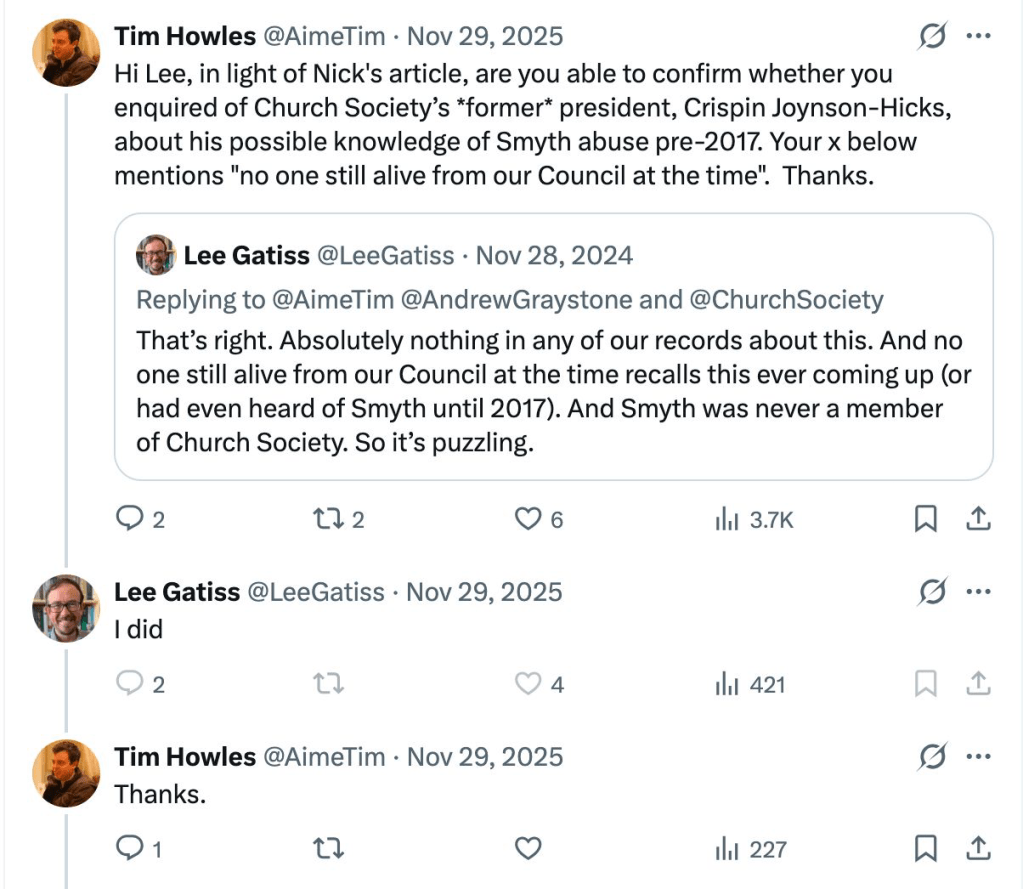
Eventually, however, the ball returned to Church Society’s court when – as mentioned above – Joynson-Hicks was named in the Makin Review’s appendices. On the social media site X (Twitter), Tim Howles, an ordained Anglican, asked Gatiss if he’d included Joynson-Hicks in his enquiries about past knowledge of Smyth’s abuse. Gatiss confirmed that he had:
Gatiss didn’t disclose how Joynson-Hicks had replied to the enquiries, but that was revealed by Jason Ward, Church Society’s chairman, in the following email:
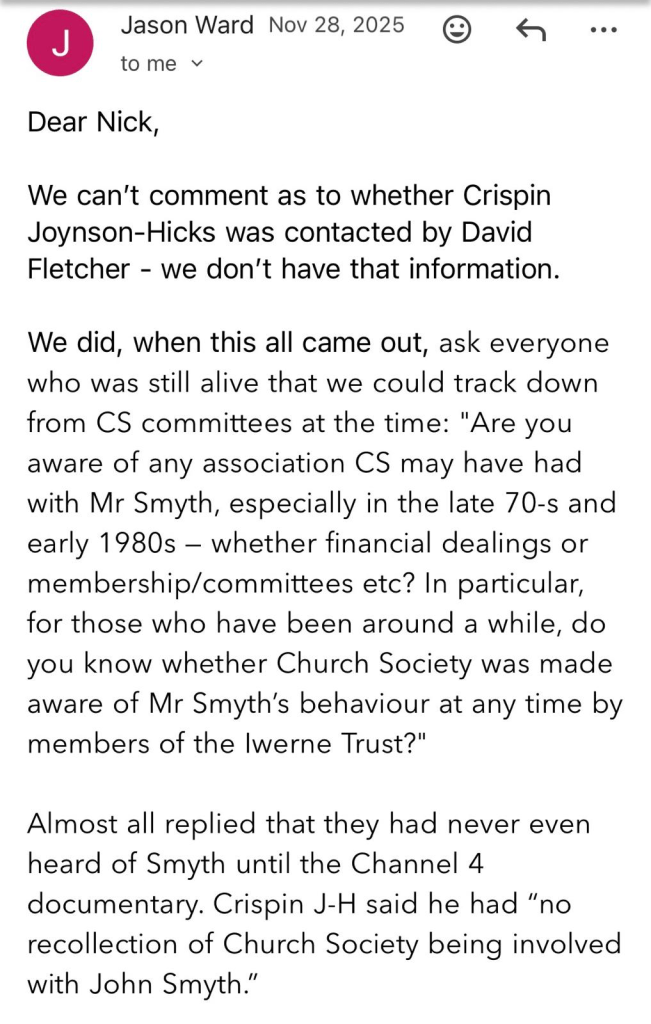
What the email shows is that Joynson-Hicks’s response to the enquiries didn’t disprove Fletcher’s claim. According to Ward, “almost all” the respondents to the enquiries said they’d never heard of Smyth, but Joynson-Hicks notably didn’t say the same. In fact, his comment about Smyth’s lack of involvement with Church Society strongly suggests he knew who Smyth was at the time. That conclusion would fit with everything said about Joynson-Hicks in the Makin Review’s appendices.
Yet, despite the noteworthy response from Joynson-Hicks, and despite the fact that he was identified in the Makin Review’s appendices, Church Society continued to imply it had nothing whatsoever to do with the scandal. In the exchange reproduced above, Gatiss leaves Howles with the misleading impression that Joynson-Hicks had never heard of Smyth until 2017. What’s more, the society didn’t mention Joynson-Hicks in any of its various reflections on the Makin Review: a blogpost titled “An Open Letter to Justin Welby”; a Facebook post; and an article in Church Society’s magazine (page 1, page 2). In all those statements, Church Society presented itself as completely blameless in relation to Smyth.
Possible objections to criticism of Church Society
It’s been argued thus far that Church Society is implicated in the Smyth scandal through Crispin Joynson-Hicks, the society’s former president, who was allegedly told about Smyth’s abuse and yet took no action. But there are several possible objections to that argument.
First, Church Society might say that the position of president is largely ceremonial, and so disclosing information to its president isn’t the same as sharing information with its board. Whilst doing the latter would certainly have carried more weight, it remains the case that Joyson-Hicks was a senior representative of the society. A legal principle known as respondeat superior, discussed in more detail later in this article, holds that an organisation is answerable for the actions of one its representatives, whether or not the organisation as a whole endorsed those actions. The same kind of principle is found throughout the Bible (see, for example, Joshua 7).
Moreover, Church Society has itself acknowledged the significance of the president’s role. If the position had been trivial, it wouldn’t have been cited alongside others when the society told the Church Times that “Church Society’s President, Chairman, Director, and the Council and Trust Directors know absolutely nothing about any involvement of John Smyth with Church Society.”
Second, Church Society could claim that a warning doesn’t amount to a disclosure of abuse. But Fletcher had to communicate the seriousness of Smyth’s misconduct so that his warning would be persuasive. The quotation above from the Makin Review’s appendices shows that Joynson-Hicks was associated with the Stewards’ Trust, which – like Iwerne – ran Christian residential events attended by boarding school pupils. After visiting one of its houseparties in July 1982 (MR, p. 69), it seems Smyth never attended another event, which Fletcher attributed to his warning: “JS [Smyth] tried to join a number of other organisations (e.g. The Stewards Trust and Above Bar church in Southampton) but DCMF [Fletcher] and others warned them off” (AMR, p. 164). Judging by that evidence, the information Fletcher gave Joynson-Hicks must have been sufficiently frank and detailed to be effective.
Third, it could be said that Fletcher’s warning was given with the Stewards’ Trust specifically in view, rather than Church Society. The Stewards’ Trust, a theologically Charismatic organisation, does have its own case to answer. But the fact that Fletcher mentioned Church Society in his 2014 briefing meeting suggests he’d always been conscious of the advantages of informing a Church Society leader. As we saw earlier in this article, Fletcher wanted to stop Smyth joining Christian organisations in Britain; warning a leader involved in two organisations was, therefore, killing two birds with one stone. Any Christian leader receiving such a warning has a duty to consider its wider implications.
Having considered those objections, we’re now in a position to make two observations about Church Society’s conduct.
Unacceptable silence
The first observation is that Church Society shouldn’t have kept silent about its apparent connection to the scandal. Fletcher’s claim about Joynson-Hicks has always been highly plausible. Church Society has never had decisive grounds for disbelieving it, since – as Ward’s email shows – it can neither confirm nor deny that Fletcher told Joynson-Hicks about Smyth.
At the time, Joynson-Hicks was a London lawyer and, from February 1983, a member of the House of Lords. If we assume that he was indeed warned about the abuse, his professional expertise and his social position could have helped him take action that might have stopped Smyth. Additionally, as Church Society’s president, he had the society’s name and resources at his disposal to help him pursue justice, had he wished to do so.
No one is saying that Church Society is at the heart of the Smyth cover-up. But when its former president was named in the Makin Review’s appendices, the society should have addressed its apparent connection to the scandal. To begin with, it should have asked Joynson-Hicks to disclose everything that he knew about Smyth. Christians shouldn’t shrink back from asking necessary questions.
If Joynson-Hicks refused to answer, or said he couldn’t remember, nothing was stopping Church Society from saying something along the following lines: “We’re aware that our former president is named in the appendices of the Makin Review. We can neither confirm nor deny the claim that he was warned about Smyth. If it’s true that he received a warning, we view that as an opportunity for action that was missed by one of our senior representatives, for which Church Society should now apologise. All those warned about Smyth should have asked probing questions, refused to take part in the cover-up, and pursued justice by reporting Smyth to the police.”
It’s an objective fact that Church Society has ignored information in the public record, acting as if it had never been named in the Makin Review’s appendices. Its silence fits all too neatly with one of the themes of this article: the deliberate evasion of accountability.
Untrustworthy communication
The second observation is equally serious. Church Society’s communication about its alleged connection to the Smyth scandal has been consistently untrustworthy.
It will be remembered that in February 2017 the Telegraph reported that Fletcher claimed to have told Church Society about Smyth. The article indicated that this had happened through the informal process of notifying a “senior figure”. Joynson-Hicks’s reply to the society’s internal enquiries, which stood out like a tall poppy from the “never heard of Smyth” replies, showed he was most likely the leader whom Fletcher had told.
When those details are kept in mind, Gatiss’s rebuttal must be considered untrue. He told the Telegraph that he “had no reason to believe that Church Society was aware of any abuse allegations of the kind referred to”. But Fletcher’s claim was itself a reason to believe that someone senior in the society was aware. The claim could only be satisfactorily refuted if all the relevant personnel had issued denials, and that hadn’t happened. To quote the email reproduced above: “Crispin J-H said he had ‘no recollection of Church Society being involved with John Smyth.’” Denying Church Society’s involvement with Smyth isn’t the same as denying awareness of abuse allegations. Gatiss’s rebuttal – given to a national newspaper – did not fit the facts in his possession.
The same could be said of Gatiss’s March 2017 comments to the Church Times. Church Society has never corrected the record, so it must be assumed that the following indirect quotation accurately captures what Gatiss told the reporter: “Nobody at the society had even heard of Mr Smyth until Channel 4 broke the story last month, [Gatiss] said.” But how could that be true when, according to Ward, “Almost all replied that they had never even heard of Smyth until the Channel 4 documentary”? Not all but almost all.
Gatiss might say his statement was true on the basis that Joynson-Hicks was no longer “at the society”, as he’d stepped down as president nine months earlier. But honest testimony deals straightforwardly with the matter at issue and is mindful of the way speech will be understood. The ignorance of current Church Society personnel wasn’t the point, and Gatiss knew it wasn’t the point. His “nobody at the society” claim was therefore either false (if it was a sweeping statement that included the society’s former president) or seriously misleading (if it was worded in such a way as to exclude former personnel while seeming to be a comprehensive denial).
Gatiss’s replies to Tim Howles in 2024 and 2025 were similarly untrustworthy. Anyone accusing an organisational leader of dishonesty needs to make the case with painstaking care, and so the following paragraphs require close attention to detail.
The first time Howles asked Church Society about Fletcher’s claim was in the exchange reproduced here:
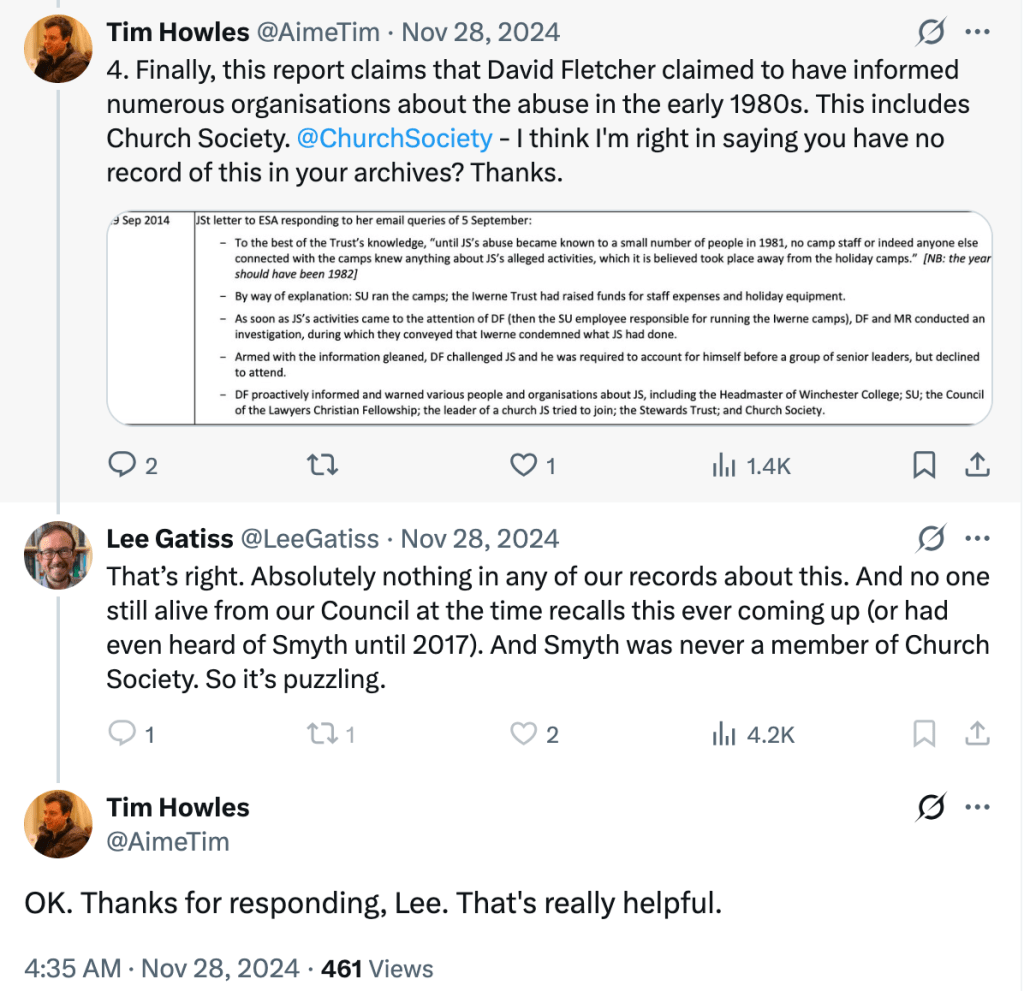
As with the 2017 rebuttals, Gatiss’s reply was effectively a categorical denial of any connection between Church Society and the Smyth scandal. If Gatiss had ended his tweet after the first two sentences (“That’s right. Absolutely nothing in any of our records about this”), his rebuttal would at least have been somewhat defensible. But Gatiss kept going, with the plain intention of communicating that the allegation was entirely baseless. He even finished off by describing the allegation as “puzzling”, something he could only truthfully say if Church Society had found no indication whatsoever that the allegation was correct. But, as we’ve seen, that wasn’t the case.
If we take a closer look at Gatiss’s reply to Howles, the problems get worse. His claim that “no one still alive from our Council at the time recalls this ever coming up (or had even heard of Smyth until 2017)” seems incompatible with the email from Jason Ward reproduced above. Far from claiming he’d never heard of Smyth, Joynson-Hicks indicated he had heard of him. According to Ward, “Almost all replied that they had never even heard of Smyth until the Channel 4 documentary. Crispin J-H said he had ‘no recollection of Church Society being involved with John Smyth.’” So, whom should we believe: Church Society’s director (Gatiss) or chairman (Ward)?
Gatiss might say that, strictly speaking, Church Society’s president doesn’t belong to the society’s council. On that basis, his claim about those still alive “from our Council at the time” could be considered technically accurate. But this nuance would only be picked up by people familiar with the society’s leadership structure; anyone else wouldn’t notice it. For example, it’s clear from Tim Howles’s follow-up question a year later, reproduced below, that he thinks the society’s president belongs to its council. That assumption supplies the logic to his question:
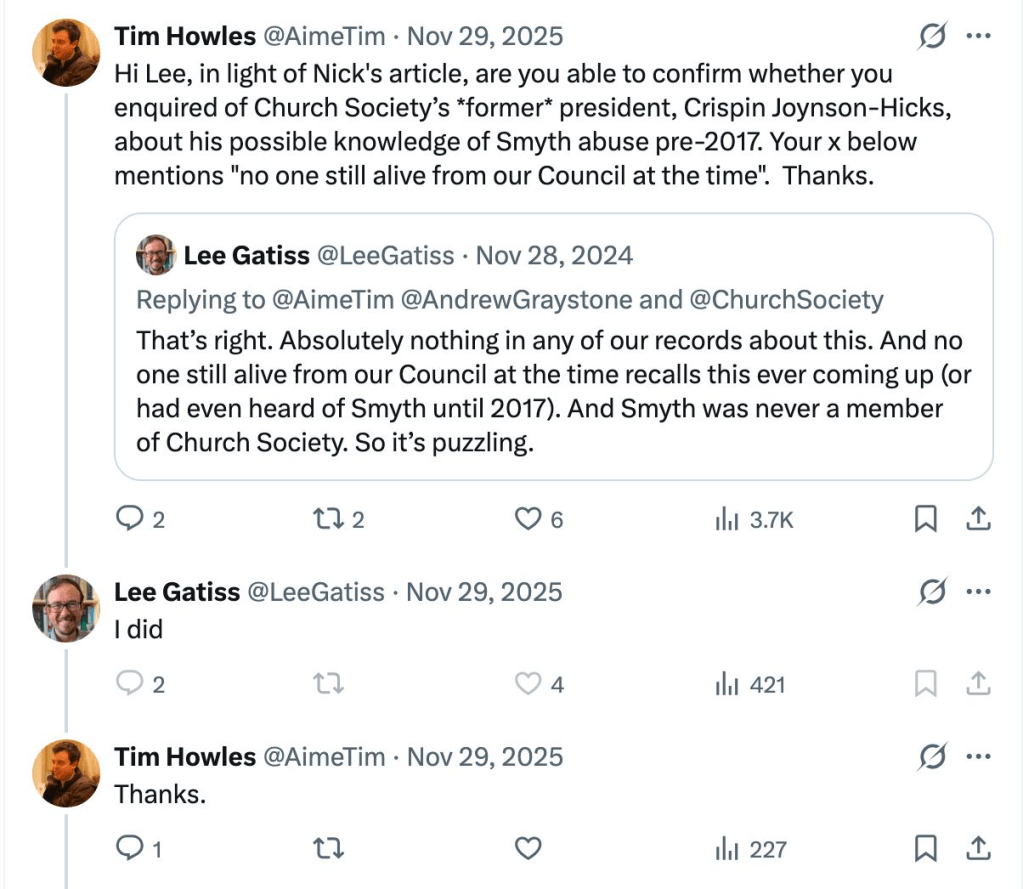
Gatiss’s “I did” answer, when combined with the 2024 tweet quoted by Howles, has the effect of funnelling Howles towards one unreliable conclusion: that Joynson-Hicks hadn’t heard of Smyth before 2017. Yet, as Gatiss knew very well, the evidence indicated that Joynson-Hicks had indeed heard of Smyth. No attempt is made by Gatiss to correct Howles’s obvious misunderstanding about the president belonging to the council.
Let’s assume that Gatiss was ignoring Howles’s reference to the 2024 tweet. If he was simply answering Howles’s 2025 question (“are you able to confirm whether you enquired of Church Society’s *former* president, Crispin Joynson-Hicks, about his possible knowledge of Smyth abuse pre-2017?”), did he answer in a trustworthy way? No, he didn’t. In the enquiries, Joynson-Hicks had been asked, “Do you know whether Church Society was made aware of Mr Smyth’s behaviour?” He dodged that specific question, and Church Society failed to press him for an answer. Gatiss shouldn’t have given the impression that he’d carried out adequate enquiries when he’d actually found out nothing definite about Joynson-Hicks’s knowledge.
Finally, it’s worth taking another look at Gatiss’s 2024 assertion, reproduced above, that he was puzzled by Fletcher’s claim that Church Society had been told about Smyth (“So it’s puzzling”). Surely it stopped being puzzling the moment the society’s former president indicated that he himself knew Smyth, precisely as Fletcher had said? Any remaining questions could have been answered by Joynson-Hicks, who was just a phone call away – if Gatiss had wanted to make the call. The idea that Gatiss was genuinely mystified is so implausible, in fact, that his “puzzling” remark must be considered dissembling, a particularly committed form of dishonesty. He falsely led Howles (and all those seeing their exchange on social media) to think he had no clue why the allegation was being made.
To reinforce the preceding point, it should be noted that both of the exchanges between Howles and Gatiss took place after Joynson-Hicks had been publicly identified as the senior Church Society figure whom Fletcher said he had warned. Anyone carrying out a Ctrl+F search for mentions of Church Society in the Makin Review’s appendices would have instantly been led to Joynson-Hicks (see the screenshot below).
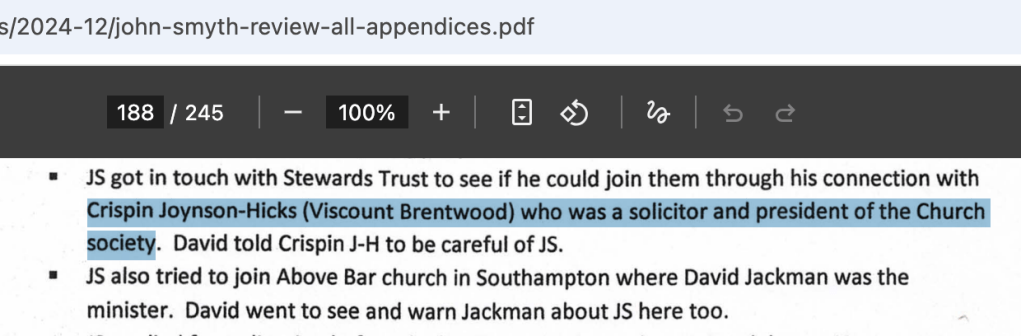
Assuming that Church Society’s leaders were aware that their former president was mentioned in the Makin Review’s appendices, Fletcher’s claim would have been even less “puzzling”.
Church Society has been caught telling serious falsehoods before, and it hasn’t corrected the record after being found out. Now it’s shown that it can’t be trusted to communicate truthfully in discussions about the most prolific abuser in British Christian history.
In a final attempt to get Church Society to properly address the claim that Joynson-Hicks had been told about the abuse, I sent a follow-up email to Jason Ward:
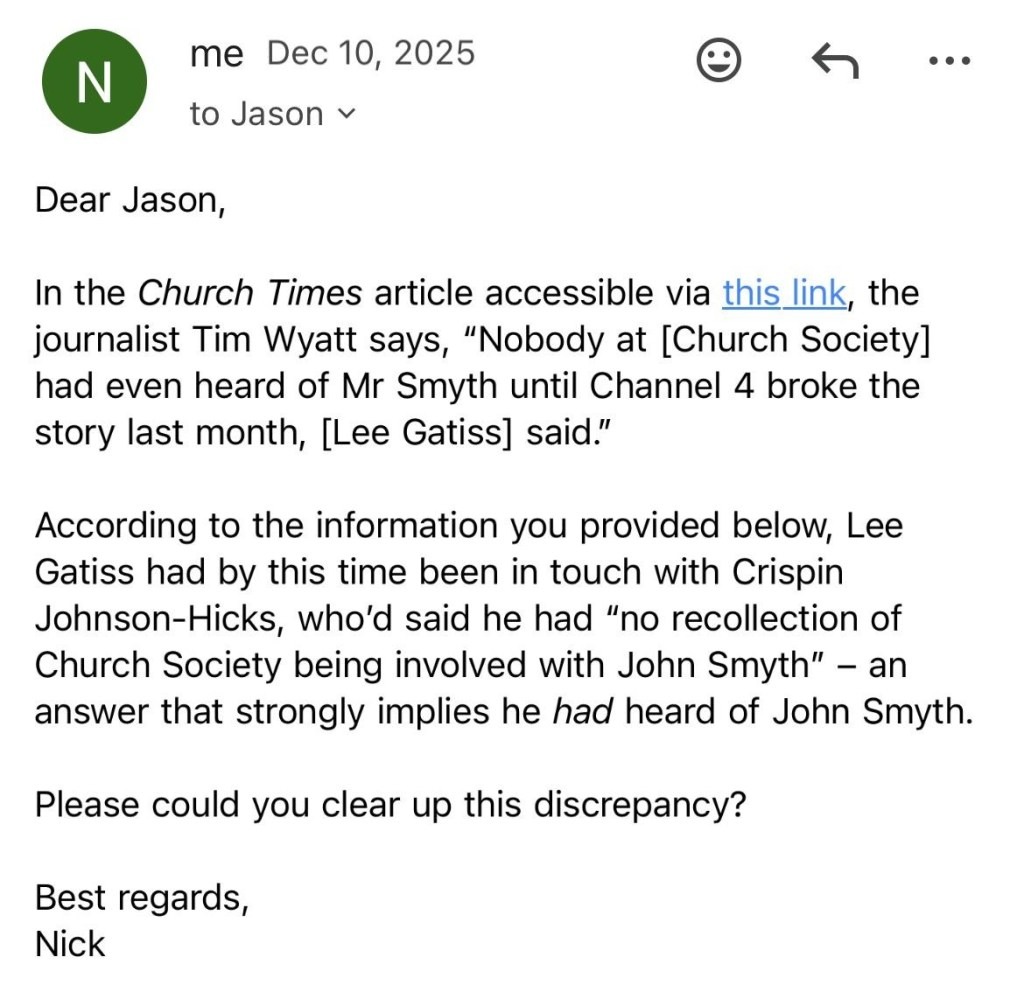
I never received a reply.
Falling short
Early in February 2017, just a few days after Channel 4 News had exposed Smyth’s abuse, Gatiss posted an article on Church Society’s blog. At that time, the Telegraph hadn’t yet suggested that Church Society might itself be implicated in the Smyth scandal. It was, therefore, a time when Gatiss could speak freely about how Christians should deal with wrongdoing. He made the following admirable points:
The gospel is not served by cover ups, and those who suffer abuse (or know about it) in Christian circles will too often keep quiet because they don’t want to be seen as “undermining God’s work,” or ostracised by others for daring to talk about it. Others try to close down conversations or control the reporting of such incidents for the same reasons, often putting pressure on reporters or even just people who post on social media.
But Jesus said “the truth will set you free” (John 8:32). And so we walk in the light as forgiven sinners, with no need to pretend we are better than we are. That is how we serve the truth.
As it happened, Gatiss had the chance to follow his own advice later that same month when the Telegraph asked him for a comment. But he rejected his own counsel. He did indeed pretend Church Society was better than the evidence suggested. Since then, he’s never directly addressed Fletcher’s claim about Joynson-Hicks. The closest he’s come is to say that Church Society included Joynson-Hicks in its enquiries, leaving it to Jason Ward to reveal, by an email instead of a public statement, Joynson-Hicks’s evasive response.
It’s worth reminding ourselves what we’re discussing. A New York Times report says that “Mark Stibbe, age 17, was ordered to strip naked and lean over a wooden chair in the garden shed … Then came the first blow from a cane, its impact so ferocious that it sent the boy into a state of paralysis that lasted through at least 30 more strokes that left him collapsed on the floor, blood oozing down his legs. ‘I remember being so appalled by how vicious the first lash was that I couldn’t scream.’”
The conservative evangelical leaders to whom this abuse was first disclosed knew that crimes had been committed, but they didn’t report Smyth to the police – not even after he began running camps for boys in Africa, where the abuse continued and where Guide Nyachuru, a good swimmer, was found dead at the bottom of a pool, with bruises (according to one witness) on his legs and groin (BFJ, pp. 166–7).
The leaders of the cover-up group, however, didn’t keep the secret to themselves. They informed other evangelical leaders, who also failed to act rightly. The fact that they copied the first group in failing to report Smyth is an important feature of the cover-up, and Church Society is objectively implicated in this part of the scandal.
Many people – victims, Christians, and non-Christians – want to know all the reasons why Smyth was allowed to escape justice. Church Society, however, has obstructed good faith efforts to discover the truth about the apparent involvement of its former president. Judging by Gatiss’s first statement about the scandal, he himself knows it’s wrong to “close down conversations”. And yet that is what he’s kept on seeking to do.
The Lawyers’ Christian Fellowship
John Smyth belonged to the Lawyers’ Christian Fellowship for about 35 years (AMR, p. 136). He was excluded from the fellowship in 2003 (MR, 13.1.160).
The LCF is mentioned in multiple places in the Makin Review, but the reviewers explain that their terms of reference don’t allow them to judge the fellowship’s behaviour (MR, 13.1.119). The LCF’s role in the scandal was also discussed in a Telegraph article in 2017.
The blameworthiness of the LCF stems from its financial support of Smyth and its failure to pursue justice. These two points will now be considered in turn.
Two decades of financial support
According to the Makin Review, LCF members voted in 1984 “to offer general, but not financial, support to John Smyth in his work in Africa” (MR, 12.1.167). However, it’s clear from the review’s appendices that the LCF did in fact provide financial support to Smyth. A 2003 LCF memo states, “It appears that the LCF has supported John ever since he left the UK and went to Zimbabwe in August 1984 … The funding has of course now been stopped.” (AMR, p. 141). Smyth himself said in a 2003 email, “I’m very grateful to LCF for helping with my financial support for many years” (AMR, p. 136).
Moreover, according to Andrew Graystone, much of the funding for Smyth’s 1991 purchase of a large house that became known as Zambesi House “came from Smyth’s supporters in the UK, and particularly from his old friends at the Lawyers’ Christian Fellowship” (BFJ, p. 161). The property was used for housing young men who helped Smyth run the camps (see MR, p. 129, 13.1.73, 13.1.156). As we’ll see later, the LCF leadership knew by 1991 that Smyth was the unnamed abusive lawyer in John Thorn’s memoir. If that information had been – at the very least – shared with the rank and file LCF membership, donations from LCF members towards the purchase of Zambesi House might have been prevented.
The time period during which the LCF sent funds to Smyth included the 1990s, when he was charged in Zimbabwe with the culpable homicide of Guide Nyachuru and also five counts of crimen injuria. The case didn’t proceed after the prosecutor was removed on the grounds of a conflict of interests. According to the Makin Review, “It is thought that both the culpable homicide case and the criminal injury case were postponed indefinitely, with the charges never being withdrawn” (MR, 13.1.77).
From an official perspective, Smyth remained innocent until proven guilty, but the charges against him presented a prima facie case for shutting down financial support for his ministry. The culpable homicide charge is self-explanatory; the other charges are summarised in the following excerpt from a report in the Mail & Guardian, a South African newspaper: “According to the charge sheet in the crimen injuria case, Smyth was alleged to have taken nude showers with the complainants, made them walk naked to the swimming pool at night and talked to them about masturbation; he ‘told them to be proud of their “dicks” as Jesus Christ had one’. The beatings allegedly continued with a table tennis bat on the boys’ ‘bare buttocks’.”
The LCF wasn’t obliged to keep funding Smyth. Even if he had vehemently denied all the charges, it would have been reasonable for the fellowship to stop its donations “out of an abundance of caution”. It should, therefore, have cut off its financial support at that time, and it should now apologise for failing to do so. If it was completely unaware of the criminal charges, it should apologise for inadequate oversight of a recipient of its charitable resources. The Makin Review rightly urges that “due diligence checks take place before donations are made to individuals and organisations, including those abroad” (MR, 19.1).
Well-meaning British Christians financed Smyth’s abusive ministry in Zimbabwe. This fact needs to be addressed. Yet, thus far, the LCF has refused to apologise for its serious shortcomings in this area.
Failure to pursue justice
The LCF’s other area of culpability is its failure to take sufficient action on three occasions when it made decisions about Smyth.
The first opportunity: circa 1982
Its first opportunity came in the early 1980s, when David Fletcher purportedly warned the LCF Council (at that time known as the “Committee”) about Smyth (TTD, p. 11, entry for 29/9/14). This was mentioned in the 2017 Telegraph article, which included the following denial from the LCF: “Mark Barrell, executive director of the Lawyers’ Christian Fellowship, said the group’s records suggested that, contrary to the Iwerne Trust documents, it had not been notified of the allegations involving Mr Smyth until 2003.” The problem with that denial is that it’s based on the silence of LCF records. As we saw in the section on Church Society, Fletcher’s warnings were typically given to senior figures on an informal basis, and thus wouldn’t be likely to appear in boardroom minutes.
Fletcher’s claim about notifying the LCF in the early 1980s should be treated as highly plausible. No evidence exists to prove that he fabricated any of his claims about warning particular organisations, and some of those claims have been verified (see, for example, MR, 12.1.84). There’s a clear pattern of activity showing that Fletcher sought to stop Smyth, prior to his move to Africa, from establishing himself in British Christian institutions (see the section above on Smyth’s banishment). It makes sense that Fletcher would have included the LCF on his list.
The LCF’s refusal to accept that it was warned during this early time period seems to be a defensive reflex. It would be far better for the LCF to admit the likelihood that at least one of its council members was warned about Smyth before his 1984 emigration, and to apologise on that basis.
The second opportunity: 1989
The LCF’s second opportunity to take action sprang from the publication of John Thorn’s 1989 memoir The Road to Winchester. Smyth knew his British supporters might find out that he was the abusive Queen’s Counsel described in the book, so he tried to limit the damage by giving his version of events to key supporters (MR, 13.1.36). One of the people he contacted was John Colyer (MR, 13.1.42), also a QC and later a circuit judge, who served as the LCF’s chairman from 1981–89 and its vice president from 1989 onwards.
Colyer was a member of the UK Council of Reference of the Zambesi Trust, which was essentially a fundraising arm of Smyth’s ministry (MR, 12.1.155). After receiving Smyth’s letter about the book, he “rang John Smyth to confront him. John Smyth proceeded to disregard the allegations as … ‘completely exaggerated’, stating that no serious physical abuse had taken place” (MR, 13.1.43). Colyer seems to have accepted that explanation because there’s no indication that he withdrew his support from the Zambesi Trust. But some of those listed with Colyer on a Trust leaflet (MR, 12.1.155; reproduced below) obtained additional information at that time and then resigned from the Trust (see CR, B.20–27). It was evidently possible in 1989 for British supporters of Smyth to uncover the horror of his abuse, but Colyer failed to do so.
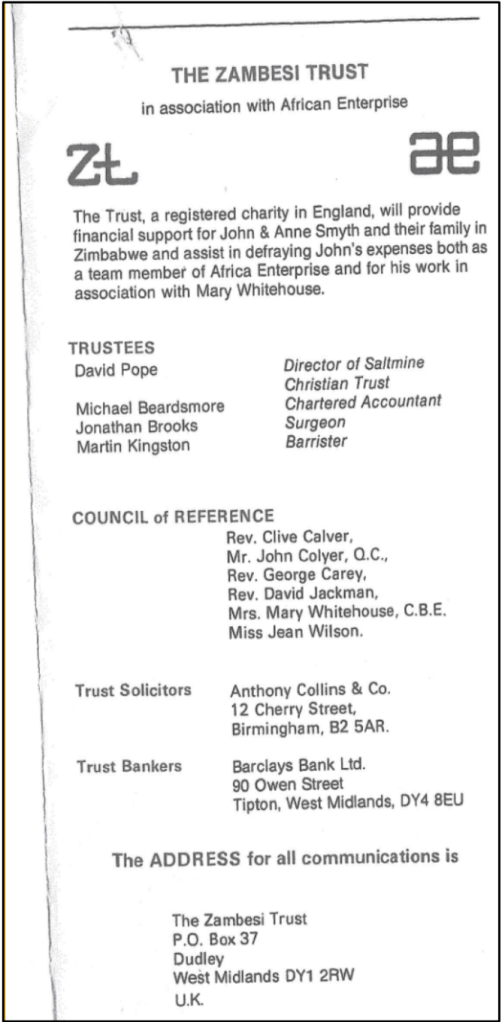
Colyer had a moral duty in his own right, as a public supporter of Smyth, to fully investigate Thorn’s revelations. He also had a duty to investigate on behalf of the LCF, as Smyth was scheduled to speak at an LCF conference later that year (MR, 13.1.42). Colyer’s failure to investigate properly must be considered a serious moral offence. If in fact he did investigate and discovered the full truth, he would be at fault for failing to take due action in response to what he learned.
On 13 April 1989, LCF leaders discussed Smyth’s attendance at the upcoming conference (MR, p. 125). The Makin Review says, “The decision was made by the LCF to not go ahead with John Smyth as a keynote speaker at the conference, in light of the publication of [Thorn’s] book” (MR, 13.1.42, emphasis added). This strongly suggests that other LCF leaders, in addition to Colyer, now knew the identity of the anonymous QC in Thorn’s book.
They would, therefore, have known that John Smyth, a high profile member of the LCF, had “gained … personal control” over a group of Winchester College schoolboys, and had begun punishing them physically for their sins. This behaviour couldn’t have been just mildly aberrational, because Thorn said that when it came to light, “Christian Forum was shattered”, and Smyth had to be “banished” to Africa. Moreover, according to Thorn this expulsion had been conducted “quietly”, which implied that Smyth’s conduct had never been reported to the police. The quietness of the process also indicated that people in Africa wouldn’t be aware of the danger that Smyth posed to boys and young men.
The LCF was sufficiently concerned about those revelations to cancel Smyth’s speaking invitation, but surely the information now in its possession warranted more action than that? Staggeringly, the LCF continued to fund Smyth’s ministry and didn’t tell its membership that Smyth, a well-known fellow member, was the abusive QC in The Road to Winchester.
As we’ve already seen, if the LCF leaders had sought it, knowledge of the full horror of Smyth’s conduct was within reach (CR, B.20). By working their contacts in the small world of British evangelicalism, they could easily have arrived at David Fletcher and the Ruston Report – as the LCF would later do in 2003. Just five years after Smyth’s exit from Britain, and three years before the death of Guide Nyachuru, these Christian legal insiders had an opportunity to pursue justice which they failed to take.
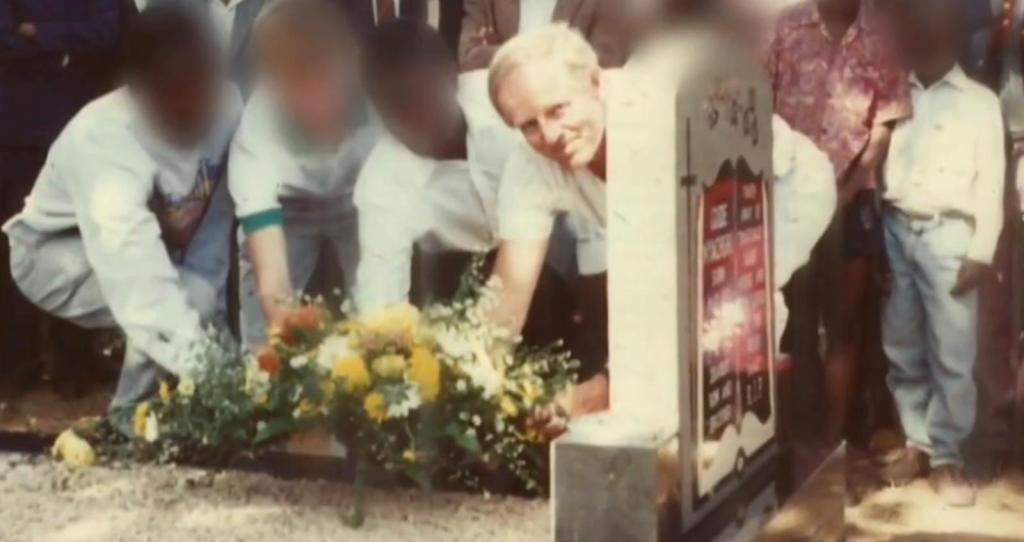
The third opportunity: 2003
Fourteen years later, in 2003, the LCF had yet another chance to take action. Smyth had recently moved to South Africa, and the criminal charges in Zimbabwe seemed to be safely behind him. He initiated contact with an LCF leader, suggesting they could meet for lunch in three months’ time when he visited Britain (AMR, p. 136). Smyth had recently been appointed National Director of the Christian Lawyers’ Association of South Africa (AMR, p. 135), and he may have envisaged some kind of partnership between CLASA and the LCF. He told the LCF leader he had “just taken a voluntary job which ties in with the UK LCF” (AMR, p. 136).
These overtures came to nothing after Smyth’s past caught up with him. The LCF leader said, “I was initially very impressed with him and circulated his name to other members of the National Committee as a possible speaker at a future event. However I soon discovered that John Smyth was not who he seemed” (AMR, p. 137). The leader’s findings were written up in an internal memo titled “Individuals and Organisations That Bring the LCF into Disrepute” (AMR, 137–48). As the title indicates, the scope of the memo wasn’t limited to Smyth.
The LCF memo
The memo included a significant amount of information from the Ruston Report: “Mr Smyth would give beatings of 100 strokes for masturbation, 400 for pride and one of 800 strokes for some undisclosed fall. Although these beatings began with the victim semi naked the custom gave way to complete nakedness”.
Several details were also included from the Coltart Report on Smyth’s abuse in Zimbabwe: “a. He made the boys swim in the nude at night; b. He would walk around the boys’ dormitory in the nude; he would stand watching boys’ showering in the nude, handing out soap. He would also pray in the nude; c. He administered beatings with table tennis bats: one boy reported being beaten 45 times with a [table tennis bat]; at least 2 boys had [table tennis bats] broken on their backsides.”
One of the purposes of the memo was to call for Smyth’s membership to be revoked: “John is not a fit person to be a member of the LCF in the absence of any true repentance from these activities. John’s continued membership of the LCF can only damage the Fellowship in the eyes of anyone who is aware of John’s past.” However, the memo notably didn’t discuss whether Smyth should be prosecuted, even though it did refer to the possibility of prosecution in 1982: “John Smyth gave a signed undertaking … not to engage in further work with young men and also agreed to leave the United Kingdom … In return he was not prosecuted for his activities.” Nor did the memo discuss the possibility of exposing Smyth via a public statement.
In 2003, Smyth was 62 years old and nothing was stopping him from abusing still more boys and young men in Africa. (Evidence gathered by Channel 4 News shows that for the rest of his life Smyth kept engineering voyeuristic situations where young men would be naked in his company.) It’s also noteworthy that by 2003 the global cascade of Roman Catholic abuse revelations was fully underway and hard to ignore. It was widely understood that it was very dangerous to let abusers evade justice. Yet that’s what the LCF did. Smyth was expelled from the fellowship, and measures were taken to address his activities in South Africa, but his abuse wasn’t reported or publicly exposed.
What’s more, when Smyth objected to his expulsion from the fellowship, the LCF committee was shown copies of the Ruston and Coltart reports (MR, p. 135). The former specifically identified Smyth’s abuse as criminal, and the latter revealed he’d continued abusing after relocating. But despite receiving these facts about Smyth – ten years before they were disclosed to Church of England safeguarding personnel – the LCF committee still failed to report him to the police, either in Britain or South Africa. In this way, the LCF participated in the ongoing cover-up.
Numerous unapologetic statements
It’s deeply troubling that the leaders of this group of Christians engaged in legal work didn’t see the need for justice. It’s also troubling that the current LCF leadership hasn’t properly addressed the organisation’s past failings and apologised. Instead of expressing repentance, every LCF statement about the Smyth scandal has bristled with defensiveness.
In the 2017 Telegraph article about the Smyth scandal, the LCF denied any knowledge prior to 2003 of Smyth’s abuse, and failed to apologise for its negligence in 2003. According to the Telegraph, the LCF’s then executive director, Mark Barrell, “refused to reveal whether the organisation had notified authorities.”
In the 2024 LCF statement that followed the Makin Review’s publication, the fellowship remained unapologetic. It will be remembered that evidence in the review disproved the LCF’s claim that it hadn’t known anything before 2003 about Smyth’s abuse. The LCF’s statement, however, completely ignored this uncomfortable fact.
In 2025, before publishing the first version of this article, I received an additional LCF statement, which was also entirely unapologetic. It cites the actions taken in 2003 to “curtail [Smyth’s] activities in South Africa”. But those actions obviously don’t make up for the failure to report Smyth to the police.
The statement also says, “It is evidently a mistake to draw a line between what may or may not have been known by a small number of individuals in the LCF, and what was known or should have been done by the membership at large”. This attempt to pass all the blame on to “individuals” who just happened to belong to the LCF is unworthy of a Christian legal group. The LCF undoubtedly understands the principle that organisations are responsible for the conduct of representatives acting in the course of duty. It should apply that knowledge to itself. LCF representatives, acting on behalf of the fellowship, failed to pursue justice in the early 1980s, and again in 1989, and yet again in 2003. Moreover, the whole LCF committee was implicated in the 2003 negligence (MR, p. 135, entry for 12/9/03), and most likely also in the 1989 negligence (MR, p. 125, entry for 13/4/89). The LCF celebrates its past achievements; it should also answer for its past misconduct.
Blind to its own failings
In the Winchester Review, one of Smyth’s victims speaks about the long-term consequences of the absence of justice: “What I experienced was hugely traumatic and I should not have gone into my marriage or into my job without having had those things sorted. I’ve had 35 years of being messed up because of it when actually if it had been reported to the police, which it should’ve been, Smyth would’ve been brought to justice and those of us who were and are victims would’ve been helped” (WCR, p. 137). In view of those and other consequences of the absence of justice in this case, the LCF is surely right to say in its 2024 statement that it’s “appalled … by the failures by many to act.” But why isn’t it appalled by its own demonstrable failures to act? It still hasn’t admitted any blame, let alone offered redress to Smyth’s victims.
As we’ll see in the next section, the Titus Trust’s refusal to face the facts has led it into outright dishonesty in its public communication. The LCF may not have crossed that line, but it certainly seems to have deceived itself. Moreover, its blindness to its own faults has had a similarly obstructive effect to the Titus Trust’s dishonesty. Both organisations have thwarted efforts to reach a righteous resolution to the scandal.
I find it hard to understand why legally-trained Christians would not respect justice enough to overcome self‑protective instincts. Upholding biblical judicial principles should be the LCF’s particular field of expertise. Its integrity is called into question by its failure to apply those principles to its own conduct.
The expression “gaslighting” seems fitting here. It refers to a situation where one party brazenly denies the reality of another party’s experience, despite both parties being conscious of the facts. Whether intentionally or not, the LCF is gaslighting Smyth’s victims by ignoring the reality of its own harmful role in the scandal.
By failing to take the opportunities discussed above, the LCF exposed many people in Africa to danger and deprived Smyth’s victims of justice. It should now not only apologise but also make restitution by contributing to the evangelical redress scheme envisaged above.
The Titus Trust
As said above, I was a Titus Trust staff member from 2000 to 2003, and I attended Iwerne events from 1993 to 2011. I haven’t changed my theology since that time, and I still support the Trust’s evangelistic objectives. However, the facts show the Trust is guilty of serious wrongdoing in the Smyth scandal, and in my opinion it has never repented.
2014–17
At a board meeting in June 2014, Smyth’s abuse was openly disclosed to all the trustees (MR, 14.3.48). This was something that had apparently never happened before. Three months later, the Trust’s Operations Director reported Smyth’s abuse to the police (MR, 14.3.51).
Arguably, the Trust could have done more to pursue justice between its June 2014 board meeting and the public exposure of Smyth’s abuse in February 2017. The Makin Review points out that the Trust didn’t tell victims that the abuse had been reported to the police, which is seen as a significant failing (MR, 14.1.1.h, 14.3.53). At that time, the Trust was interacting with one particular victim via a Church of England safeguarding advisor; the advisor apparently thought it wasn’t necessary to give the crime reference number to the victim. Ideally, however, the Trust’s Operations Director should have insisted that the number be given to the victim.
In addition, when the Trust was encouraged in 2015 to issue a public statement about the abuse, it rejected that advice (TTD, p. 16). This ought to be considered a serious error. As discussed earlier in this article, the case needed the oxygen of publicity. The trustees should have eagerly hoped to see Smyth face justice, and they should have recognised that a public statement would have helped to bring that about. The Trust’s decision had the effect of protecting Smyth.
While recognising the deficiencies of the Trust’s 2014–17 conduct, this article will focus on other aspects of the Trust’s role in the scandal: first, its inherited responsibility for the actions of the Iwerne Trust; second, its responsibility for the actions of its own representatives from 1997 (when it came into being) to 2014.
From the Iwerne Trust to the Titus Trust
I was present at a mid-1990s meeting of Iwerne leaders when Giles Rawlinson, the last chairman of the Iwerne Trust, told us the Trust would soon undergo changes. It would be given a new name – the Titus Trust – and it would also become a limited company, which was (and still is) an alternative way of structuring a charity. However, it was abundantly clear that the work of Iwerne would continue as usual. When the Iwerne Trust duly became the Titus Trust in 1997, it was like a crab changing its outer shell. The internal organism remained the same.
After the Smyth scandal broke, the Trust said, “The Titus Trust is an entirely separate legal entity from The Iwerne Trust” (AMR, p. 196). This technical separateness has been highly convenient for the Trust, from a worldly-wise point of view. As we’ll see later in this section, the Trust has strongly implied that it cannot be held to account for matters that took place before it existed. So it must be asked whether the 1997 restructuring was deliberately designed to future-proof Iwerne from liabilities to do with Smyth.
During the 1990s, there was growing awareness among religious organisations of the legal risk posed by abuse. For example, a 1995 Church of England statement draws attention to the fact that “It is possible to bring claims for damages in the civil courts in respect of abuse.” The restructuring in 1997 may well have been devised with this risk in mind.
It should be noted, in support of that theory, that David Fletcher and Giles Rawlinson were confident at a surprisingly early date that the Titus Trust was legally invulnerable with regard to Smyth. Reflecting on discussions that took place in 2013, when he was Operations Director of the Trust, James Stileman said of Fletcher and Rawlinson, “They were both adamant that TT (which did not exist until 1997) was not responsible for running Iwerne camps when the abuse occurred.” This was before any lawyers had been engaged by the Trust to explore questions of inherited liability. How, then, could Fletcher and Rawlinson have been so sure? It’s reasonable to propose they were “adamant” that the Titus Trust wasn’t liable because they’d already explored questions of liability at the time of the Trust’s creation.
Alternatively, it’s also possible that the changes in 1997 weren’t designed with Smyth-related liabilities in mind. The main work of the Iwerne Trust was to fund the salaries and expenses of certain Scripture Union employees who ran camps for pupils from independent schools. These men and women were considered by the Iwerne Trust to be “our staff team”. In 2000, the hybrid arrangement with Scripture Union came to an end and the relevant personnel became employees of the Titus Trust (MR, 9.1.1). Perhaps the 1997 restructuring was a preliminary stage on the way to that end goal.
A third possibility is that the restructuring was motivated by both of the above aims. However, whatever the purpose might have been, the crucial fact is that the Titus Trust was no more than a renamed, remodelled version of the Iwerne Trust. This will be shown by the evidence that follows.
The Titus Trust’s 1998 statement of accounts says, “The Titus Trust took over the activities of the Iwerne Trust on 1st December 1997”. Far from starting a new ministry, the Titus Trust did what the Iwerne Trust had already been doing.
The same statement reveals that “the Iwerne Trust gifted its assets of £363,985 … to The Titus Trust.” These assets were mainly investments but also included office and camp equipment (see below). In other words, the computers previously used to organise the Iwerne Trust’s camps were now being used to organise the Titus Trust’s camps, and the songbooks, footballs, tennis rackets, and golf clubs previously used on the Iwerne Trust’s camps were now being used on the Titus Trust’s camps.
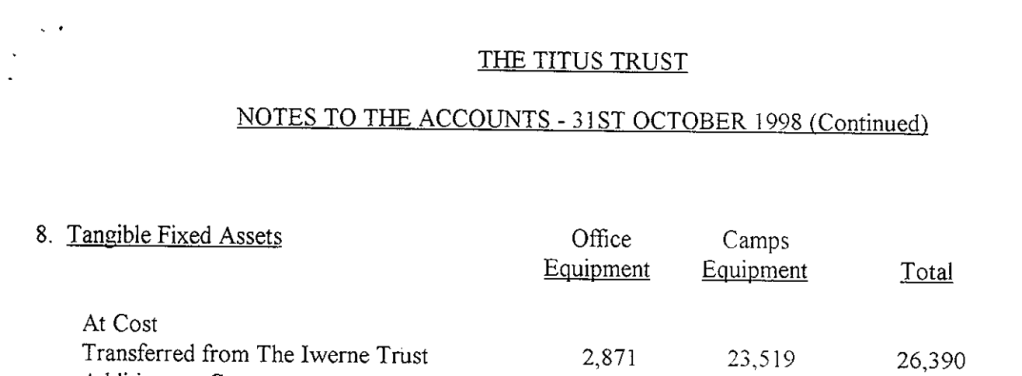
Three quarters of the first directors (i.e., trustees) of the Titus Trust had previously been serving as trustees of the Iwerne Trust (AMR, p. 163). Similarly, Giles Rawlinson switched from chairing the Iwerne Trust to chairing the Titus Trust. And when the Titus Trust took over the task of funding certain Scripture Union employees, the personnel remained the same.
Promotional literature produced by the Titus Trust demonstrates the closeness of its relationship with the Iwerne Trust. The cover of a leaflet designed to introduce the Titus Trust describes the new organisation as “Formerly the Iwerne Trust” (see below).

The leaflet goes on to say, “we have decided to adopt a fresh name for the Iwerne Trust. We have chosen ‘The Titus Trust’” (see below).
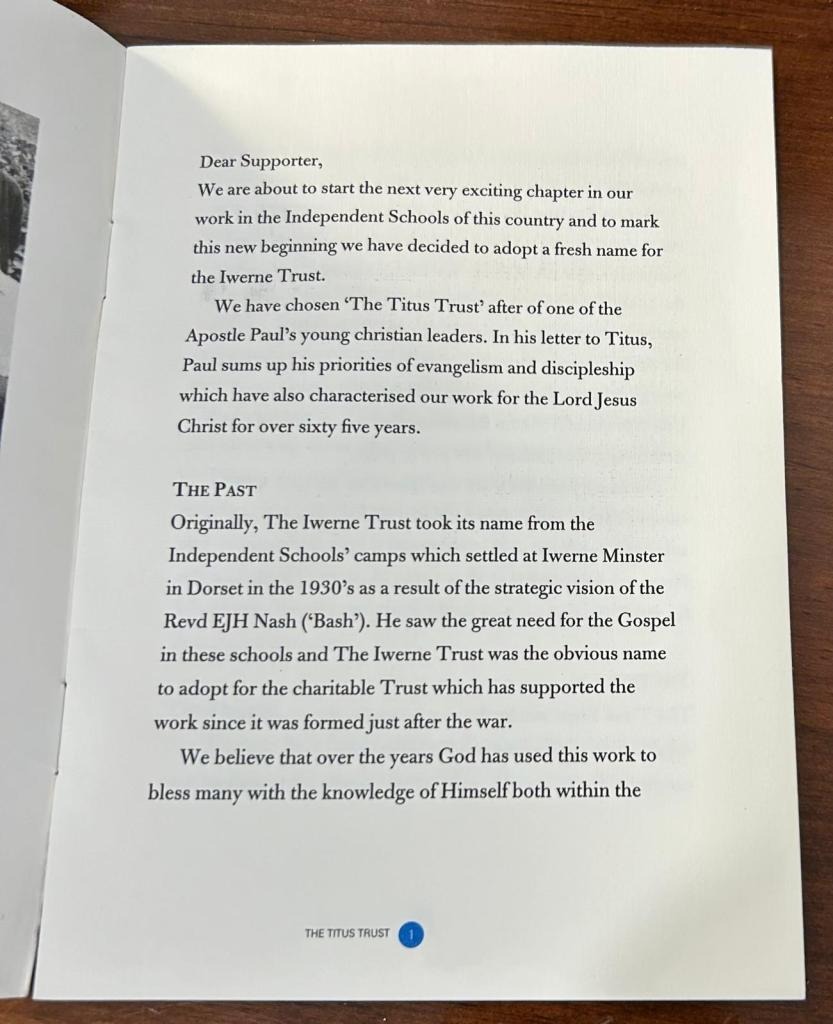
The continuity between the Iwerne Trust and the Titus Trust can also be seen in a 2003 summer camps brochure. The Titus Trust was technically just six years old, but the brochure says “The Titus Trust … has been involved in the work of Scripture Union in Independent Schools for over sixty years” (see below). This shows that the Titus Trust’s own staff members viewed their organisation as the Iwerne Trust under a different name.
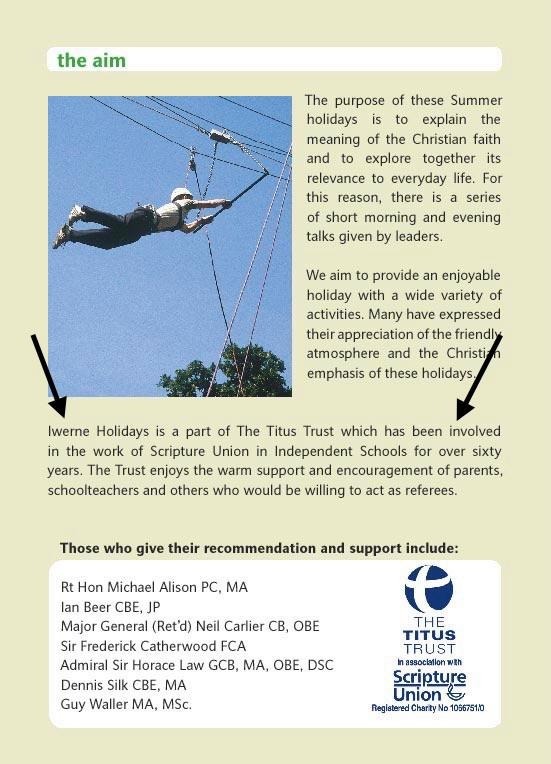
Even more conclusively, the Titus Trust’s own website declared, “The Titus Trust has been running excellent activity holidays for young people at independent schools since the 1930s” (see the white portion of the screenshot below).

That wording was still being used on 7 November 2016, just a few months before Smyth’s abuse was exposed. It was only in February 2017 that the Trust started saying, “It is not … correct to refer to The Titus Trust as the successor body to The Iwerne Trust” (AMR, p. 196).
The most formal context in which the Trust articulated its relationship to the pre-1997 camps was in its annual accounts. As the Trust’s Independent Culture Review points out (TTCR, pp. 105–06), the accounts for 2016 state that the Trust’s charitable objective “has, for over 86 years, demonstrated a broad and long term effect”. In the accounts for 2017, however, that reference to a legacy of 80+ years is nowhere to be seen.
Until February 2017, therefore, the staff members and trustees of the Titus Trust saw their organisation as a modified version of the pre-existing Iwerne Trust. This was so real to them that they themselves talked as if the Titus Trust had existed since 1930. Still more evidence along the same lines can be found in the Trust’s Independent Culture Review (see TTCR, pp. 104–08). The review says, “With regard to the moral responsibility of the Trust, there is good evidence that, prior to 2017, the trustees and the Trust as a whole saw the link between the Iwerne Trust, Iwerne holidays and the Titus Trust and indeed used that to promote the work” (TTCR, p. 105).
A final point to note is that the Titus Trust’s above-quoted claim that “It is not … correct to refer to The Titus Trust as the successor body to The Iwerne Trust” is contradicted by the Charity Commission, which has described the Iwerne Trust as “the predecessor charity” of the Titus Trust (MR, 14.3.54).
The Titus Trust’s refusal to accept responsibility
Despite the facts set out above, the Titus Trust has refused to accept responsibility for anything to do with Smyth that happened before 1997. What arguments has it used to defend that position? A letter sent to Trust supporters on 17 February 2017 (page 1, page 2) lays out three main lines of defence.
First, the letter emphasises that the Trust “did not exist at the time” and the matters in question “occurred prior to its formation”. The implication here is that the Trust can’t answer for conduct that took place before it came into being. This argument is based on the technical distinction between the Iwerne Trust and the Titus Trust. As we’ve seen, however, that distinction is wafer thin and wasn’t even recognised by the Titus Trust itself before the Smyth scandal broke in 2017.
The second line of defence is that the Titus Trust is “not the legal successor of the body that did run the camps”. The body in view here isn’t the Iwerne Trust but Scripture Union (SU), which, as mentioned earlier, employed the relevant staff until 2000. According to Andrew Graystone, the Titus Trust’s lawyers advised that “Their best strategy … might be to emphasise the discontinuity between Iwerne and Titus, and to assert that the Scripture Union, who had been the formal employers of many of the Iwerne staff, should be held responsible for any safeguarding failures” (BFJ, p. 250, emphasis added). By shifting the blame on to SU, the Titus Trust sought to put even more distance between itself and Smyth.
The legal question of which organisation ran the camps remains unresolved. The Titus Trust claims that “SU ran the Iwerne camps until 2000” (TTD, p. 23); SU, however, disputes this, citing its Independent Review, which “finds that Scripture Union did not operate the Iwerne Camps.” SU’s review says that “at the time of Smyth’s involvement, Iwerne Trust, another Christian charity, had financial, management and executive control over the Iwerne Camps” (SUR, p. i, 2.2). The review also notes that David Fletcher “indicated that he regarded his employment by SU as a technicality as the money to pay for his camp work and salary was raised through the Iwerne Trust” (SUR, p. 7, 6.4). Speaking personally, I experienced six of the summers when, according to the Titus Trust, SU ran the camps (1994–1999), and it was as if SU didn’t exist.
One way to cut through this dispute is to say that once Smyth’s abuse had been disclosed, both organisations should have reported it. But the Iwerne Trust’s responsibility was surely greater, because Smyth was a trustee – indeed, he was chair of the board – which meant the abuse was unquestionably a fiduciary matter for the Trust itself. (By the time of the disclosures, Smyth was no longer a trustee of Scripture Union, although he had been in the past [MR, p. 38].) Moreover, several of the Iwerne Trust’s trustees were among the original recipients of the disclosures, whereas SU’s leaders were only notified later (SUR, p. 7, 6.5).
The letter’s third line of defence is to claim that the Trust isn’t allowed to imply liability for wrongdoing that technically isn’t its own: “As trustees we have clear and binding legal duties under charity law not to do anything that might be taken to infer the liability of the Trust by claiming responsibility”. This argument has been reiterated by the Trust elsewhere: “The trustees could not voluntarily assume responsibilities and liabilities which are not those of the Titus Trust” (TTD, p. 25, emphasis added). But this is untrue. There is no legal requirement tying the trustees’ hands.
The trustees have a duty to fulfil the purposes of their organisation, which are “to seek by every available effective means to make the Christian faith a living practical issue to young people having a present or past association with independent schools in England and Wales, this being done in accordance with the basis of faith.” Fulfilling those objectives doesn’t mean prioritising the survival of the organisation. As the well-respected Christian charity Stewardship explains, “acting in the best interests of the charity is about doing those things which enable the charity to fulfil its purposes … it is not about serving the best interests of the trustees, staff, members, supporters or donors, or even preserving the organisation itself.”
Therefore, even if it’s right to think that the Titus Trust isn’t technically liable for the failings of 1980s-era Iwerne personnel, the Trust could still accept its moral responsibility and act accordingly. This approach would model the “living practical” faith that the Titus Trust was set up to promote. Christians are expected to demonstrate “justice and mercy and faithfulness” (Matthew 23:23).
Interestingly, the Trust’s documents suggest that its own lawyers merely recommended that it shouldn’t make Smyth-related payments (TTD, p. 17, entry for 16/03/15). But the Trust has claimed that it couldn’t make those payments (“The trustees could not voluntarily assume responsibilities and liabilities which are not those of the Titus Trust” [TTD, p. 25]). So the Trust has wrongly portrayed a course of action that its lawyers considered inadvisable as if it were unlawful.
The Trustees have effectively been saying “Our hands were tied” when they weren’t (and aren’t) tied. Whether or not the Trust intended to be deceptive, its “could not do this” falsehood has certainly had the effect of pulling the wool over many people’s eyes.
In short, the three arguments used by the Titus Trust to distance itself from Smyth don’t stand up to inspection.
The Titus Trust’s own conduct since 1997
The debate about the continuity between the Iwerne Trust and the Titus Trust can obviously be left behind as we turn to the Titus Trust’s own actions since 1997.
David Fletcher and David Wilkinson were among the original recipients of the Ruston Report (MR, 12.1.33). They were also founding trustees of the Titus Trust. The creation of the Trust in 1997 gave Fletcher and Wilkinson an opportunity to clean house by putting an end to the cover-up they’d begun 15 years earlier. They chose instead to continue covering up Smyth’s abuse.
The correspondence quoted earlier in this article shows that the leaders who failed to report Smyth were acting on behalf of “camp”. This motivation never changed (see MR, 12.1.10.e). Therefore, when Fletcher and Wilkinson maintained the cover-up after the Titus Trust was established, they were fulfilling what they considered to be their duty as trustees.
That’s significant because if an individual in an organisation commits wrongful acts in the course of duty, the organisation as a whole is liable for those acts, not just the individual. This is the legal principle known as respondeat superior – “let the master answer”. A quick thought experiment shows the value of this principle. Imagine a chemical manufacturer dumped pollutants near your home, and a family member developed life-threatening tumours as a result. The principle of respondeat superior would prevent the company from simply blaming the pollution on a rogue employee and thereby evading all liabilities.
Respondeat superior means it’s not necessary to show that the Titus Trust as a whole decided to cover up Smyth’s abuse. That kind of organisational decision is hard to prove in cover-up cases because most leaders are shrewd enough not to discuss such things on the record. What’s more, in this case it would be impossible to prove what the Trust did or didn’t decide because some of the minutes of early Trust meetings are missing (TTCR, p. 23).
In sum, to hold the Titus Trust responsible for covering up Smyth’s abuse, all that needs to be shown is that one or more of the Trust’s representatives maintained the cover-up after the Trust began operating. And that’s precisely what Fletcher and Wilkinson did.
Moreover, the Trust doesn’t just consist of its trustees. It’s also represented by staff members and volunteer leaders. When the Trust came into existence, Tim Sterry was its most senior staff member and Peter Wells was a volunteer leader. They had both received the Ruston Report 15 years earlier (MR, 12.1.33). Jonathan Fletcher served for many years as a volunteer leader on Titus Trust camps; he had also participated in the cover-up in 1982 (MR, 12.1.120).
All in all, at least two Titus Trust trustees (David Fletcher and David Wilkinson), at least one Titus Trust staff member (Tim Sterry), and at least two influential Titus Trust volunteer leaders (Jonathan Fletcher and Peter Wells) knew the full horror of Smyth’s abuse and didn’t report it to the police. They weren’t individuals acting independently of each other. They belonged to an inner circle that had deliberately chosen not to report criminal abuse to the police since 1982, and they maintained their collective cover-up after the Titus Trust came into being. In addition, we’ll see below that Giles Rawlinson, the most powerful member of the board, had access to the facts from 1999 onwards but chose not to consult them, even when the Trust was directly challenged about Smyth.
Covering up the abuse in 2012–13
Everything said so far is already enough to prove that the Titus Trust covered up Smyth’s abuse after it came into existence in 1997. But there’s yet more evidence confirming that conclusion.
Giles Rawlinson, the Titus Trust’s first chairman, had joined the board of the Iwerne Trust in 1980, when Smyth was still its chairman (AMR, p. 163). As a result, he would have witnessed Smyth’s unexpected withdrawal in 1982 from all Iwerne events. (This was an obvious red flag, and it worried the Iwerne group covering up the abuse [see AMR, p. 110].) When Tim Sterry retired from the Titus Trust in 1999, he gave Rawlinson an envelope containing the Ruston Report and told him “it was about John Smyth but that it should not be opened until there was a need to do so” (MR, 14.3.43). Rawlinson would inevitably have connected those ominous instructions with the sudden disappearance of Smyth from Iwerne activities 17 years earlier.
Rawlinson wasn’t obliged to obey Sterry. In fact, he had a fiduciary duty to read the document immediately because Sterry’s words hinted at a risk to the charity for which Rawlinson was responsible. But he’s said he didn’t open the envelope at that time (MR, 14.3.43).
Thirteen years later, the Trust was directly challenged about Smyth. And yet, even then, Rawlinson failed to open the envelope. The journalist Anne Atkins had written for the Daily Mail in October 2012 about two abusers known to her who had never been reported. One of them was an unnamed lawyer who “used to invite boys to his house for Bible study … he would strip and beat them, in a shed where no other adults were allowed.” An individual, who’s referred to as “R1” in the relevant documents, emailed the Trust to say that the lawyer in Atkins’s article was Smyth (TTD, p. 4). The Trust’s Operations Director forwarded the correspondence with R1 to six core Trust personnel – a combination of trustees and senior staff members (AMR, p. 178).
As the following quotation shows, R1 couldn’t have been clearer when urging the Trust to doublecheck whether Smyth’s conduct had been criminal: “You (or one of your Trustees) need to send me a ‘winding up’ statement on this matter. Has this historic situation been investigated/faced up to? Perhaps it was at the time, but it will have to have been looked at again in the light of what constitutes abuse and what constitutes criminal activity, as you know, by both the school involved and any organisations directly or indirectly linked with what happened” (AMR, pp. 178–79).
It was Rawlinson who drafted the Trust’s factually-incorrect reply to R1, sent in January 2013: “I can confirm that a specific investigation has been carried out by the Trustees since your enquiry, and they are assured that this matter was handled at the time, and that no criminal activity occurred” (TTD, p. 4, emphasis added). If Rawlinson had chosen to open the envelope containing the Ruston Report, he could have avoided giving false information. But he only opened it eleven months later, in response to separate developments (MR, 14.3.43). By keeping the information hidden from R1, Rawlinson participated in the cover-up.
Rawlinson was plainly acting on behalf of the Trust, and he did so with the knowledge of the Operations Director, the Trust’s vice chair (whose specific responsibility was safeguarding), and David Fletcher (TTD, p. 4). Additionally, the three senior staff members who’d been shown R1’s emails were evidently content to let Rawlinson handle the matter on the Trust’s behalf. The Trust itself explicitly refers to the January 2013 email drafted by Rawlinson as its own activity, describing it as “the Trust’s response to the person who contacted them in November and December 2012” (TTD, p. 25).
What’s more, Rawlinson actually raised the matter with the full board of trustees on 12 March 2013. He mentioned the Anne Atkins article, an enquiry from an external party, and what he termed “the Winchester affair” (TTD, p. 5). Those sizable breadcrumbs were more than enough to lead everyone at the meeting towards the truth, had they wished to discover it. The Atkins article could have been accessed on a smartphone in seconds.
Even the most fervent defender of the Trust would have to agree that when it was challenged by R1, it conducted a cover-up.
In the “Frequently Asked Questions” section of its documents, the Trust addresses the allegation that it covered up Smyth’s abuse. One part of its answer deals with its response to R1. The Trust forgets the question it has just put to itself (“To what extent, if any, was there a cover-up by the Titus Trust?”), and instead explains the motive behind its actions: “the Trust’s response to the person who contacted them in November and December 2012 was shaped by the need to protect victims’ identities” (TTD, p. 25). This is horribly evasive and misleading. The Trust could have responded rightly to R1’s disclosure without revealing any victims’ identities. What’s more, its primary responsibility has never been confidentiality but justice (see MR, 12.1.49–50).
The Trust’s correspondence with R1 in 2012–13 is one of the most significant episodes in the decades-long cover-up. By 2013 the Trust was highly attuned to safeguarding norms, and the importance of proper reporting had been brought to the whole nation’s attention by the Jimmy Savile revelations – a scandal that R1 mentions in the correspondence (AMR, pp. 181). Yet R1’s earnest and detailed disclosure to the Trust still hit a brick wall. Although the full details weren’t openly shared with the whole board at the March 2013 meeting, some key details were shared, and so it can’t be claimed that the board was kept in the dark.
It may feel now as if John Smyth was bound to be exposed at some point, but in 2013 no one could have been sure it would ever happen. The correspondence with R1 shows the Trust actively keeping criminal abuse unreported and protecting Smyth from exposure.
Despite knowing all this, the Trust still claims “there has not been – as some have suggested – any cover-up on our part” (TTD, p. 2). That statement is false and reprehensible.
The Titus Trust’s apologies
The title of this article refers to the lack of personal apologies from evangelical leaders responsible for the Smyth cover-up. However, it’s also true that there have been vanishingly few apologies from the relevant evangelical organisations. When the Titus Trust’s various Smyth-related apologies are examined, they all fall badly short.
An apology for “mixed messages”
In December 2021, when the Titus Trust’s Culture Review was published, the Trust issued the following apology: “The report … highlights ways in which we have been inconsistent in speaking about the organic connections between the camps that we run today and the camps that ran before the Titus Trust came into being. We acknowledge we have given mixed messages about this legacy. We apologise for this and apologise to the victims and survivors of John Smyth’s abuse for ways in which this has compounded their pain”.
That statement misses the point. The Culture Review hadn’t criticised mixed messages about the connection between the camps before and after the Trust’s creation; it had criticised mixed messages about the connection between the Trust itself and the pre-1997 camps: “It is the reviewers’ opinion that the Trust should apologise for the way in which it has conveyed a mixed message about its connection to the Iwerne camps” (TTCR, p. 108, emphasis added).
Since the Smyth scandal broke, the Trust has kept denying its connection to the pre-1997 camps, which is so plain to see, and which the Trust itself had previously promoted. To apologise properly for its mixed messages, the Trust would need to admit that the 1997 remodelling didn’t break the organisation’s connection to the previous decades. It must be reemphasised that the organisation’s chairman, staff members, volunteer leaders, databases, camp locations, equipment, financial capital, ministry practices, and distinguished reputation all remained the same. The Titus Trust’s denial of organisational continuity is a denial of reality.
An apology that isn’t an apology
The Trust’s collection of documents about the Smyth scandal begins with the following apology, which is later restated in various ways: “We recognise that at times we have failed to show our concern for the victims and survivors of John Smyth’s abuse. The welfare of every victim and survivor should always have been our main priority. We can see that we could have done more, perhaps alongside independent experts, to reach out to victims and survivors and work with them in shaping our responses. In seeking properly to discharge our regulatory duties and in establishing that we did not have legal responsibility for Smyth’s abuse, we have not always displayed all the Christian love and compassion that should be expected of an organisation committed to making the Christian gospel known. We are deeply sorry for the additional pain that we caused for a number of these men and their families” (TTD, p. 2; see also sections 1, 9, and 13 of the “Frequently Asked Questions” document, pp. 23–25).
At first sight, that apology seems to be a suitably contrite expression of wrongdoing. But it doesn’t add up. The Trust is apologising for conduct that fitted its legal strategy “not to do anything that might be taken to infer … liability”, and yet the Trust never admits this strategy was morally wrong. In fact, the trustees remind readers – in the middle of their apology – that they were “seeking properly to discharge our regulatory duties”. So the Trust is essentially saying, “We’re sorry for doing what it was our duty to do.” That’s an expression of regret, not an apology for wrongdoing. Expressing regret offers little comfort to the injured party, whereas apologising for wrongdoing dignifies the injured party by admitting the reality of an offence.
The following specific example will demonstrate the point. The Trust’s timeline includes this entry for 16 March 2015: “BR [Barlow Robbins, the Trust’s lawyers] provided detailed advice regarding funding counselling sessions, recommending that the Trust should not pay as it did not bear the responsibility for JS’s [John Smyth’s] action” (TTD, p. 17). The Trust evidently still thinks this advice was correct, because it continues to insist, “The trustees could not voluntarily assume responsibilities and liabilities which are not those of the Titus Trust” (TTD, p. 25). As a result, when the Trust says “We are sorry not to have done more to offer support” (TTD, p. 24), it’s not genuinely apologising because it’s not admitting that it did anything blameworthy.
The moral incoherence of the Trust’s position is encapsulated in a single sentence: “we recognise that at times our response was shaped more by legal and statutory responsibilities than by our Christian compassion, and we are very sorry” (TTD, p. 23). By claiming it was fulfilling responsibilities, the Trust undercuts its apology for its actions. Again, it’s expressing regret rather than actually apologising.
To repeat what was explained above, the Trust was guilty of the gravest wrongdoing that deserved a true apology. It covered up Smyth’s abuse and, despite its claims to the contrary, it wasn’t bound by any legal responsibility forbidding it to be generous to victims.
Although the Trust may not have meant to be misleading, that’s the effect of presenting expressions of regret as if they were true apologies. It gives the impression of genuine Christian repentance to casual onlookers, while people who are really in the know, such as victims and lawyers, understand that no wrongdoing has actually been admitted.
An apology for negligence
On top of the apologies already discussed, there’s a separate apology for a particular instance of negligence: “The timeline shows that police and safeguarding authorities were involved from 2013 onwards. But we wish, for instance, that more questions had been asked within the Trust before summer 2014. For example, when, in December 2013, the then Chair of the Trust made a reference to something he ‘was dealing with’, all trustees should have insisted on knowing the nature and seriousness of the matter. We are sorry about this too” (TTD, p. 2).
There’s a serious problem with this apology: it foregrounds a missed opportunity at the Trust’s December 2013 meeting, instead of the much more important missed opportunity in March that year – the enquiry from “R1” discussed above.
The timings in 2013 matter because Smyth’s abuse was disclosed that summer to the Bishop of Ely’s safeguarding advisor, who informed the police (MR, 14.1.1.a and p. 173) and also the Trust (TTD, p. 5). None of those steps had yet been taken when the Trust’s board met in March that year. So the trustees’ negligence at that March meeting had the effect of perpetuating a cover-up that could – as far as the Trust was concerned – have gone on for ever.
The current trustees understand the significance of responding negligently to a disclosure. That’s why they point out that safeguarding authorities were already involved by the time the Trust’s December 2013 negligence happened. So it’s hard to believe they chose to focus on December – rather than March – by accident. Apologising for the March 2013 negligence, when the authorities weren’t yet involved, would have drawn unwelcome attention to the Trust’s role in the cover-up. It would have made the “no cover-up” claim impossible to sustain. Putting it simply, by highlighting December the trustees kept people from looking too closely at March. That’s hardly a commendable apology.
Where now for the Trust?
The Trust has a pathway back to truthful, righteous conduct that lines up with the Christianity it professes. It needs to admit blame and offer financial restitution.
1. Admissions of guilt
In Genesis 20 verse 2, Abraham describes his wife Sarah as “my sister.” The predictable outcome is that “Abimelech king of Gerar sent and took Sarah.” Abraham has a technical defence because Sarah is in fact his half-sister. But commentators agree it was nonetheless terribly wrong of him to let his wife be treated as his marriageable sibling. The technical truth of Abraham’s claim doesn’t stop him being in the wrong.
The Titus Trust’s reliance on the technical difference between itself and the Iwerne Trust (“The abuse took place many years before the Titus Trust came into existence” [TTD, p. 24]) is similarly unjustifiable. The Titus Trust should stop depending, Abraham-style, on that technicality. The continuity between the two trusts couldn’t be clearer. The Titus Trust should accept responsibility for the actions of the Iwerne Trust and apologise unreservedly.
The Titus Trust should also stop trying to shift blame on to Scripture Union. SU may have its own case to answer, but the Iwerne Trust undeniably had a fiduciary responsibility to report the crimes of John Smyth, its chairman. And no existing organisation is better placed to take responsibility for the Iwerne Trust’s wrongdoing than the Titus Trust.
In addition, the Trust committed Smyth-related wrongdoing of its own after it was constituted in 1997. It should admit that at least five senior representatives maintained the cover-up during the years 1997–2014, and it should admit that seven of its most powerful personnel covered up the abuse when they received a crystal-clear disclosure about Smyth in 2012.
The Trust should also admit that it communicated dishonestly when, in 2017, it issued the following public response to the Channel 4 News exposé: “It was only in 2014 that the board of The Titus Trust became aware of these allegations, after which the Trust provided full disclosure to the police”. The truth was that two board members knew about the allegations when the Trust came into existence; the founding chairman had the facts in his possession from 1999 onwards; a core group of board members covered up the abuse when directly challenged in 2012; the whole board responded negligently to information about the allegations in March 2013; and the chairman and another board member received detailed information about the allegations in November 2013 (TTD, p. 5).
The Trust could have accurately said, “It was only in 2014 that the whole board of the Titus Trust became fully aware of these allegations.” But of course that kind of carefully qualified statement would have prompted awkward follow-up questions: “What do you mean by the whole board? What do you mean by fully aware?” Instead of inviting such questions by making an honest statement, the Trust made the unqualified claim quoted in the previous paragraph. It had no right to make that claim. In doing so, the Trust seriously misled the general public, Smyth’s victims, and its own supporters.
In this way, at the very start of the public phase of the scandal, the Trust attempted to present itself favourably rather than admitting blame. But the only way it could achieve this was by creating a false narrative (essentially, “We reported this in the same year we heard about it”), instead of sticking to the facts, no matter how uncomfortable they might have been. This calls for repentance.
2. Financial restitution
Anyone who has followed the global Roman Catholic abuse scandal will know that settlements with victims typically involve large compensation payments. Such payments have also been made by evangelical Anglicans, whose churchmanship is the form of Christianity most closely associated with the Titus Trust. These payments represent due recognition of the impact of abuse on victims at the time and throughout their later lives.
The Trust has given the following information about a settlement between itself and Smyth’s victims: “When the trustees were informed of potential action against the Trust related to the actions of John Smyth they were legally bound to act in the best interests of the charity and sought legal advice to ensure that these duties were discharged properly. A detailed review concluded that the Titus Trust was not responsible for running the Iwerne camps in the 1980s when Smyth’s appalling abuse took place. The trustees could not voluntarily assume responsibilities and liabilities which are not those of the Titus Trust and this resulted in a settlement with those who were planning to bring the action” (TTD, p. 25).
Further information about this settlement can be found in Bleeding for Jesus: “The 2018 Annual Report of the Titus Trust recorded its expenditure of money, not to help victims of Smyth, but rather to avoid being compelled as the successor organisation to Iwerne to support the victims. The report said: ‘The Trustees are confident that the Trust bears no legal responsibility nor, therefore, any financial liability in regard to this matter … the extensive legal work to protect the Trust has been substantial, in total, legal fees of £72,724 were incurred in the financial year, and the Board set aside monies from reserves to cover in full further anticipated legal costs.’ The following year they spent even more on lawyers and consultants … Eventually the trust agreed to make ex-gratia payments to the three claimants. Their first offer was so small that after legal costs, it would have left the men out of pocket. They eventually settled for a combined sum that was a small fraction of the amount the Titus Trust had spent on defending itself and its reputation” (BFJ, p. 291).
Based on those details, the Trust has not yet offered the victims anything close to a suitable sum. One way to put that right would be for the Trust to contribute very generously to an evangelical redress scheme (as discussed earlier), so that the overall amount is commensurate to the amount paid in similarly destructive abuse cases.
Speaking personally, I don’t want the Titus Trust to cease to exist. I can’t imagine how the evangelistic work it does would be done without it. I know the Trust doesn’t have bottomless resources, and by meeting this particular obligation it may put its future at risk. But it shouldn’t be controversial to say that Christians should do the right thing and entrust the consequences to God, even when doing the right thing means making large-scale, unbudgeted financial restitution. The songs sung at the Trust’s camps speak of a God who’s more than capable of meeting all our needs. They speak of a God for whom all things are possible (Matthew 19:26).
Unapologetic Individuals
The conservative evangelical leaders to whom the abuse was first disclosed in 1982 are now deceased, with the exception of the Anglican clergymen Jonathan Fletcher and Roger Combes. Fletcher was himself found, via the legal process known as an “examination of the facts”, to have indecently assaulted a man on multiple occasions between 1973 and 1999. Combes claims he “held [the Ruston Report] unopened on his knee, realised the seriousness and the nature of the report and chose not to read it” (MR, 12.1.34). He thereby abdicated his responsibility to handle the disclosure rightly, which effectively made him complicit in the cover-up. To my knowledge, Fletcher and Combes have never apologised for their conduct in the scandal.
Later in the 30-year period of silence, other conservative evangelical leaders gained knowledge of Smyth’s abuse and also failed to respond rightly. There’s an important sense in which the cover-up wasn’t their cover-up. They didn’t make the original choice not to report Smyth. They’re not as culpable as the Iwerne leaders who made the key decisions in 1982. But they could and should have acted differently, and they should now apologise.
The main reason for apologising is to seek reconciliation. The power of an apology for bringing about reconciliation was demonstrated in the documentary See No Evil when Anne Smyth, John Smyth’s widow, apologised to his victims, saying, “I’m so sorry for what you went through … I feel … desperately sorry that I wasn’t strong enough to stand up to him – just to say to him ‘Why don’t you just stop all this?’” In response, Mark Stibbe said, “I fully and unconditionally forgive her for what happened all those years ago.” Anne Smyth also apologised to her children: “I want with all my heart to say I am so sorry; I am just – I’m ashamed of myself.” Her son, PJ, replied, “I’m so grateful. This is just what we’d hoped for.” She then said, “I’ve been longing for this too. And I’m so grateful that you haven’t given up on me. Thank you.”
A second reason why it’s necessary for the individuals at fault to apologise is so they can maintain their Christian integrity. The gospel calls for faith and repentance. Repentance requires acknowledgment of sin and – if needed for reconciliation – personal apologies. How can these Christian leaders preach the gospel with integrity if they’re not willing to demonstrate repentance themselves?
A third reason for publicly apologising is to explain what ought to have been done differently. An apology has educative power because it shows others what they should do if they ever find themselves in a similar situation. In contrast, refusing to apologise sends the false, dangerous message that failing to report abuse is an insignificant oversight.
A good introduction to biblical forgiveness is Kevin DeYoung’s article “Following Up on Forgiveness”. On the particular subject of apologies, a recommended resource is the final segment of a seminar by Wade Mullen titled “The Power of Truth and Sincerity”. Proper apologies acknowledge specific wrongdoing, whether intentional or unintentional, and ask for forgiveness. In this case, apologies would need to be made in public statements in order to reach the British and African victims whose identity has remained secret.
The three individuals below don’t represent an exhaustive list. They’re discussed because they’re well known in the conservative evangelical movement, which means their unwillingness to admit personal fault in this scandal sets a powerful negative example.
David Jackman
David Jackman is one of the most respected figures in British conservative evangelicalism. After pastoring Above Bar Church from 1976–91, he led the Cornhill Training Course from its inception in 1991 until 2004. He then served as the president of the Proclamation Trust until 2009.
Jackman’s role in the Smyth scandal was mentioned in one of the first in-depth reports in the national media. Discussing events that happened in the early 1980s, a Telegraph article said, “David Jackman, then a senior minister at a leading evangelical church also admitted he was told about the allegations at the same time.”
Jackman isn’t a Church of England officer, which means the Makin Review wasn’t tasked with gathering information on his conduct (see MR, 3.2–3). Nevertheless, the review mentions him frequently because of his significant role (see MR, pp. 71–2, entries for January 1983, 8/3/83, 13/3/83, Spring 1983; p. 121, entry for August 1984; 12.1.84, 12.1.132, 12.1.138, 12.1.141, 12.1.144–5, 12.1.150, 12.1.154, 12.1.164, 12.1.165).
The closest the review comes to issuing a verdict on Jackman’s conduct is the following comment: “The leaders of a Church [Smyth] tried to join in Southampton … were warned about him. A summary of the Ruston Report was shown to them, detailing the nature and extent of the abuse that he perpetrated, this did not lead to any further action or reporting that prevented further abuse” (MR, 16.23). The implicit rebuke of Jackman in those final words is hard to miss.
Another deducible criticism of Jackman can be found in the review’s comments on the neglect of Smyth’s family. As seen in the earlier section on Above Bar Church, Jackman was the family’s pastor for at least a year. The review says, “The needs of John Smyth’s own family were overlooked throughout this entire period of Review, by all of those involved in responding to his abuse … There is nothing to suggest any consideration was given as to whether he presented a danger to his own family, particularly his wife and his children, and later his grandchildren” (MR, 22.1.2; see also 22.1.3).
In assessing Jackman’s role, it’s helpful to bear in mind comments from John Stevens – the influential non-Anglican leader mentioned earlier – about the culpability of Justin Welby. When the Makin Review was published, Stevens strongly implied that Welby should resign as Archbishop: “It is hard to see any justification why he should remain in post given the loss of his moral authority. His account of his knowledge prior to 2013 is unconvincing, and his failure to act appropriately after he was fully aware of the nature of Smyth’s abuse indefensible.”
After Welby had resigned, Stevens told FIEC’s podcast, “[In] 2013, victims were beginning to come forward and the church did not do enough to pursue that, and actually Makin concludes that the Archbishop of Canterbury had a responsibility to do more, that he in a sense was morally, personally accountable. … Makin finds that essentially Smyth continued to abuse from 2013 up until even his death in 2018 so the failure to act in 2013 in and of itself perhaps potentially enabled that to happen and I think that that made [Welby’s resignation] inevitable.”
Stevens’s verdict on Welby’s failure “to do more” is surely also applicable to David Jackman, about whom Stevens has said nothing. By his own admission, Jackman was alerted to “the extent and very serious nature of [Smyth’s] actions” (MR, 12.1.145). This happened in 1983 (MR, 12.1.144). If Welby was culpable for not taking sufficient action in 2013, how much more was Jackman 30 years earlier, when responsible action could have prevented all of Smyth’s abuse in Africa?
What’s more, Welby was told in 2013 that the police were handling the Smyth case (MR, p. 174, entry for 9/8/13). Jackman lacked any such assurance, and moreover he actually facilitated Smyth’s exit to Africa, making it harder for the authorities to deliver justice. He did this in two ways: by commending Smyth to African Enterprise (MR, p. 121, entry for August 1984), thereby helping him find work; and by joining the Council of Reference for Smyth’s fundraising charity (MR, 12.1.155). Jackman did these things even though he’d banned Smyth from attending his own church (12.1.84). His behaviour was similar to that of Roman Catholic bishops who moved abusers from their own diocese to distant regions.
To continue the parallel between Welby and Jackman, Welby’s account of his pre-2013 knowledge of Smyth’s abuse was, according to Stevens, “unconvincing”. But Jackman’s testimony to Andrew Graystone, the author of Bleeding for Jesus, is even less plausible: “When interviewed, [Jackman] told me that he cannot remember seeing or hearing anything about John Smyth’s abuse, and that he was not involved in facilitating his move to Zimbabwe” (BFJ, 1st ed., p. 272). Jackman later gave completely different testimony to the Makin Review, presumably because evangelical leaders who hadn’t spoken to Graystone were now giving evidence, and their detailed contributions made it impossible for Jackman to continue claiming ignorance.
Another example of the implausibility of Jackman’s testimony is the explanation for his actions that he gave to the Telegraph in 2017: “I assumed that the matter was being dealt with by the authorities concerned.” How could he possibly have thought this? He was fully aware that he himself had made it harder for the authorities to deal with Smyth, because the reference he had provided to African Enterprise had helped Smyth leave.
Andrew Graystone’s words about Anglican clergymen who participated in the cover-up are surely also applicable to Jackman: “Had any one of these men spoken out about what they knew, upwards of 90 African children might not have been viciously beaten, and the UK victims might have seen Smyth and those who colluded with him face the justice they deserved” (BFJ, p. 298). Similarly, the firm conclusions expressed in the Makin Review about early 1980s Anglican clergymen who knew of the abuse could also be applied to Jackman: “further abuse could and should have been prevented”; “there was a legal and moral imperative … to report the matter to the relevant authorities” (MR, 16.29; see also 16.22–4).
Conservative evangelical silence
Why have John Stevens and FIEC said nothing about Jackman despite the evidence implicating him in the cover-up? Stevens says he has read both Bleeding for Jesus and the Makin Review, and so he must have observed Jackman’s prominent role. I can only conclude that Jackman has escaped criticism because he – unlike the former Archbishop of Canterbury – is a conservative evangelical. This is a self-protective version of “two tier justice”, where defendants from a favoured group receive leniency while those outside the group are treated severely. It’s also the kind of behaviour that distinguishes a cult from a regular religious institution. Cults are notorious for failing to rebuke esteemed leaders. (I don’t believe conservative evangelicalism is a cult, but I do think conservative evangelicals can behave in cult-like ways.)
Stevens’s silent response to Jackman’s conduct sets a terrible precedent for future evangelical scandals. If he can’t explain why Jackman should get a free pass while Welby shouldn’t, and if he remains unwilling to criticise Jackman, Stevens must be held to account by FIEC’s trustees. Favouritism should be unacceptable to Christians in any context (James 2:1–4), but especially in judicial matters such as ministerial wrongdoing. Having spoken out about Welby, Stevens can’t object when he’s asked to address Jackman’s conduct in the very same scandal. FIEC must not allow its National Director to demonstrate partiality when publicly adjudicating the worst scandal in recent British Christian history. This is a test of FIEC’s integrity.
The problem, however, goes beyond FIEC alone. For British conservative evangelicals, one of the highlights of the annual calendar is the Proclamation Trust’s Evangelical Ministry Assembly. At this year’s EMA, one of the ten plenary meetings will be a full-session interview with David Jackman. This is comparable to a lifetime achievement award at a major ceremony. Many of those attending the conference will have personally argued, after the Makin Review’s publication, that Justin Welby should resign. But, as shown above, Jackman’s wrongdoing in the crucial early years of the scandal far outweighs Welby’s misconduct. How can it be right for Jackman to be honoured, post-Makin, by the very same people who thought Welby should resign in disgrace?
It says in Proverbs 20:23: “The Lord detests differing weights, and dishonest scales do not please him.” I’d be grateful if anyone could explain to me how British evangelicalism’s scales are functioning honestly when Welby is condemned for his role in the Smyth scandal while Jackman’s role is completely overlooked. Victims of Smyth told the Scripture Union Review that “they felt there was a level of ‘willful ignorance’ demonstrated by the wider evangelical community” during the scandal (SUR, p. 12, 6.34). Willful ignorance is the perfect summary for the evangelical community’s ongoing attitude to Jackman’s record.
If, in 2017, Jackman had himself disclosed the facts that would later be revealed by the Makin Review, and if he’d apologised unreservedly at that time, the severity of any reaction would surely have been mitigated by respect for openness and repentance. The actual situation – in which Jackman hasn’t admitted any wrongdoing, and the evangelical community has ignored his role in the scandal – is effectively rewarding unrepentance. The implicit message is that it’s smart to avoid admitting blame. It’s hard to imagine a worse precedent being set for the future.
In her psychological profile of Smyth, Dr Elly Hanson says, “Moving beyond victim-blame … involves living in a world of shattered assumptions – a world in which those whom we intimately trust can betray us; in which horrific things happen to good people; and in which, as a result, we are all vulnerable to being profoundly hurt and harmed by other people” (AMR, p. 78). She goes on to argue that facing this reality is “the necessary starting-point for change.” The test for British conservative evangelicals is whether we’re willing to be led by the facts into the real world of shattered assumptions, including assumptions we once held about our own well-loved leaders.
Jackman remains active in evangelical ministry: his latest book, Proclaiming the Word, was published in September 2024, and he preached in April at the 150th anniversary of Above Bar Church. I recently exchanged emails with him, and he confirmed that I had the correct email address. When I then asked, in a very respectful follow-up email, if he was willing to apologise for his role in the Smyth scandal, he never replied.
Vaughan Roberts
The cover-up of Smyth’s abuse can be pictured as a circle containing a series of concentric rings around an inner core. The core represents the leaders who didn’t report Smyth to the police in 1982. The rings around the core represent those who came to know of the abuse later and failed to take sufficient action. Those with the most knowledge and the most power belong in the ring closest to the core; those with the least knowledge and least power belong in the outermost ring. Blameworthiness increases the closer someone is to the centre.
Where should Vaughan Roberts, senior minister of St Ebbe’s Church, be placed in the circle? To answer, we need to consider his knowledge and power. Roberts attended Winchester College in the early 1980s, but he never met Smyth. By his own admission, he read John Thorn’s memoir, The Road to Winchester, when it was published. That means he’s known since 1989 that a Queen’s Counsel involved with Winchester’s Iwerne-linked Christian Forum physically punished some of the boys for their sins. According to Thorn’s memoir, this scandal was so serious that “Christian Forum was shattered” and the QC had to be “banished” to Africa. The publication of Thorn’s book led to the resignation of all the trustees of the UK branch of Smyth’s Zambesi Trust (CR, B.20–27), which shows how significant Thorn’s revelations were at the time.
Moreover, the Makin Review indicates that Roberts already knew, before 2017, that the QC’s name was John Smyth (MR, 15.1.94). Neither Roberts nor St Ebbe’s has denied this point, but Roberts has never explained how he came to know Smyth’s name.
Roberts would also have known, through his own association with Iwerne, that the Iwerne-linked group at Winchester was banned for decades from meeting on school property, which was both an ongoing reminder of Smyth’s abuse and another indication of its seriousness. Lastly, Roberts has admitted taking part in conversations before 2017 that referenced Smyth’s abuse “in very vague terms”.
As for power, Roberts helped to govern Iwerne from 2001 to 2007 as a trustee of the Titus Trust. By then he was already the senior minister of St Ebbe’s, one of the most prominent conservative evangelical churches in the country. In 2009, he succeeded David Jackman as president of the Proclamation Trust, at that time perhaps the most prestigious position in the British conservative evangelical movement. Roberts was, therefore, perfectly placed to obtain further information about Smyth and take action.
In the early 2000s, the exposure of countless abuse cases in the Roman Catholic Church created global shock waves. Roberts knew that Iwerne had its own historic abuse case, and the facts of the case – particularly the quiet banishment to Africa – suggested it had never been justly resolved. He should have made sure Iwerne had reported Smyth’s abuse and done everything possible to prevent him reoffending. That conclusion reflects the Makin Review’s general verdict that those who gained awareness of Smyth’s British abuse after his departure to Africa took “insufficient action to prevent further abuse” (MR, 16.33).
It’s profoundly disheartening that Roberts hasn’t yet apologised for his own insufficient actions. As with David Jackman, if Roberts had apologised at an early opportunity, the reputational problems of association with the scandal would have been greatly lessened by respect for transparent repentance. (Apologies obviously need to be sincere. One of the problems with Justin Welby has been his tendency to undermine his apologies by effectively contradicting them.)
Roberts might say that it simply never occurred to him to raise questions about Smyth with the Titus Trust board. That’s an explanation, but it’s not an excuse. Unawareness of one’s moral shortcomings – such as responding negligently to abuse – doesn’t stop them being shortcomings. If sin had to be intentional to be sinful, all the sins that happen through negligence rather than deliberate intent wouldn’t be counted as sin, which would defy both biblical truth and human experience. Unintentional speeding is still speeding, which is why it’s no defence to say you didn’t notice a change in the speed limit.
When we’re made aware of our unintentional sins, the proper response is to repent, apologise, and pray for forgiveness and help. By accepting that we’re probably committing numerous sins that we’re not yet aware of (Psalm 19:12), we lay the groundwork for spiritual growth.
It’s also possible that Roberts sincerely believes he has nothing to apologise for. Perhaps he’d say it’s not realistic to expect someone who didn’t know the full horror of the abuse to have taken action, and so to call for him to repent now is to conduct a kind of witch hunt based on hindsight bias. But Roberts knew that Smyth’s physical punishments had been so transgressive that he’d had to leave the country, and he knew about the connection with Iwerne (Thorn’s account specifically mentions “Varsity and Public School Camps … at a school in Dorset”, which Roberts would have recognised as a reference to Iwerne). Hindsight isn’t necessary to say that Roberts should have obtained more facts and then taken due action. One of the lessons of the Smyth scandal is that investigative action should be taken when an allegation of abuse has been made, even if the full horror of the case hasn’t yet been understood.
Did Roberts know more than he’s admitted?
Everything said so far is already enough to show that Roberts is one of the unapologetic leaders who should publicly address their negligence. But Roberts’s knowledge of the abuse may have been much more extensive than he’s admitted, which would place him even closer to the core of the cover-up circle and would also raise doubts about his honesty. The concern here is that when Roberts informed the Makin Review “that he did not know of the seriousness of the abuse until the airing of the Channel 4 programmes in early 2017” (MR, 15.1.94), he may have stretched the truth out of recognition, seriously misleading the reviewers.
Evangelicals instinctively wish to trust their leaders without questioning their conduct, but that’s the mindset that helped maintain the Smyth cover-up for more than 30 years. In the wake of this and other scandals, no one should be ashamed to call for greater transparency and openness in our movement. For that reason, it’s not wrong to question Roberts’s account of his knowledge of the abuse.
Roberts began his final year (aged 17–18) at Winchester College in September 1982, which was when Smyth was banned from the premises (MR, p. 70, entry for 13/9/82). So, while not a victim himself, he understood the context of the abuse. At least two of his close associates have publicly acknowledged being victims. Roberts was also on close terms with some of the leaders most at fault for the cover-up: the Fletcher brothers, David Wilkinson, Peter Wells, and Mark Ashton.
Perhaps most significantly, Roberts served from 1991–98 as the curate of St Ebbe’s Church while David Fletcher was the rector. In 1993, Fletcher corresponded with David Coltart, the lawyer who investigated Smyth’s Zimbabwean abuse; Fletcher also allegedly visited Smyth in Zimbabwe that year (MR, p. 130, entry for 27/5/93). It would have been natural for Fletcher, who didn’t keep information about Smyth tightly guarded (MR, 12.1.123), to share the Zimbabwean developments with Roberts, a Iwerne man working alongside him, who already knew the basic facts about Smyth’s abuse in Britain. The Makin Review says that in the mid-1990s, “People in the UK, including Church officers, were very aware of these attempts at bringing John Smyth to justice in Zimbabwe” (MR, 16.32).
Eighteen months ago, I asked Roberts what, if anything, David Fletcher had told him about Smyth, along with a number of other questions about his knowledge of Smyth’s abuse. He brought his churchwardens into the correspondence, and they said, “We have encouraged Vaughan not to engage with bilateral questions outside of the formal channels [i.e., the National Safeguarding Team].” This meant Vaughan wasn’t just refusing to answer my questions, he was refusing to answer questions raised by anyone other than Church of England safeguarding personnel. The questions he wouldn’t answer can be seen at the end of a post titled “St Ebbe’s and the Smyth Scandal: An Inadequate Response”. They remain unanswered to this date.
That response from the churchwardens was disappointing for two reasons. First, they shouldn’t have privileged the non-evangelical NST above Roberts’s fellow evangelicals (see the discussion about the NST earlier in this article).
Second, it’s suspicious when someone refuses to answer clarifying questions. Generally speaking, if people have nothing to be ashamed of, they won’t mind fielding questions about their conduct. The Bible says the “open statement of the truth” is commendable “to everyone’s conscience” (2 Corinthians 4:2).
Roberts’s refusal to answer questions is particularly problematic because the little that he has seen fit to communicate about the scandal has been unreliable, to say the least.
Roberts’s communication to his congregation
In 2024, when the newly-published Makin Review revealed that Roberts, among many other Christian leaders, had some knowledge of the abuse prior to the 2017 Channel 4 News exposé, an obvious question to ask was “Why didn’t leaders such as Roberts report Smyth’s abuse to the police?” The answer from St Ebbe’s was that Thorn’s account, which Roberts had read, “implied the facts were already widely known by those in authority.” But, as the excerpt below shows, Thorn implied no such thing. He actually implied the very opposite by saying the QC was “quietly” banished to Africa. A quiet banishment is only achievable if the facts of a case aren’t widely known and if the authorities haven’t been informed.
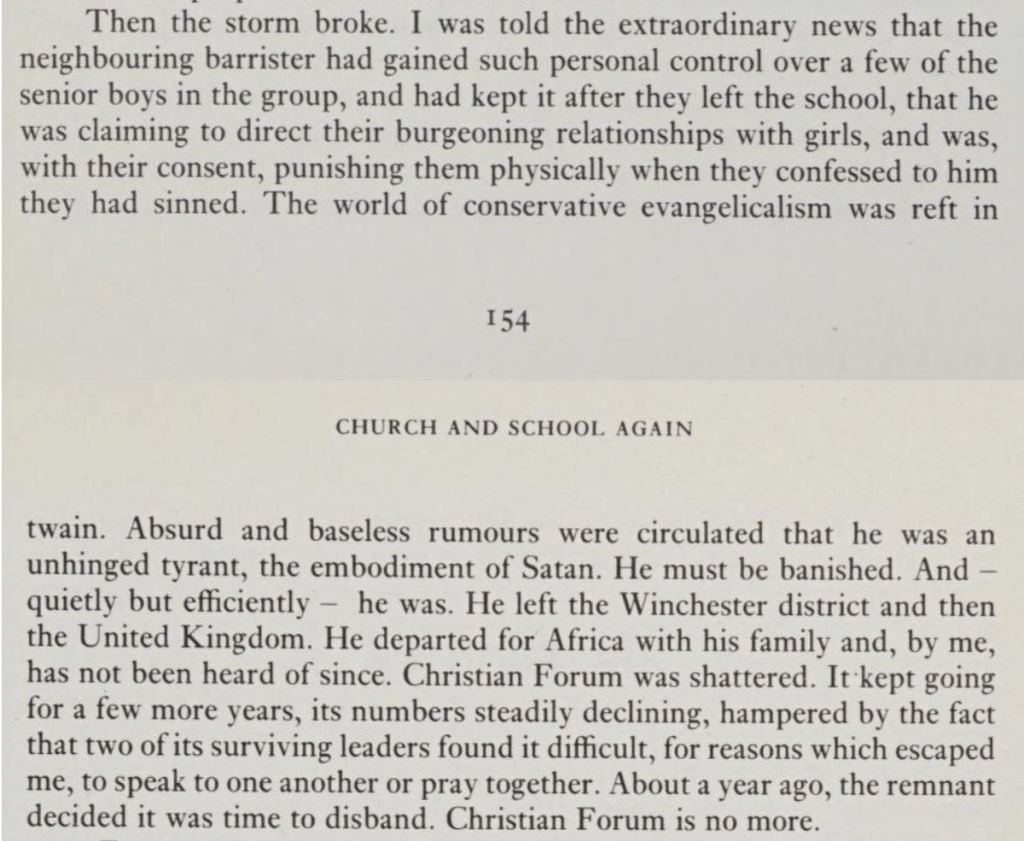
As the Winchester College Review observed in 2022, “It is clear from the description in The Road to Winchester that John Thorn was aware that Smyth had left the UK after the disclosure, that he had not been referred to the authorities by the school, that his abuse was not generally known to the public and that he was operating without any restrictions on his future involvement with children” (WCR, p. 104, emphasis added). What would the members of St Ebbe’s have thought if that accurate summary of Thorn’s account had been included in their church’s post-Makin statement, instead of the misleading summary they actually received?
Roberts didn’t write his church’s post-Makin statement, but he was responsible for it as the senior minister. After corresponding with St Ebbe’s earlier this year, I received confirmation that Roberts had read my November 2024 article criticising the statement. This greatly compounds the problem of his unreliable communication. To stand by a misleading statement after someone has exposed its objective faults is to reject truth-telling. That’s a weighty offence for a minister of Christ. Whenever it becomes apparent that a sensitive piece of communication is objectively misleading, honesty requires immediate correction.
The congregation of St Ebbe’s includes high-ranking professionals, some of whom have no doubt paid careful attention to the handling of misconduct allegations in their own organisations. It’s possible that if they’d been accurately informed about what Roberts knew, they would have urged him to apologise for failing to ensure Smyth’s abuse had been reported. A healthy church will encourage that kind of frank two-way flow of information and advice. In this case, however, church members couldn’t challenge Roberts because they’d been misinformed. The failure to correct the statement shows the misinforming was deliberate.
It’s worth repeating at this point that the gospel calls for faith and repentance, and truly repentant people won’t refuse to admit blame when they’re in the wrong (John 3:20–21). These are truths that Christian leaders need not only to proclaim but also to exemplify. Preaching that lacks integrity rings hollow.
I’m aware that what I’ve written about Vaughan Roberts may seem overly harsh in the eyes of readers who know him personally and value his ministry. But we must train ourselves to concentrate on the facts and give them their due weight.
Final facts
Some final facts need to be considered. After Channel 4 News broke the story in 2017, the horror of Smyth’s abuse was clear to everyone, and it was widely accepted that the abuse should have been reported to the police when it was first disclosed. Even the Titus Trust said, in 2021, “we certainly believe that Smyth’s abuse should have been reported to the authorities when it was first discovered in 1982.”
Yet I’ve found no evidence that David Fletcher, who was leading Iwerne in 1982, ever repented of his actions. When he testified to the Makin Review, he sought to justify his conduct by saying, “I thought it would do the work of God immense damage if this were public” (MR, 12.1.10.e). This is relevant to Vaughan Roberts because Fletcher was a member of St Ebbe’s in the years between 2017 and his death on 31 January 2022. Spiritually speaking, Roberts and his churchwardens had every right to require Fletcher to publicly repent as a condition of ongoing membership of St Ebbe’s. Nothing of the kind ever seems to have happened. This passive acceptance of Fletcher’s lack of contrition would have sent the worst signal to Fletcher himself, everyone else at St Ebbe’s, and the watching world. What does it say about a church when its promotional material features someone who unrepentantly covered up savage, criminal beatings (see below)?

After Fletcher’s death, there are strong indications that the Thanksgiving Service held at St Ebbe’s on 18 February 2022 was a packed celebration of his life and ministry. The official invitation even reached me in America, probably because it said “Do please spread the word to others.” It was written by one of the few people who had publicly defended Fletcher, saying just a few months earlier, in an unfavourable review of Graystone’s Bleeding for Jesus, “David Fletcher is … blamed for the decision not to call the police in 1982 when Smyth’s abuse was first discovered. The matter was more complicated … and this blame seems unfounded.”
No one would have wanted to deny Fletcher’s family a plain church funeral. But the service held at St Ebbe’s seems to have been a far grander occasion. And there isn’t the slightest suggestion in the invitation that the service would properly acknowledge that Fletcher was as worthy of disgrace as a Roman Catholic bishop who had covered up abuse and relocated the perpetrator.
We know how this looked to at least some of Smyth’s victims, because after Fletcher died a group of them told the Telegraph “What will make us most angry is the paeans of praise that will inevitably mark his passing. In fact, he was a man who covered up horrific abuse for 40 years, and he must bear significant responsibility for Smyth’s continuing abuse in Africa. May that be his legacy.”
Vaughan Roberts, therefore, not only failed to insist that Fletcher should publicly repent, he also presided over what seems to have been a celebratory Thanksgiving Service for Fletcher’s life and work.
There’s a pattern of behaviour evident in Roberts’s response to the cover-up of Smyth’s abuse. He’s never taken a meaningful stand against the people responsible for the cover-up, either while it was happening or after it was exposed. Throughout the timeframe, he’s acted in ways that have benefitted the perpetrators of evil rather than the victims of evil. But to this day, he hasn’t admitted any personal blame in connection with the scandal. There are victims still waiting to hear him say that he’s sorry.
Rico Tice
Rico Tice is a well-known evangelist and author. In 1987, when Tice was 20, he was told about Smyth’s abuse by the Winchester College teacher Peter Krakenberger, who had read the Ruston Report in 1982 (WCR, p. 96). This disclosure took place with several of Tice’s flatmates present. According to the Makin Review, “Peter Krakenberger said that he wanted the abuse ‘out’ and known and he went into some detail about the scale and the nature of the abuse” (MR, 13.1.25, emphasis added).
Four years later, Tice took part in a Church of England selection conference, where he was “asked by Reverend Martin Seeley … about John Smyth” (MR, 13.1.25). The Makin Review doesn’t include Tice’s response, but he’s indicated in a personal statement that he told Seeley what he knew. There’s no indication, however, either in the Makin Review or Tice’s statement, that Seeley promised to pass on the information to the authorities or to take action himself. Tice was accepted as a candidate for ordination, and he served as a licensed Church of England minister from 1994 to 2024.
The interaction with Seeley wasn’t the first time Tice had talked about the abuse. He says in his statement that in the years before the selection conference, “I had reported what I knew to senior people in the Iwerne camp hierarchy more than once.” The statement indicates that after the 1991 selection conference he made no disclosures about the abuse until the Channel 4 News exposé in 2017 – a 26-year period of silence.
I spoke with Tice about these things in a three-way video call in 2025 with Kevin Appleton, the Chairman of Christianity Explored Ministries.
Tice clarified that the disclosures made to the Iwerne hierarchy consisted of informal conversations with two different senior leaders. He told me, “I knew that I was meant to be silent”, which shows he was aware that Iwerne had decided to cover up the abuse. Given Tice’s personal opinion of the abuse – “I could see that it was profoundly wrong” – his awareness of the cover-up means he knew for decades that Iwerne was deliberately hiding serious wrongdoing from public view.
Tice also told me that he became aware in the mid-1990s (several years after his disclosures) that Smyth had been reoffending in Africa.
Assessing Tice’s conduct
We usually think of disclosures as the formal reporting of abuse to the relevant authorities so they can protect the vulnerable and pursue justice. Tice’s disclosures weren’t like that at all. One was an unplanned answer to an out-of-the-blue interview question; the others were conversations with leaders participating in the cover-up. There was never any suggestion that action would be taken in response to what Tice had said. Moreover, his knowledge of Smyth’s abuse in Africa means he had no illusions that his disclosures might have been effective.
Since Tice had received no assurances that his disclosures would be followed up, and since he knew Smyth had kept on abusing, wouldn’t any safeguarding expert or spiritually mature Bible reader say he should have done more with the information he had? That’s certainly the implication of the Makin Review, which says of the period 1984–2001, “The numbers of people (including Church officers) having an awareness of these abuses and taking insufficient action to prevent further abuse occurring, grew. The UK abuses could and should have been reported to the Police in the UK in this period, especially given the fact that the Church of England began to adopt safeguarding policies from 1995 onwards and the general awareness of safeguarding in the UK was greatly increased, with relevant guidance and legislation being introduced throughout this period” (MR, 16.33).
It seems accurate to say, given the facts set out above, that from the mid-90s onwards Tice reluctantly participated in the cover-up of Smyth’s abuse. Of course, a reluctant cover-up has exactly the same effect as an eager cover-up: the perpetrator remains free to abuse more victims.
I’m writing with a heavy heart, because Rico was very kind to me when I was a teenager and at other times in the years since. I take no pleasure in criticising him. But sometimes, out of loyalty to Christ, it’s necessary to criticise friends. When the Makin Review was published, evangelicals rushed to criticise Justin Welby for his conduct, without criticising Rico for his comparable failure to pursue justice. This cannot be allowed to stand. The signal being communicated is that evangelicals will protect their own leaders from criticism while simultaneously denouncing non-evangelicals for equivalent wrongdoing. This kind of self-protective partiality is immensely problematic. It leads potential whistleblowers to conclude that speaking truth to evangelical power will likely turn out to be a futile exercise.
Someone might argue that the parallel between Welby and Tice isn’t exact. That’s true, but the differences aren’t all in Tice’s favour. On the one hand, Welby had much more power than Tice. But on the other hand, Tice never had any assurance that the police had been informed, unlike Welby (MR, p. 174, entry for 9/8/13). What’s more, Tice has admitted he was told about Smyth’s abuse in 1987, while it’s never been proven that Welby knew about it before 2013. Added to that, Tice knew in the 1990s that Smyth had reoffended in Africa; again, that was long before Welby received the same information.
I don’t necessarily think Tice should follow in Welby’s footsteps and resign from his position, but I do think he should apologise for not doing more to pursue justice and protect the vulnerable. Welby admitted, in a moment of clarity, “I did not ensure that this was pursued as energetically, as remorselessly as it should have been.” That’s also objectively true of Tice, and yet he’s refused to admit any blame in relation to Smyth.
Another way to think about Tice’s involvement in the scandal is to ask what kind of precedent should be set. If Tice continues in ministry without apologising, the takeaway for evangelicals would be that an informal disclosure of abuse is sufficient in itself, even without any assurances of follow-up, and even when the abuse is known to have continued. But that’s absolutely not how safeguarding should work. Tice’s denomination and his fellow evangelical leaders should urge him to apologise so that the right precedent is set for future scandals.
In the Makin Review, a safeguarding adviser called Yvonne Quirk gives the following apology for dropping her efforts to contact counterparts in South Africa: “I recognise now that what I should have done was step back, take a proper break from the case and then return fresh to my part of the fight. But I did not. I fully accept the criticism levelled at me in that regard. To the victims of JS, I apologise directly and unreservedly for that. I am so very sorry. You deserved better” (MR, 14.3.16). That’s the kind of precedent-setting apology we need to hear from Tice. It would also seem right for him to make a generous donation to the redress fund proposed above.
Church discipline in the International Presbyterian Church
Like many other British conservative evangelical churches, Tice’s current church now has a safeguarding statement. Although this may have introduced certain specific guidelines and procedures, the relevant principles already existed. All Christian leaders should have already understood that, in the words of the safeguarding statement, “it is the responsibility of each of us to prevent the physical, emotional, sexual, financial and spiritual abuse of children, young people and adults.”
The gap between Tice’s conduct and his church’s safeguarding statement is something the church’s leaders should address. They’re currently promoting a code based on principles that Tice, their most famous member, manifestly failed to keep, and yet Tice is refusing to admit he did anything wrong. If the church’s safeguarding statement is sincere, Tice’s refusal to apologise for his past conduct is untenable and requires church discipline.
The absence, thus far, of church discipline in this case communicates the message that safeguarding ceases to matter if it endangers the reputation of high-status leaders. Precisely the same message was communicated by another conservative evangelical London church, St Helen’s Bishopsgate, when it absolved one of its leaders – without explanation or evidence – for failing to warn the church’s senior minister about Jonathan Fletcher’s abuse. The secretive actions of St Helen’s in that case made it impossible for anyone to learn lessons about safeguarding rights and wrongs. Wouldn’t any external observer see Tice’s case and the St Helen’s case as examples of a self-protective culture that fails to implement the standards it professes to uphold?
Many of the ministers in the International Presbyterian Church – the denomination Tice joined in 2024 – will no doubt feel sympathy for his predicament. They’re likely conscious that they might have done just as he did if they’d been in his shoes, and conscious also of the public shame he’d experience if he confessed Smyth-related shortcomings. I can imagine IPC elders recoiling at the thought of urging him to repent and, if he were to refuse, baulking at the prospect of publicly rebuking him in accordance with 1 Timothy 5:13. But this kind of “gentlemanly” habit of turning a blind eye to an ally’s misconduct must stop. British conservative evangelicals must get used to doing the right thing whatever the relational discomfort it might cause.
It should be reiterated that Tice’s failings in the Smyth scandal can’t be excused by the absence of safeguarding codes at the time when he was first informed. Current safeguarding norms are practical applications of age-old morals. It has always been right to love one’s neighbour, watch out for wolves among the flock, and seek justice. The Makin Review makes a similar point from a non-biblical perspective: “While ‘safeguarding’ as a term may not have been widely understood in the early period covered by the Review … the importance of protecting of children from physical harm was a widely known societal issue of concern” (MR, 6.1.4).
It should also be emphasised that safeguarding standards were in fact codified for much of Tice’s 26-year period of silence (MR, 13.1.1.h). From the early 2000s onwards, a time when Tice had growing influence due to the popularity of his Christianity Explored course, safeguarding guidelines were commonplace. Right up until the Channel 4 News exposé in 2017, Tice could have taken steps to make sure Smyth’s abuse was reported. Just a single phone call or email from Tice about Smyth could have set the ball rolling and had significant consequences. But that never happened.
It’s too easy to forget what we’re actually talking about when we discuss the Smyth scandal. Smyth’s victims sometimes defecated in terror as they pulled down their trousers and underwear so he could lash them dozens of times with his cane (MR, 12.1.31; AMR, p. 77). “Polite” silence about the safeguarding failings that protected Smyth cannot continue.
Final Thoughts
Sol Price, the American businessman who pioneered Costco-style discount shopping, once wrote to employees, “You must feel confident that you are working for a fine and honest company.” How much more important is it for British evangelicals to feel confident that their movement is fine and honest? But that’s currently far from the case.
Since the Makin Review was published in 2024, evangelicals have falsely denied an organisational cover-up (the Titus Trust); given objectively dishonest information about a leader’s knowledge of abuse (St Ebbe’s Church on behalf of Vaughan Roberts); adamantly refused to criticise their own former leaders, who failed to pursue justice despite being shown the Ruston Report and the Coltart Report (the Lawyers’ Christian Fellowship); distanced themselves, by objectively misleading statements, from a former leader implicated in the scandal (Church Society); denounced a non-evangelical leader while failing to mention evangelical leaders whose conduct was worse (FIEC and Church Society); and failed to apologise for past wrongdoing (the organisations and individuals discussed earlier in this article).
What’s more, there’s been no sign of any disciplinary action within the evangelical movement for Smyth-related matters. For example, as discussed above, the International Presbyterian Church has had nothing whatsoever to say about Rico Tice’s failure to properly disclose Smyth’s abuse and his current refusal to apologise.
This is not a fine and honest movement.
The hard truth here is that doctrinally-sound Christians can maintain a sinful status quo. Anyone who doubts that should meditate on the church history of the American South during the centuries of slavery and segregation.
The Titus Trust’s external review speaks of “an underlying belief that leaders are ‘good’ people, doing a good work and that safeguarding issues are more likely to occur elsewhere” (TTCR, p. 80). The reviewers then say, “This sense of pride can also lead to a loyalty towards the Trust and its people which promotes its protection over other important issues.” Those perceptive observations could equally well be made about British evangelicalism in general.
In addition to pride, another phenomenon explaining British evangelicalism’s culture is the powerful role of fear identified in thirtyone:eight’s Jonathan Fletcher review and discussed in the supplementary statement from the review’s Independent Advisory Group.
The sad irony here is that the “see no evil” mindset keeping evangelical leaders from addressing their movement’s inadequate response to the Smyth scandal is precisely the same mindset that sustained the thirty-year cover-up. It’s very disappointing that institutions that might have been expected to disrupt this mindset, such as Evangelicals Now, have chosen not to do so. Unless I’m mistaken, there hasn’t been a single EN article calling for a specific evangelical leader or organisation to apologise for Smyth-related failings. Surely the time has come for that to change.
One silver lining to the darkness of scandals is the educative opportunity they usually offer. In this scandal, however, there are highly significant questions that still haven’t been formally addressed by evangelical leaders. What, for example, should evangelicals think about the issue of redress for Smyth’s victims? Should they receive financial payments, like the victims of other scandals, and, if so, who should make those payments and how much should be given? Unless I’m mistaken, no evangelical leader has addressed those questions. I can’t think of any valid argument against the idea discussed earlier in this article, that a fund should be set up so that conservative evangelical organisations (and individuals too) can contribute to financial restitution for Smyth’s victims.
Equally importantly, what should evangelicals think about the non-reporting of Smyth’s abuse by victims who later went into ordained ministry? If a schoolteacher had been abused as a child by a teacher who, 20 years later, was still working with children, wouldn’t there be a duty of care to report the abuser, at least anonymously? The Makin Review says “victims of abuse have the right to remain silent about their experience”, citing the Human Rights Act (MR, 6.3.29); but it also says, “It is incumbent on the Church to come to a decision as to … whether ordained persons … should be required to reveal their abuses in the pursuit of identifying abusers” (MR, 18.4.10).
Any evangelical statement on that issue would need to take account of warnings such as Jesus’s words in Matthew 7:15: “Watch out for false prophets. They come to you in sheep’s clothing, but inwardly they are ferocious wolves.” That’s an especially important duty for Christian leaders, who have the task of “keeping watch over your souls” (Hebrews 13:17). Deciding whether formerly-abused Christian leaders should be excused from that task calls for coordinated input from theologians, experienced pastors, and Christian psychiatrists. Yet instead of purposeful coordination we find only a leadership vacuum. Where are the evangelical leaders who are willing to enter into the arena?
One respondent to the Titus Trust’s external review pointed out that the mistakes of a previous generation “become mistakes of your generation unless you deal with them properly” (TTCR, p. 106). In this case, the recapitulated mistake – happening right before our eyes – is the silent closing of ranks to protect the movement. The effect, of course, isn’t really protection at all; it’s moral and spiritual deterioration.
This has been an “in-house” article for evangelicals, but I’m conscious that some of Smyth’s victims may read it. Once again, I’m personally very sorry that I didn’t raise questions about the information I was given. While I’ve been writing this article, you’ve been in my thoughts. Evil engulfed you, through no fault of your own, and I hope and pray for your continued healing. I hope you receive the restitution and redress that you deserve.
Nick Howard
Note: In Matthew 18:15–20, Jesus calls for personal interaction between believers in a private dispute. This article, in contrast, is about the public response of conservative evangelicals to the Makin Review. For that reason, I haven’t corresponded personally with every individual mentioned in this article. I did, however, contact David Jackman and Rico Tice. I also contacted Vaughan Roberts, but was told by his churchwardens that he wouldn’t answer any questions on this subject. The rights and wrongs of publicly criticising fellow Christians are helpfully discussed by D. A. Carson in his article “Editorial on Abusing Matthew 18”.

 sixty guilders


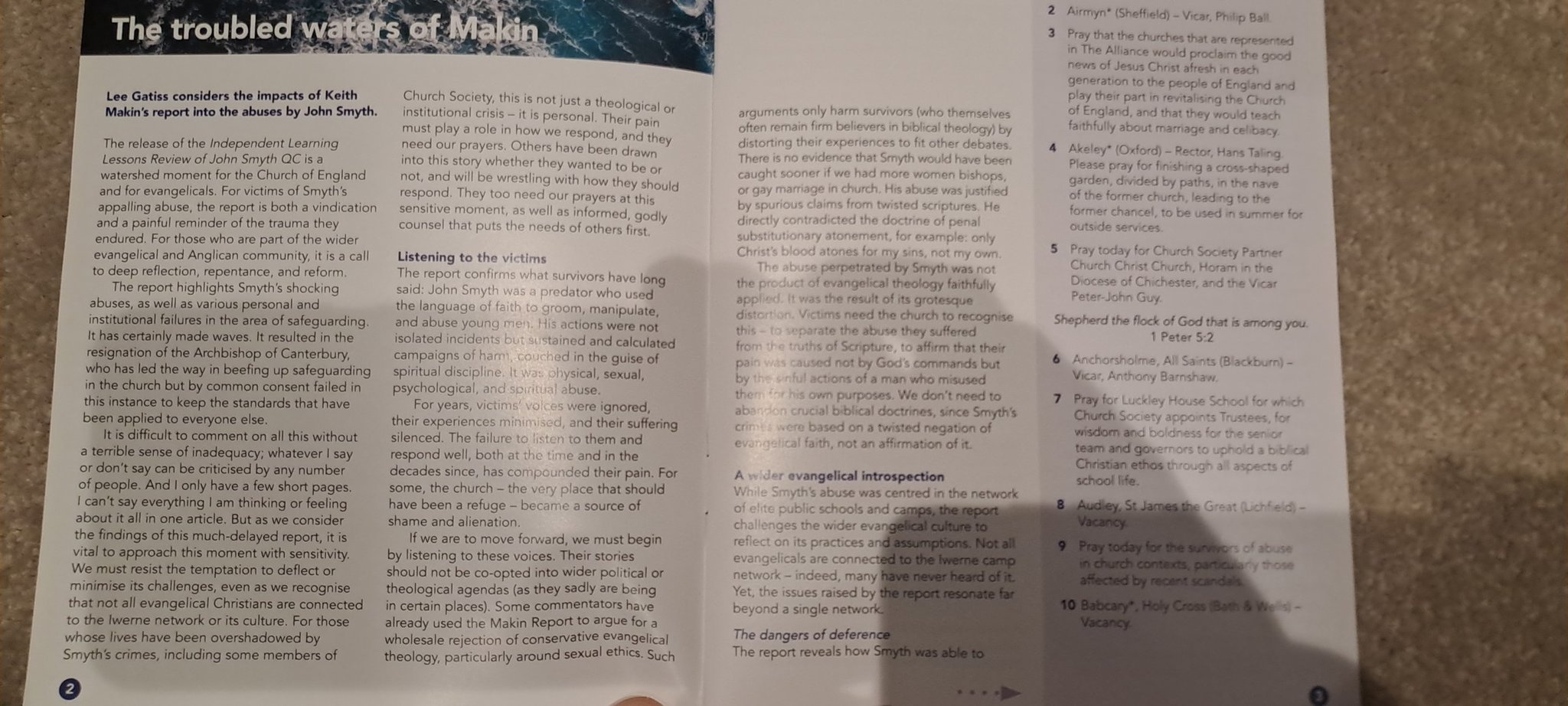
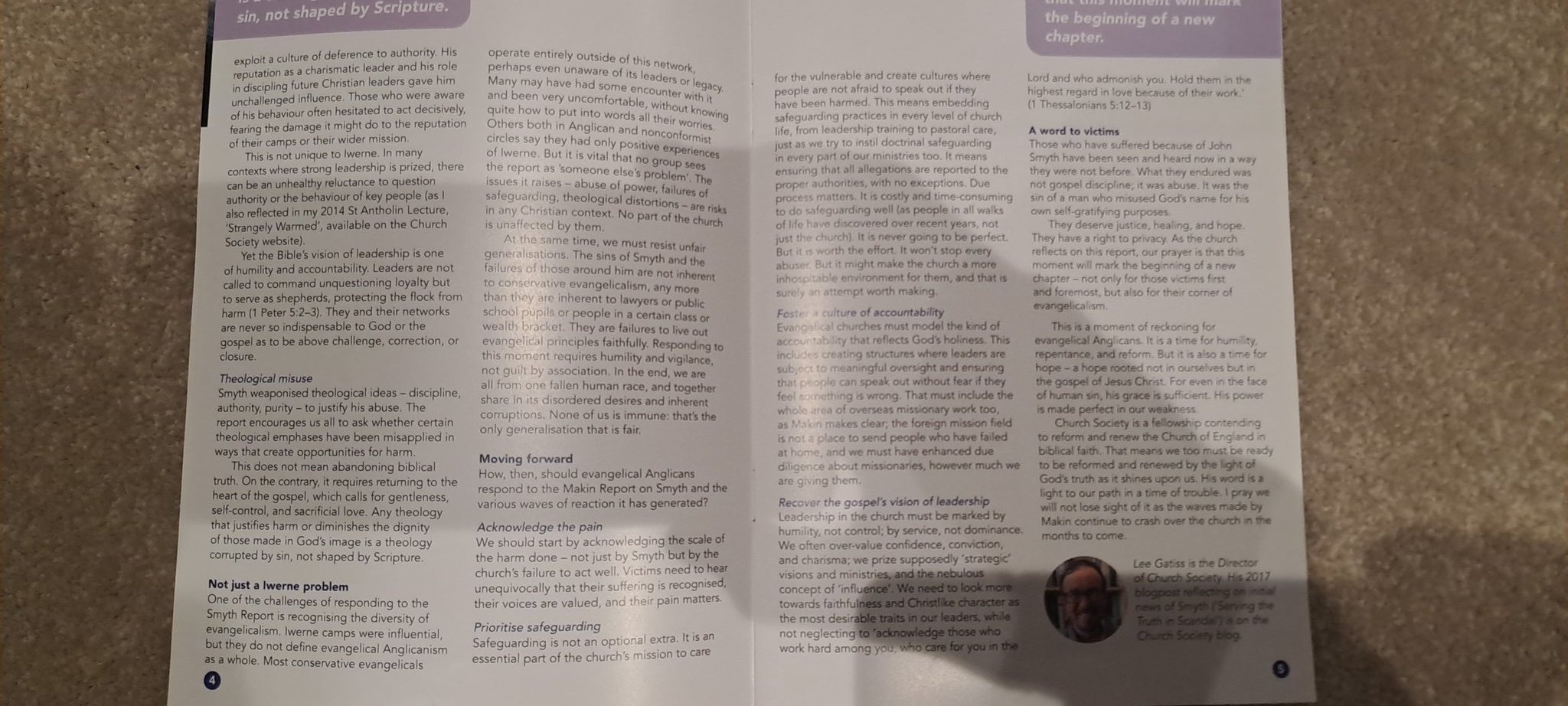
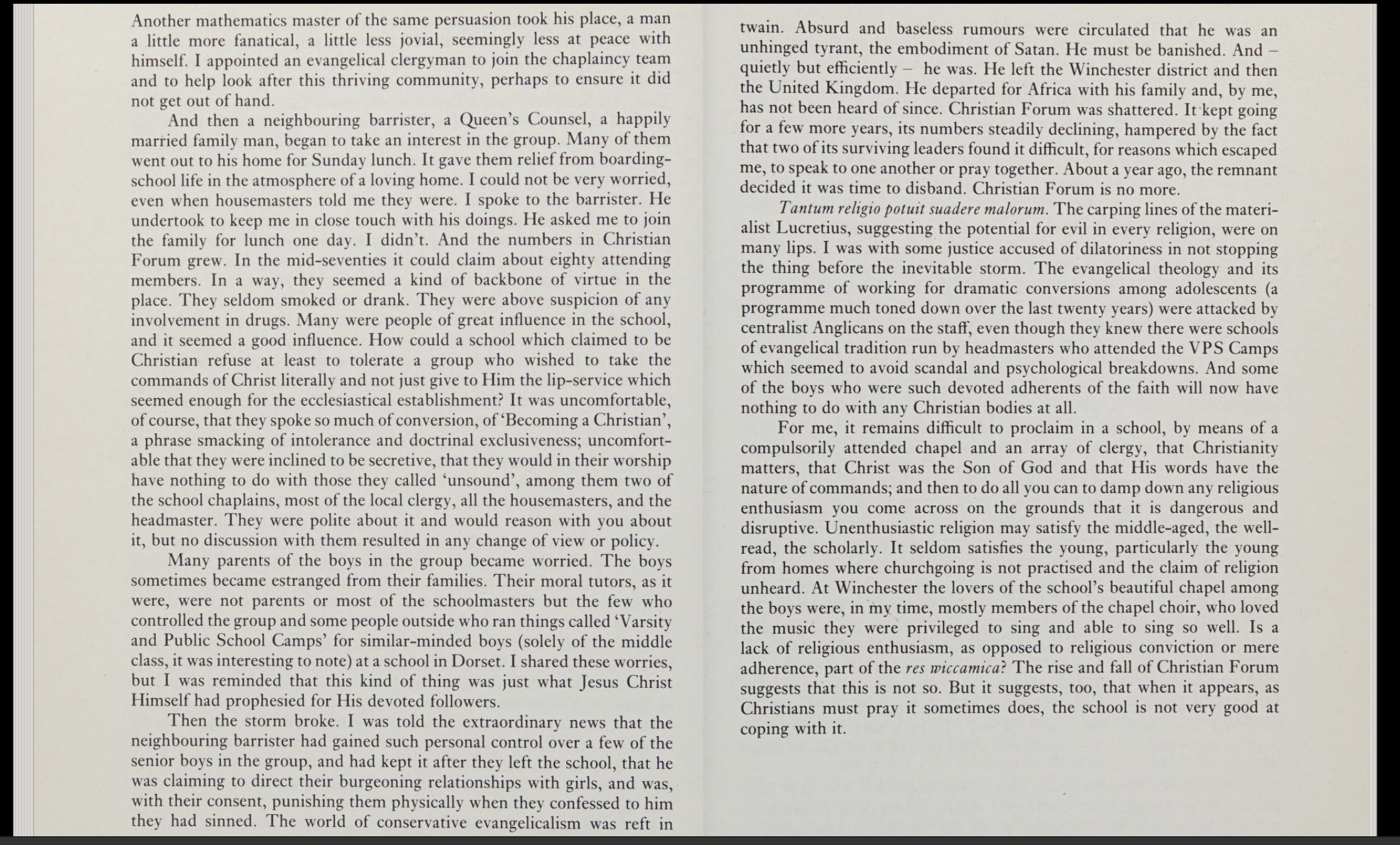
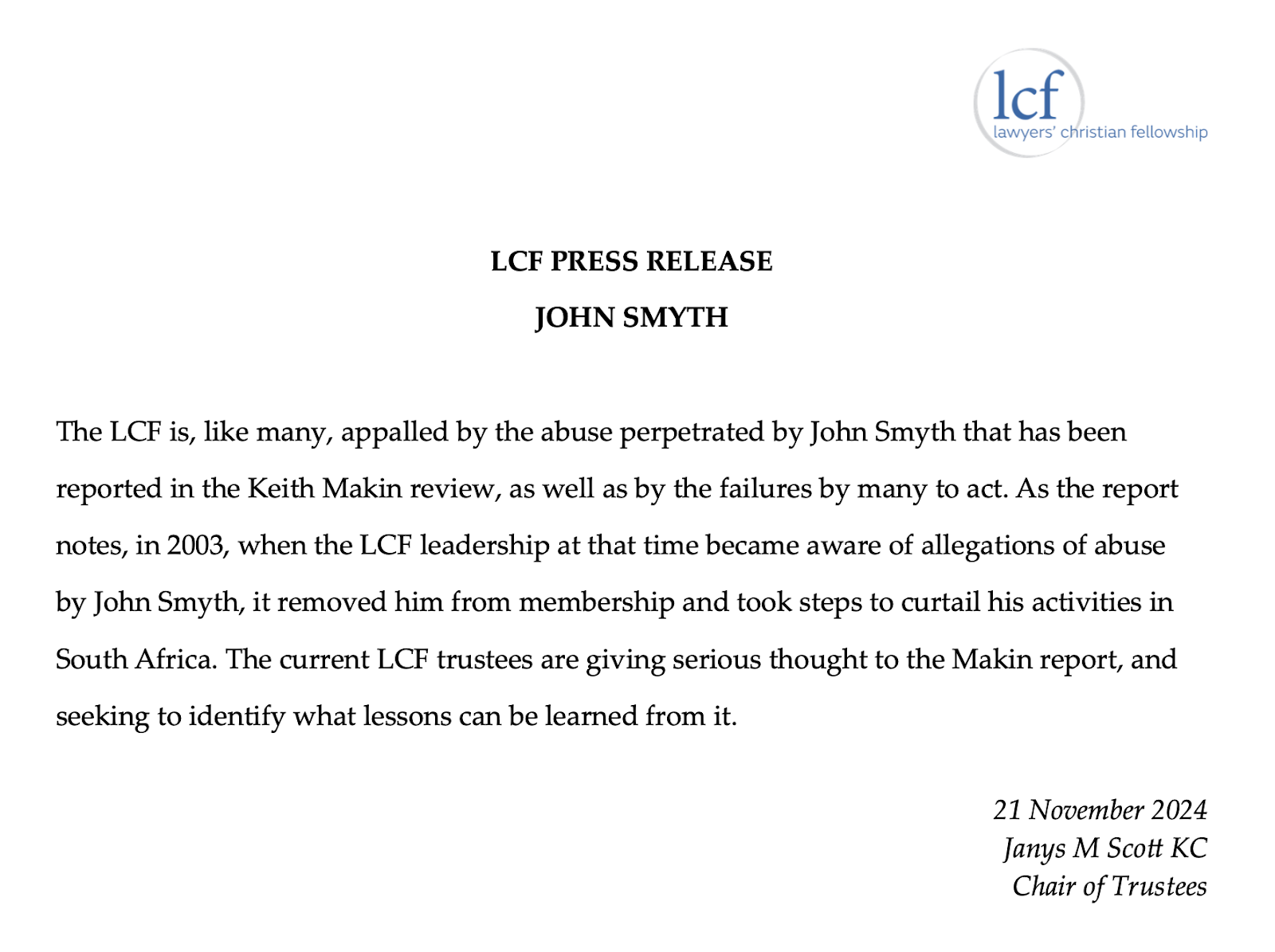
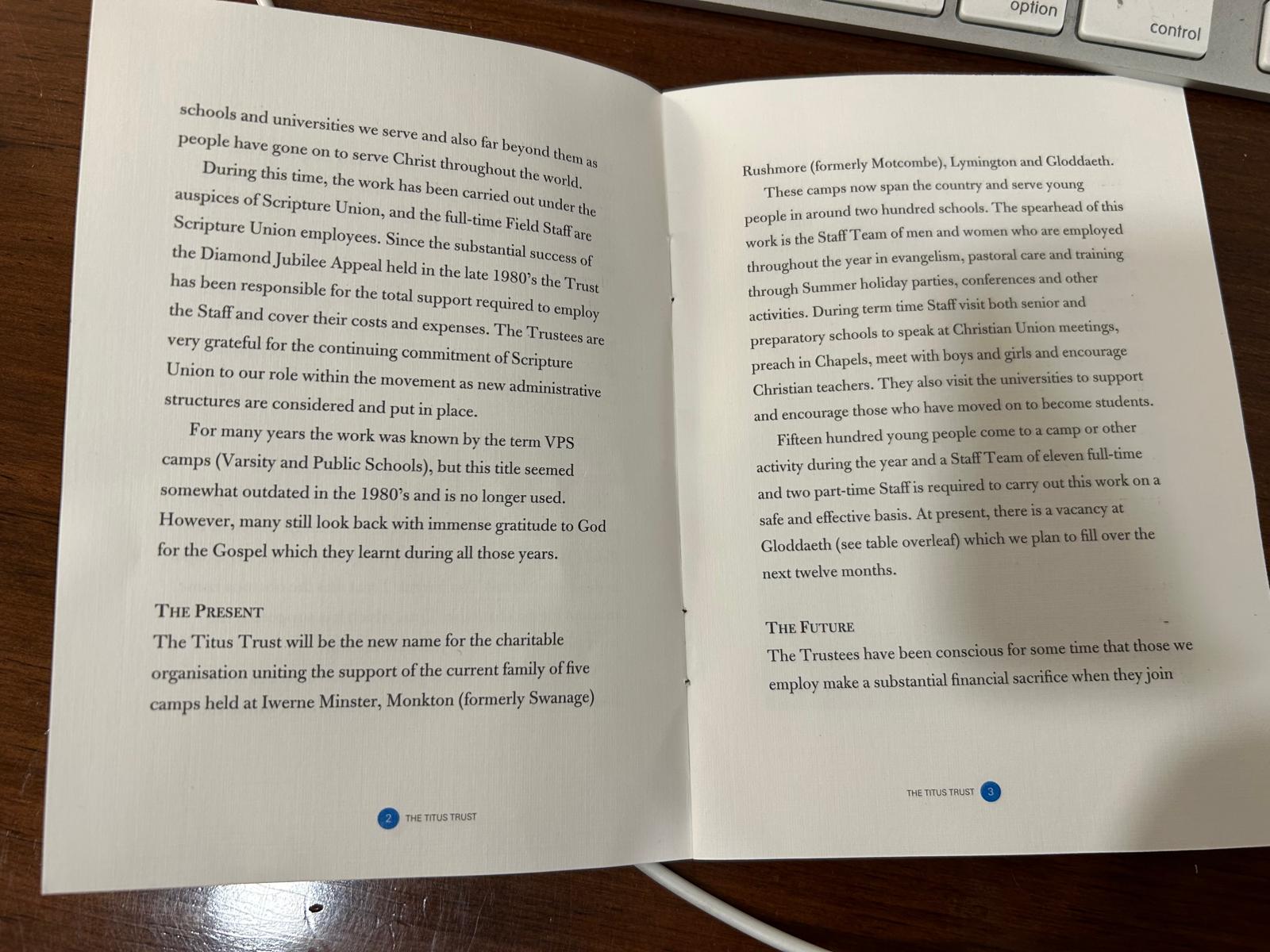
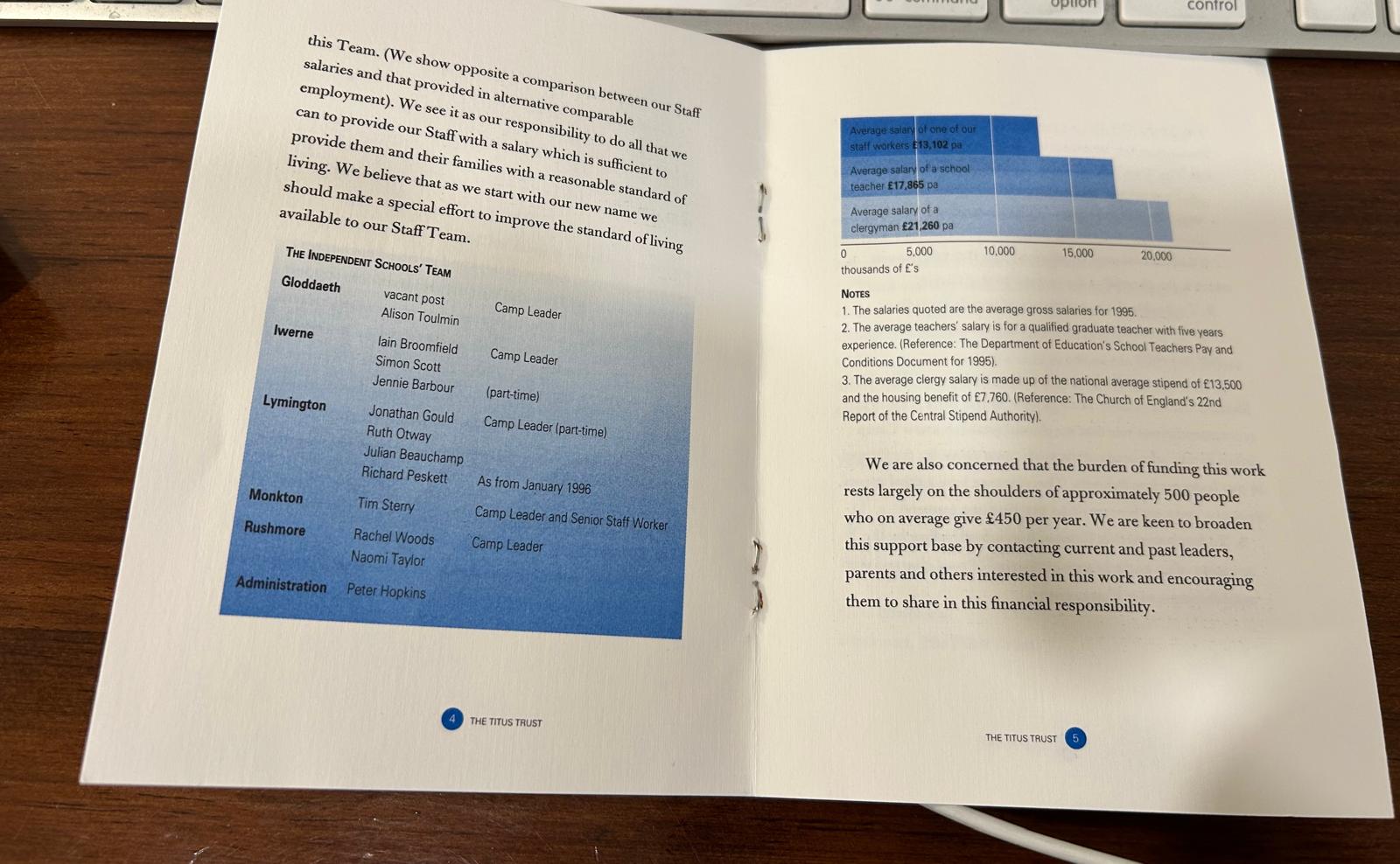
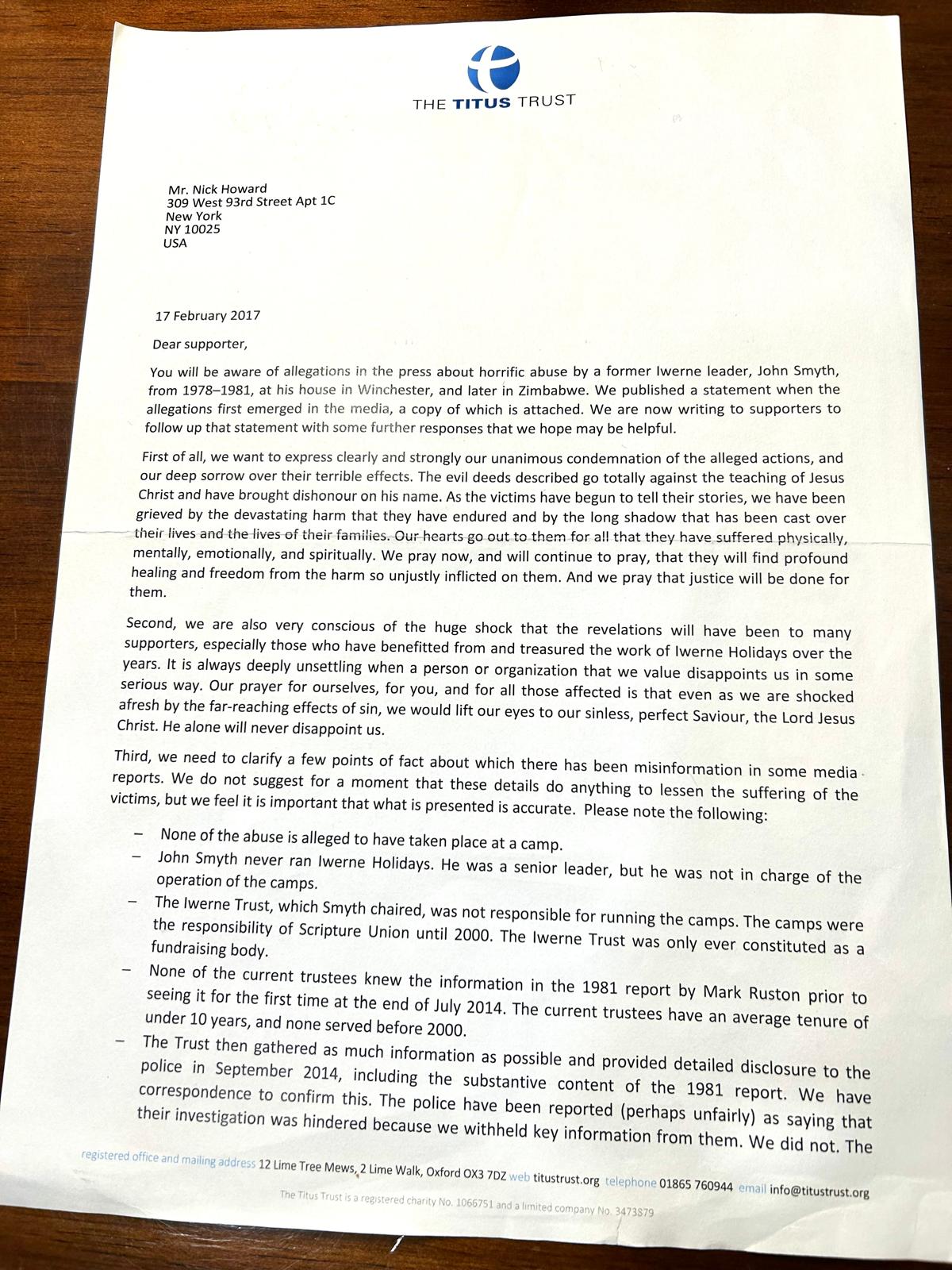
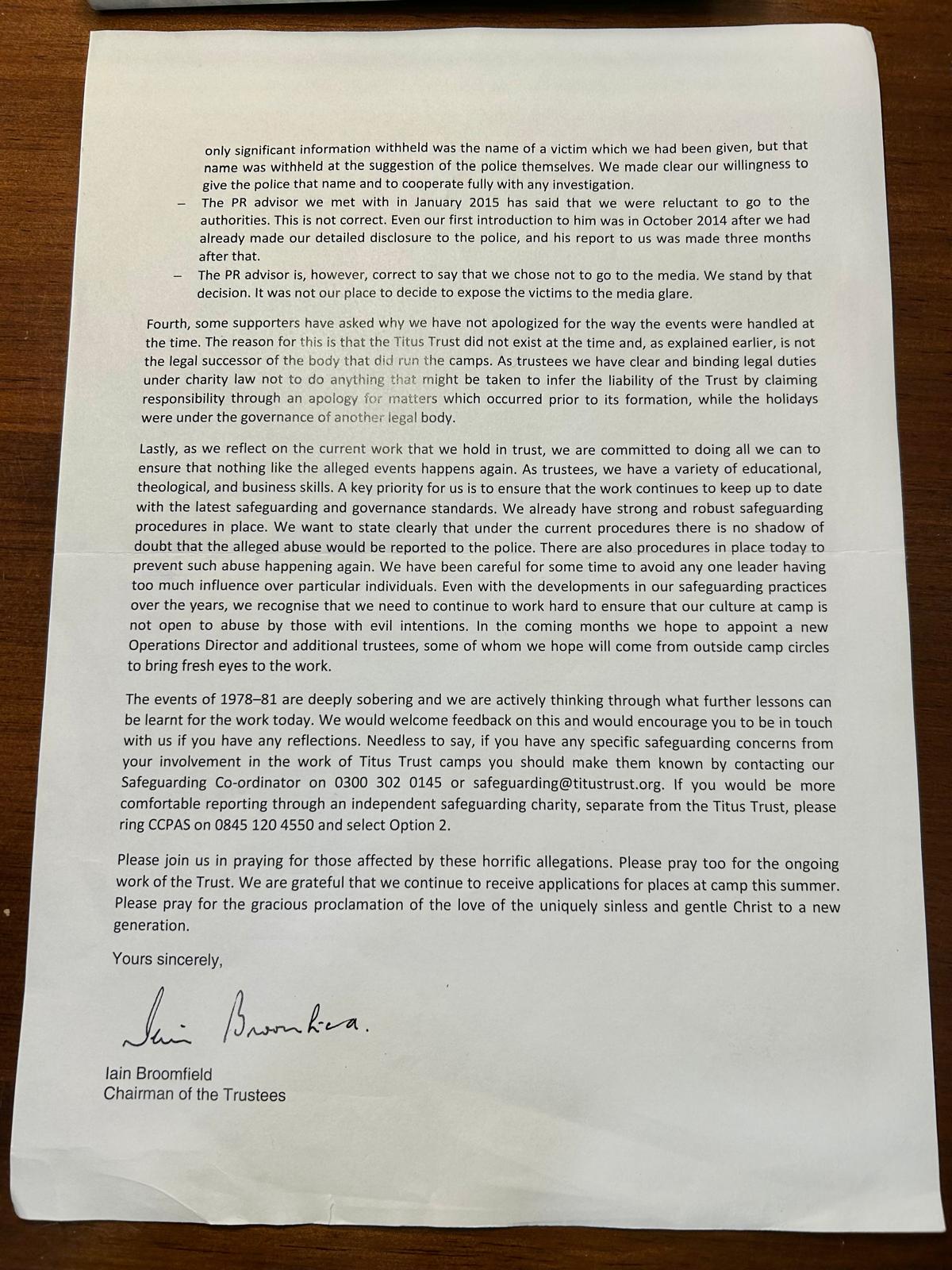
Leave a comment