
In the Oscar-winning film The Lives of Others, an East German intelligence officer explains how he can tell when someone is guilty. In his experience, innocent people will say everything they possibly can about their actions to persuade whoever’s listening that they’re blameless. Guilty people, meanwhile, stick to one carefully formulated line, never deviating from it, no matter how many questions they’re asked.
Advice from a fictional communist might seem an odd starting point for a Christian article. But the character’s opinion draws strong support from Paul’s words in 2 Corinthians 4:2: “By the open statement of the truth we would commend ourselves to everyone’s conscience in the sight of God.” According to Paul, being willing to speak openly is a universally-recognised virtue.
The reason why Christians, in particular, should speak and act openly is explained in John 3:20–21: “For everyone who does wicked things hates the light and does not come to the light, lest his works should be exposed. But whoever does what is true comes to the light, so that it may be clearly seen that his works have been carried out in God.” In other words, those who find their self-worth in God don’t live in fear that their sins will be exposed. Instead of hiding their past deeds, they’re willing, when necessary, to “come to the light” so that God will be glorified for forgiving their sins and empowering their acts of obedience.
Does Jesus himself present a counter-argument? After all, Isaiah said the suffering servant would be as silent as a sheep before its shearers (Isaiah 53:7), and Jesus did indeed remain silent when questioned by Herod and for most of his interrogation by the Sanhedrin. But when he was cross-examined in relatively good faith by Pilate, a questioner who was willing in principle to release him, Jesus spoke with remarkable openness (John 18:33–38; 1 Timothy 6:13). Even in much more hostile circumstances, he was willing to speak plainly when necessary (Mark 14:61–62).
Bible-believing Christians, therefore, should expect their leaders to give full, transparent answers when questioned in good faith about their own or their organisation’s conduct. But the current culture of British conservative evangelicalism demonstrates precisely the opposite approach. A range of organisations have shown, when challenged, that they prefer defensive silence to full and frank communication. Some examples include the International Presbyterian Church, the Fellowship of Independent Evangelical Churches, St Ebbe’s Church, the Regional Gospel Partnerships, the Church of England Evangelical Council, St Helen’s Bishopsgate, Church Society, and ReNew (see the appendix at the end of this article).
One recent example of this incommunicativeness is Oak Hill College’s refusal to engage with valid questions about its treatment of a former faculty member.
Oak Hill’s turbulent recent history
Oak Hill College, which is located in Southgate, a suburb of north London, is one of the Church of England’s officially recognised training institutions. It’s been described by Evangelicals Now as a “reformed evangelical training college”.
On 10 March 2023, Jeremy Anderson, chairman of the College Council, announced that Johnny Juckes would be resigning from his dual role as the college’s president and principal. Anderson, who also serves as a churchwarden of St Helen’s Bishopsgate, said, “some weeks ago Johnny asked the College Council to begin looking for a successor … please do pray for the Lord to raise up the right person for the next phase of the College’s life, and wisdom for us to know who that is.”
Reporting this news, Evangelicals Now said, “Oak Hill spokesmen are remaining tight-lipped about what has been happening at the theological college after the institution’s President, Johnny Juckes, announced his intention to stand down. en has received confidential information originating from reliable and diverse sources which speak of considerable conflict. … en gave Juckes and Anderson the opportunity to state publicly that the reported claims were untrue and to respond, but they did not do so, saying they had nothing to add to the existing website statement.”
In a second statement, issued on 31 March, Oak Hill’s Council finally acknowledged that “over the course of time, issues to do with Johnny’s leadership were raised” and admitted “Those concerns … did identify areas where Johnny should change or develop his approach”.
On 3 April, just three weeks after Anderson had broken the news that Oak Hill needed a replacement for Juckes, the college announced that James Robson would be its next principal. Before Robson arrived, Juckes taught a summer intensive module on “Advanced Christian Leadership”, even though the college had taken the extraordinary step of announcing publicly that his own leadership practices needed to change.
Towards the end of 2024, about a year after Robson’s arrival, the Council commissioned a review of the college’s organisational health. It was completed in April 2025. The review wasn’t made public, but a summary document leaked to the Church Times acknowledged that Oak Hill had experienced a season of “challenge and tension”. The document also acknowledged “the need, in some areas, for restoration, forgiveness and healing”. Logically, therefore, at the time of the review’s completion, the areas in question were still marked by brokenness, division, and pain. This might explain Oak Hill’s astonishingly high turnover. According to the Church Times, as many as 15 staff members left the college from 2023–25.
Criticism from former staff members
In November 2025, Premier Christian News published an article titled “Former Oak Hill staff warn of ‘unhealthy culture’ for students and employees”. The main interviewees were Sydney Tooth and Clare Osborne, who had resigned from Oak Hill in early 2025 and late 2023 respectively.
Sydney Tooth had been the college’s lecturer in New Testament and Greek and its director of postgraduate studies. Her concerns focussed on the conduct of the college’s vice principal, Matthew Sleeman: “I repeatedly witnessed Matthew respond passive aggressively to colleagues in faculty meetings, shout at other staff members, intimidate students, and make passive aggressive comments to questions I and others raised in meetings. He was repeatedly dismissive of certain staff members and made derogatory comments about them to me.”
Tooth added that she had raised these concerns with James Robson, the new principal, “multiple times” and said “many complaints” had been made about Sleeman “by both students and staff”, yet he had “suffered no public consequences for his actions.” Explaining her decision to go on the record, she said “The injustice of what I and so many others experienced at Oak Hill runs deep and I am compelled to speak up on behalf of those who can’t, and to protect those who are still in harm’s way by bringing these repeated patterns of behaviour to light.”
Clare Osborne had been the college’s admissions and internal communications manager. She told Premier, “I was seeing things I really didn’t like and didn’t have any confidence that they would change. It looked like ‘protect the institution’, ‘protect those with power’ … It did not feel like Oak Hill was walking in the light. Additionally, it was reminding me of things that have been mentioned in recent reports about serious failings in Christian leadership. What I saw also looked like the squeezing out of those who were trying to lead in healthy, humble ways and it was being replaced with a more dictatorial/do what I say sort of leadership which seemingly went unchallenged.” Osborne added that Oak Hill’s leadership and council refused to “acknowledge when leaders made mistakes, did things wrong, or harmed people” and “were not really prepared to deal with bad behaviour even when concerns were raised about it.”
Osborne went on to say, “When it is leaders acting like this, it’s bad. When you see Christian leaders acting like this it’s worse because your expectations are higher and when Christian leaders fail it impacts so many people; when you see Christian leaders training others for Christian leadership lead in unhealthy and harmful ways, that feels even worse because the impact is potentially much greater as individuals are sent out into a variety of ministry settings. … In the end, it’s God’s church that is impacted. What I would love to see is fulsome acknowledgement of wrongs and repentance from Oak Hill.”
Oak Hill’s response
Responding to the criticisms, Oak Hill told Premier, “We can confirm that there are no current formal grievances against any member of the Leadership Team.” Robson acknowledged that on arriving at the college he had been aware of “the pain that quite a number felt”, and he explained how he had sought to address it: “One of my priorities on arrival was organisational health. Listening carefully was paramount. Stories differed. Then it was trying to chart a way forward that reflected good practice and the good news of Jesus Christ, where there is humility and courage, truth and grace. Navigating that has not been easy. Addressing issues of culture and behaviour is neither quick nor comfortable. But in the Lord’s mercy there has been significant progress, and the external review has helped with that.”
Robson and Anderson then issued a long statement defending Oak Hill on the college website. Evangelicals Now reproduced the statement in full, explaining that it followed “recent stories about the institution”. EN didn’t quote any of the whistleblowers’ criticisms of the college.
Matthew Sleeman’s statement
Matthew Sleeman, Oak Hill’s vice principal, made a claim in the Premier article that stood out as particularly significant: “The specific allegations from Sydney [Tooth] put to me by Premier that I ‘bullied her, shouted at other staff members and intimidated students’ have been fully investigated by the College and I have been cleared of them.” As an executive officeholder, Sleeman was necessarily speaking on behalf of the college as well as for himself. In this way, Oak Hill was officially declaring that he’d never offended in those ways. It logically followed that the college had found Tooth to be an unreliable witness. It’s easy to see how harmful that could be to Tooth’s standing in the world of evangelical academia.
Given the significance of this judicial claim, the college needs to be able to show that the investigation cited by Sleeman met the standards that would be expected when professional careers are at stake. What would such an investigation have entailed?
To rigorously test Tooth’s allegations and Sleeman’s counterclaims, the college would have had to seek testimony from witnesses in support of each side. It would have been essential to keep careful records of that testimony. A right-of-reply stage in which each side could respond to the other’s evidence would also have been essential. The judicial process would ultimately have led to a written judgment dealing with all the relevant points. Finally, it’s good practice in such investigations to include the right of appeal.
Therefore, Sleeman’s claim about his own exoneration is verifiable: if it’s true that Oak Hill fully investigated Tooth’s allegations and cleared him on the relevant points, the college will have a trail of documents – a judicial dossier – to show for it. This dossier might be subject to data protection rules, but there’s nothing to stop Oak Hill from making a suitably redacted version available. It’s easy to find comparable cases for clergy and doctors where the relevant judicial material can be accessed.
A parallel case at the University of Cambridge confirms the reasonableness of asking Oak Hill to verify Sleeman’s claim by providing documentation. As reported by Times Higher Education, “A University of Cambridge ‘whistleblower’ who raised concerns about bullying has won his case at employment tribunal … The academic had claimed he was victimised after raising concerns about the treatment of female staff members within the university’s Institute of Astronomy (IOA).” The article went on to say that the tribunal found that “leadership within the IOA and the university failed to consistently demonstrate how they reached the decisions they did throughout the dispute” [emphasis added]. Oak Hill deserves to be similarly censured unless it can demonstrate how it reached the decision to exonerate Sleeman on each count.
Good faith attempts to seek clarification
Earlier this year, I communicated these concerns about the investigation to a member of Oak Hill’s Student Committee. My contact was unable to get answers from James Robson, yet he told me, “James is happy to respond to your points, but he’d rather you contact him directly.” When I did so, however, Robson only said “It would not be appropriate for me to speak with others about private HR matters.” In response, I pointed out that Sleeman had spoken publicly about HR matters to Premier Christian News. (It could be added that the College Council had also spoken about HR matters when it commented on Johnny Juckes’s leadership record in its 31 March 2023 statement.) Robson merely restated, “It still would not be appropriate for me to speak with others on this matter.”
It seems incontrovertible that Oak Hill is failing to demonstrate how it reached its decisions in a case with great significance for the reputations of two academics and the college itself. The college’s own Student Committee and an outside observer weren’t allowed to see any evidence. Oak Hill has indicated that Sydney Tooth is an unreliable witness – an opinion that happens to be very convenient for its own reputation while very harmful for her – without showing its working. Its silence is unkind in the extreme.
A simple way forward for Oak Hill
In sum, it’s not acceptable for the vice principal of an academic institution to describe his own case as “fully investigated” unless that has objectively happened. To verify Sleeman’s claim, Robson should release the dossier from the case, with names redacted as necessary. If he claims he can’t release it for legal reasons, he should identify the relevant section of the statutory act supposedly forbidding him. If he maintains his silence, students and other onlookers will justifiably conclude that the exoneration of Sleeman and the implicit denigration of Tooth cannot be trusted. Justice must be seen to be done. Regular evangelicals are tired of silence being used to protect powerful leaders. To repeat Paul’s words in 2 Corinthians 4:2: “By the open statement of the truth we would commend ourselves to everyone’s conscience in the sight of God.”
Appendix
Sadly, Oak Hill’s silence fits an established mould. The following examples show how widespread and firmly established evangelicalism’s culture of silence has become. These cases reveal not only a pattern of unbiblical silence spanning Presbyterianism, Nonconformism, and Anglicanism, but also a recurring motive for the use of silence: to protect a valued leader from unwelcome scrutiny. None of these cases are trivial, which means they all require openness so that justice can be seen to be done. In such circumstances, calling for justice isn’t divisive or ungodly but spiritually necessary, because justice is one of the fruits expected of branches belonging to Christ’s vine (John 15:1–5; cf. Isaiah 5).
The International Presbyterian Church
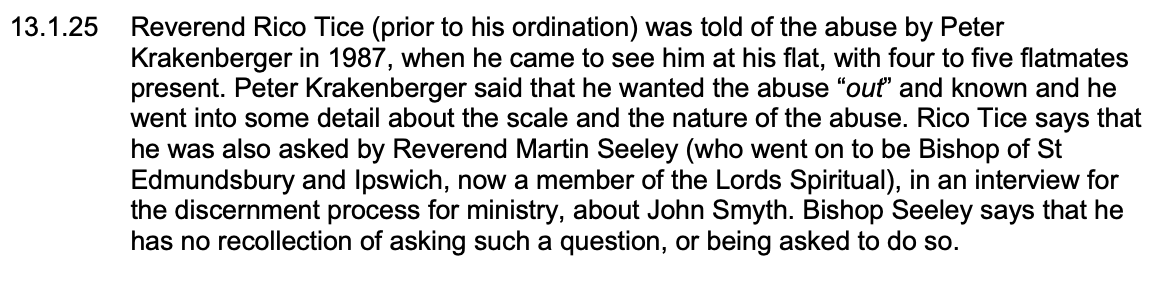
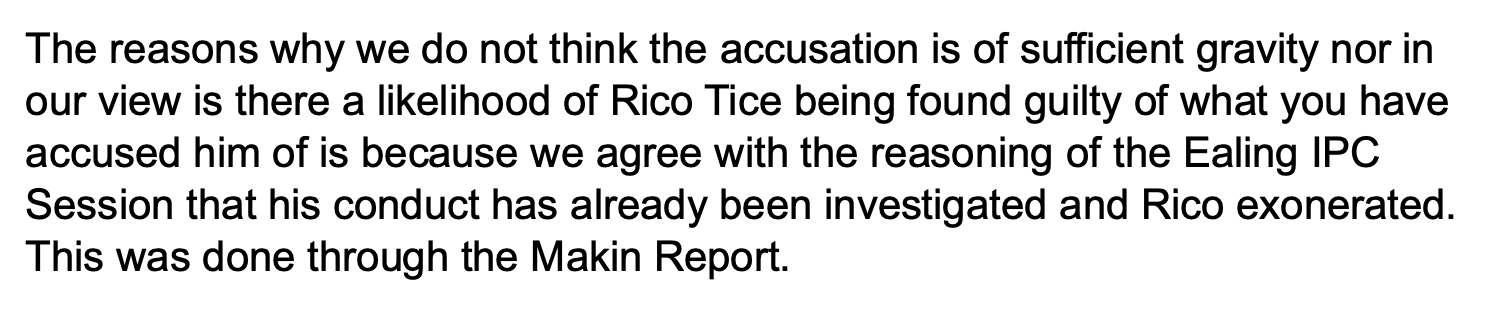
In the early 1990s, Rico Tice was told that John Smyth (already known to Tice as a sadistic abuser) had resumed his abuse after moving to Africa. Tice didn’t take any action in response, and he’s never publicly repented for this negligence. These uncontested facts were recently brought to the attention of Tice’s pastor, Paul Levy of IPC Ealing; they were later raised with Chris Cradock, the denomination’s Moderator, and Iain Clements, its Clerk. They chose silence by deciding that the IPC wouldn’t address the issue. Instead, they deferred to the Makin Review, even though they knew the relevant facts had only come to light in 2025, after the Makin Review’s publication. For a denomination supposedly committed to repentance and biblical church discipline, choosing silence is inexcusable. Tice, the author of Faithful Leaders and the Things That Matter Most, remains unapologetic for failing to protect Christ’s flock from abuse.
The Fellowship of Independent Evangelical Churches
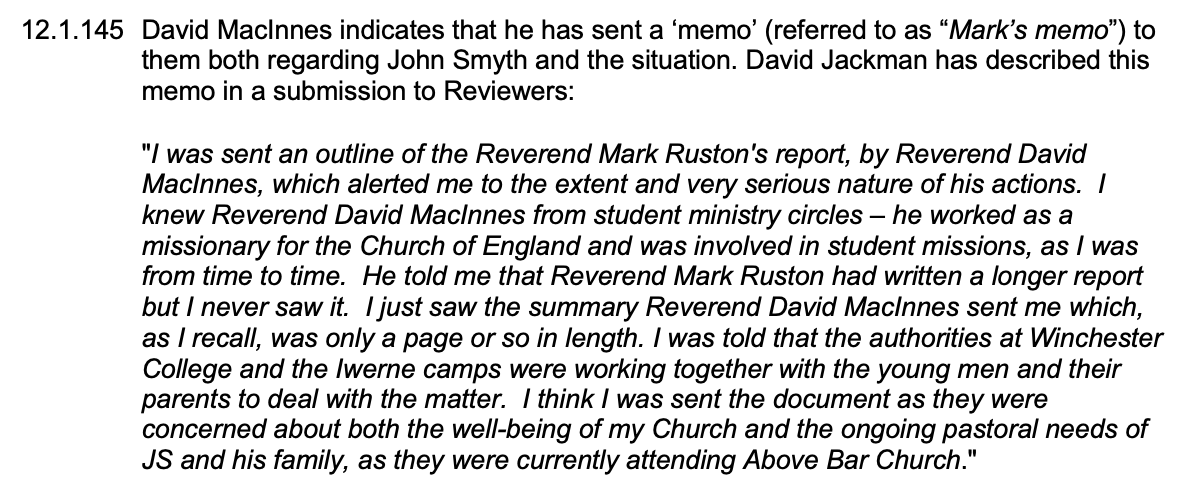
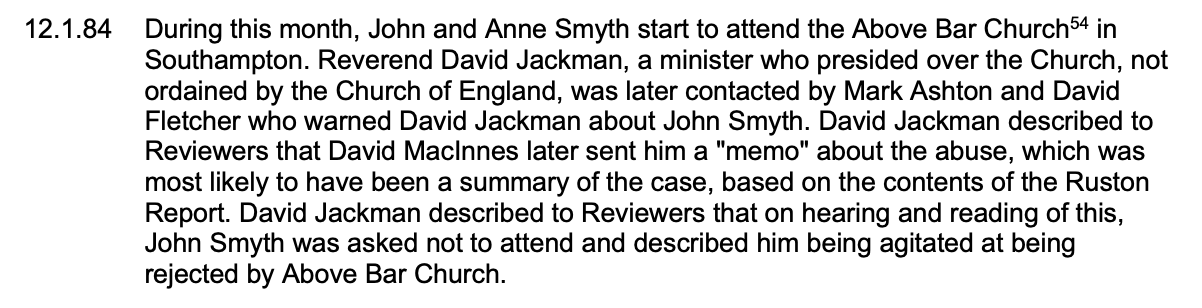
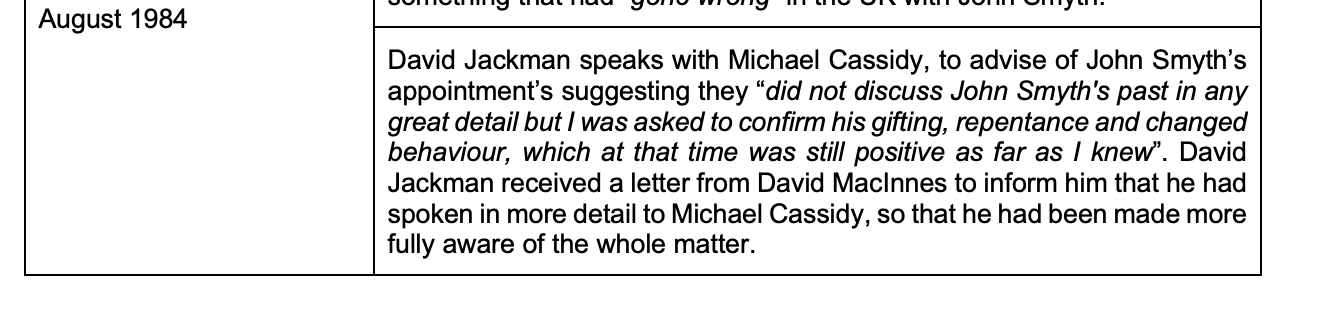
The 2024 Makin Review revealed that Above Bar Church, an FIEC church, had played a key role in covering up John Smyth’s abuse. David Jackman, the church’s then pastor, was told “the extent and very serious nature of [Smyth’s] actions” but didn’t report him to the police. He simultaneously banned Smyth from attending the church and commended him to an African mission agency, thereby allowing a wolf in sheep’s clothing to attack African Christians. When FIEC leaders John Stevens and Adrian Reynolds discussed the Makin Review, they addressed the conduct of Anglicans (“there’s quite a large number of Anglican clergy who are currently under investigation, and you’d have to say rightly so, if they’re people who knew and didn’t do anything”), while remaining silent about Above Bar Church and Jackman. It’s hard to imagine a clearer example of raw favouritism, which is a serious sin. When the FIEC Trust Board was asked about this, it denied its leaders had demonstrated one-sidedness. To this day, Stevens, Reynolds, and the FIEC Trust Board remain silent about the part played by an FIEC church in the cover-up of Smyth’s abuse. Above Bar Church and Jackman remain unapologetic.
St Ebbe’s Church, Oxford
Vaughan Roberts was aware as long ago as the 1980s that John Smyth was guilty of physical and spiritual abuse. He also knew that Smyth had never been properly held to account. In 2001, Roberts joined the board of the Titus Trust, a remodelled version of the Iwerne Trust, which Smyth had chaired at the time of his abuse. This put Roberts in an excellent position to make sure Smyth’s abuse was reported to the authorities, but he failed to take any action at all. He’s never apologised to Smyth’s victims for his negligence. After the publication of the Makin Review, the St Ebbe’s churchwardens said, “We have encouraged Vaughan not to engage with bilateral questions outside of the formal channels.” In other words, the churchwardens didn’t want Roberts to answer any questions put to him by the church’s members, fellow evangelical leaders, or even Smyth’s victims. St Ebbe’s has in this way completely shut down discussion of its senior minister’s actions.
The Regional Gospel Partnerships
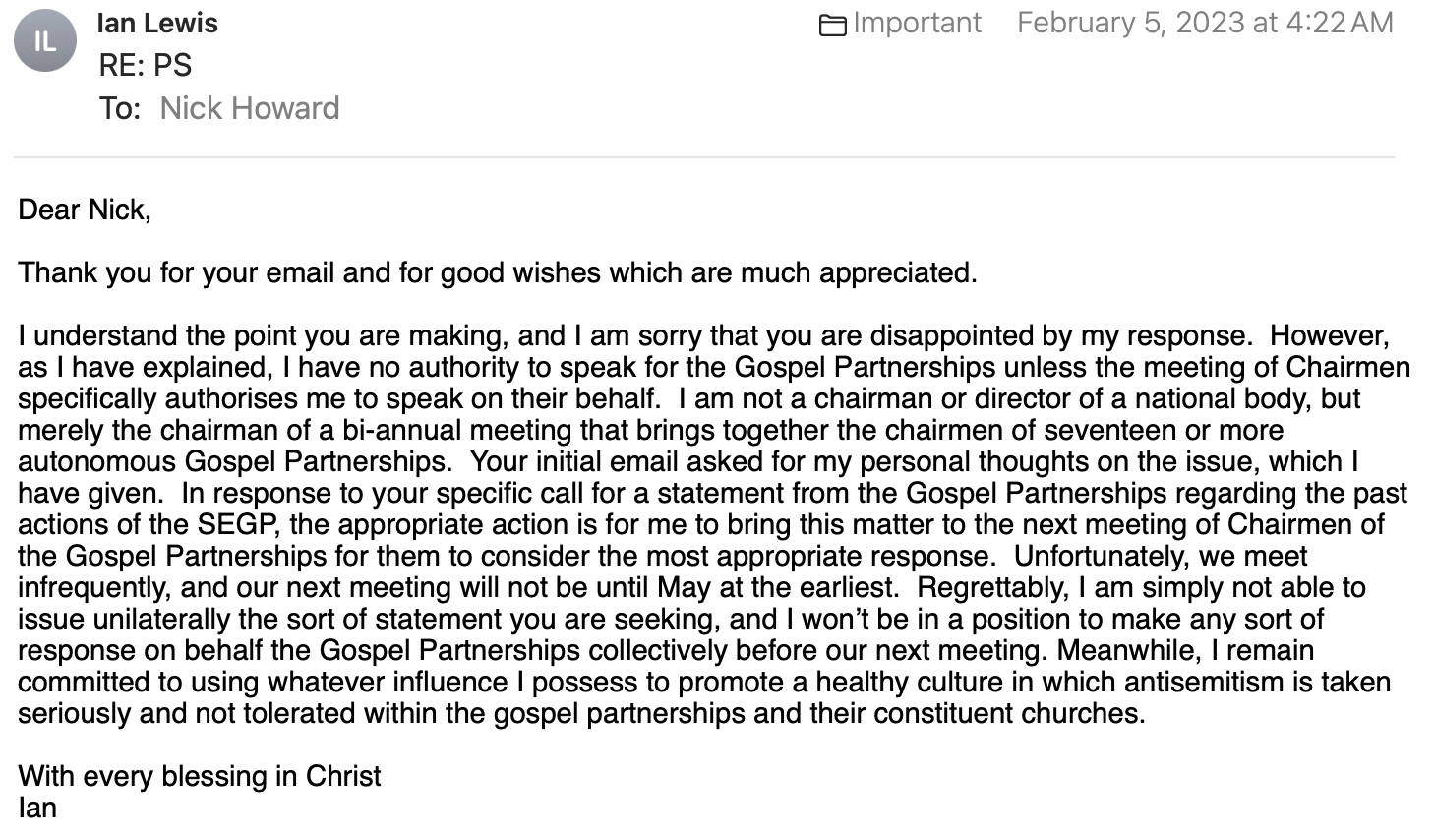
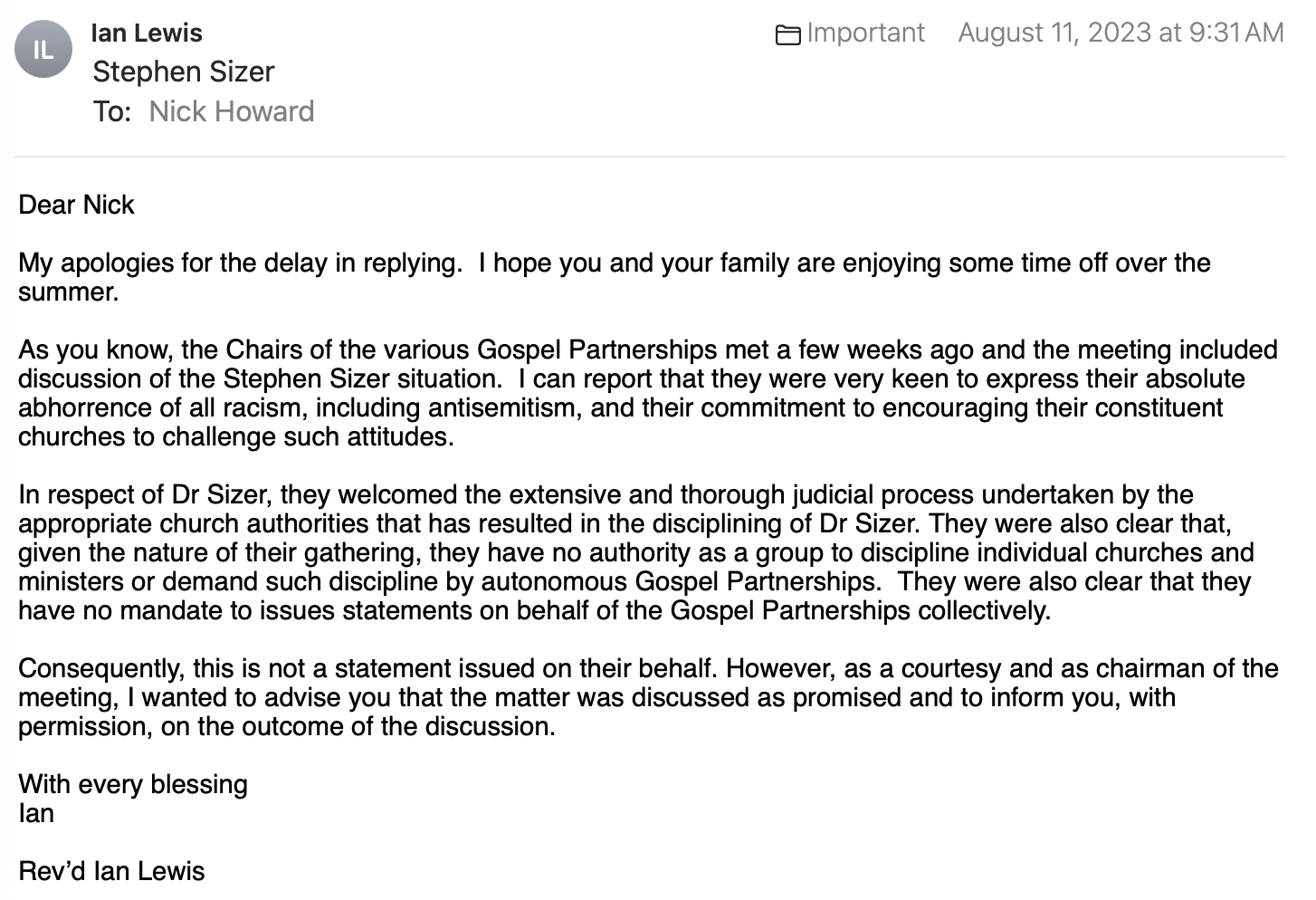
In 2022, a tribunal found that Stephen Sizer, formerly the vicar of Christ Church Virginia Water, had engaged in antisemitic activity. Ten years earlier, the South East Gospel Partnership had refused to take action against Sizer, despite receiving evidence that he’d sought to divert church funds to an explicitly pro-Hamas organisation. The relevant SEGP leaders have never admitted wrongdoing or apologised to the Jewish community. The conduct of the SEGP was discussed in 2023 at a formal meeting of leaders of the regional partnerships. But they said they had “no mandate to issue statements on behalf of the Gospel Partnerships collectively.” Silence is therefore a design feature of the network, making it impossible to hold the SEGP leaders to account. This silence is very convenient for Christ Church, which remains in the Gospel Partnerships network and which has never apologised for its grievous failures of oversight. It’s also convenient for Nick McQuaker, the network’s only executive office holder, because he belonged to the SEGP Steering Committee at the time in question, and he’s never apologised for rejecting all the appeals for action to be taken against Sizer.
The Church of England Evangelical Council
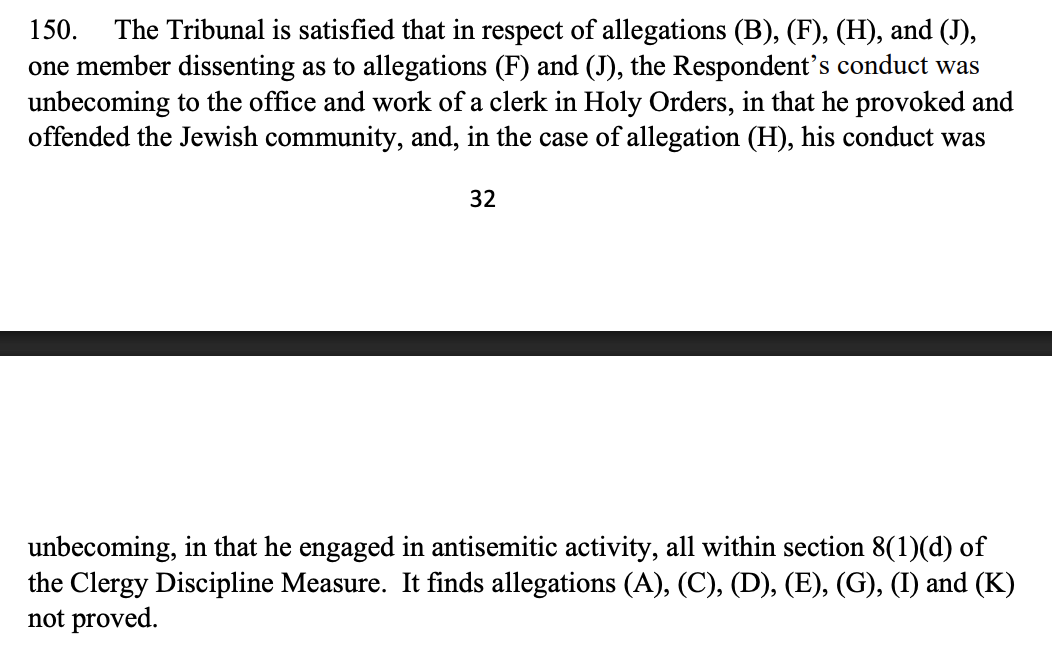
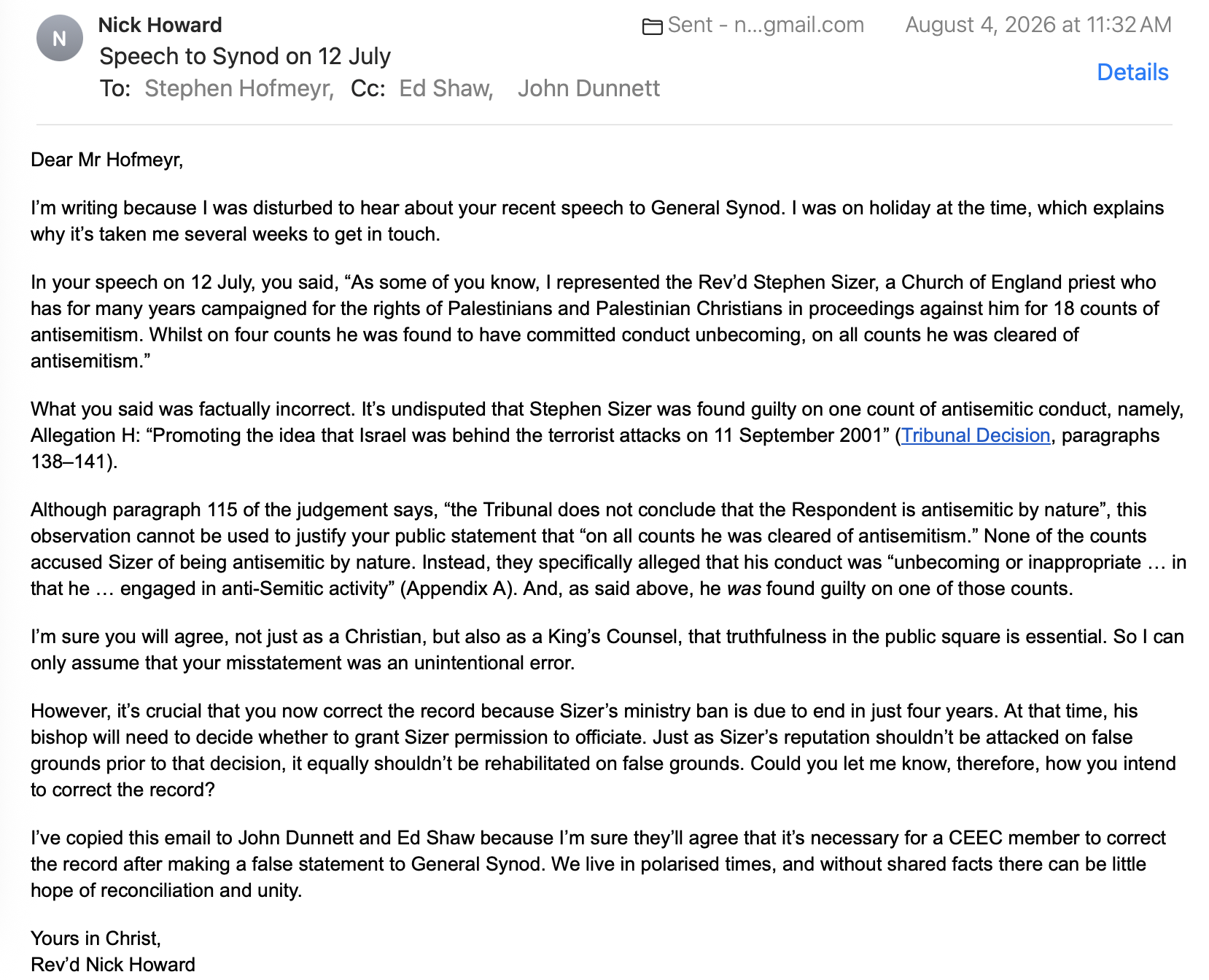
Stephen Hofmeyr KC is a member of the CEEC. In a speech to General Synod in July, he said, “I represented the Revd Stephen Sizer … in proceedings against him for 18 counts of antisemitism. Whilst on four counts he was found to have committed conduct unbecoming, on all counts he was cleared of antisemitism.” This was flatly untrue. One of the four counts cited by Hofmeyr alleged that Sizer had promoted “the idea that Israel was behind the terrorist attacks on 11 September 2001”, and on this count the tribunal did indeed find that he had “engaged in antisemitic activity” (Tribunal Decision, paragraph 150). Hofmeyr’s whitewashing of Sizer was bizarre because the tribunal’s verdict is well known. In the hope that CEEC would honour the ninth commandment by requiring Hofmeyr to retract his falsehood, all these facts were set out in an email to Hofmeyr, copied to John Dunnett (CEEC National Director) and Ed Shaw (Co-Chair). No response has been received from Hofmeyr, Dunnett, or Shaw. Hofmeyr has never withdrawn his outrageous falsehood and remains a member of the Council, protected by his colleagues’ silence.
St Helen’s Bishopsgate
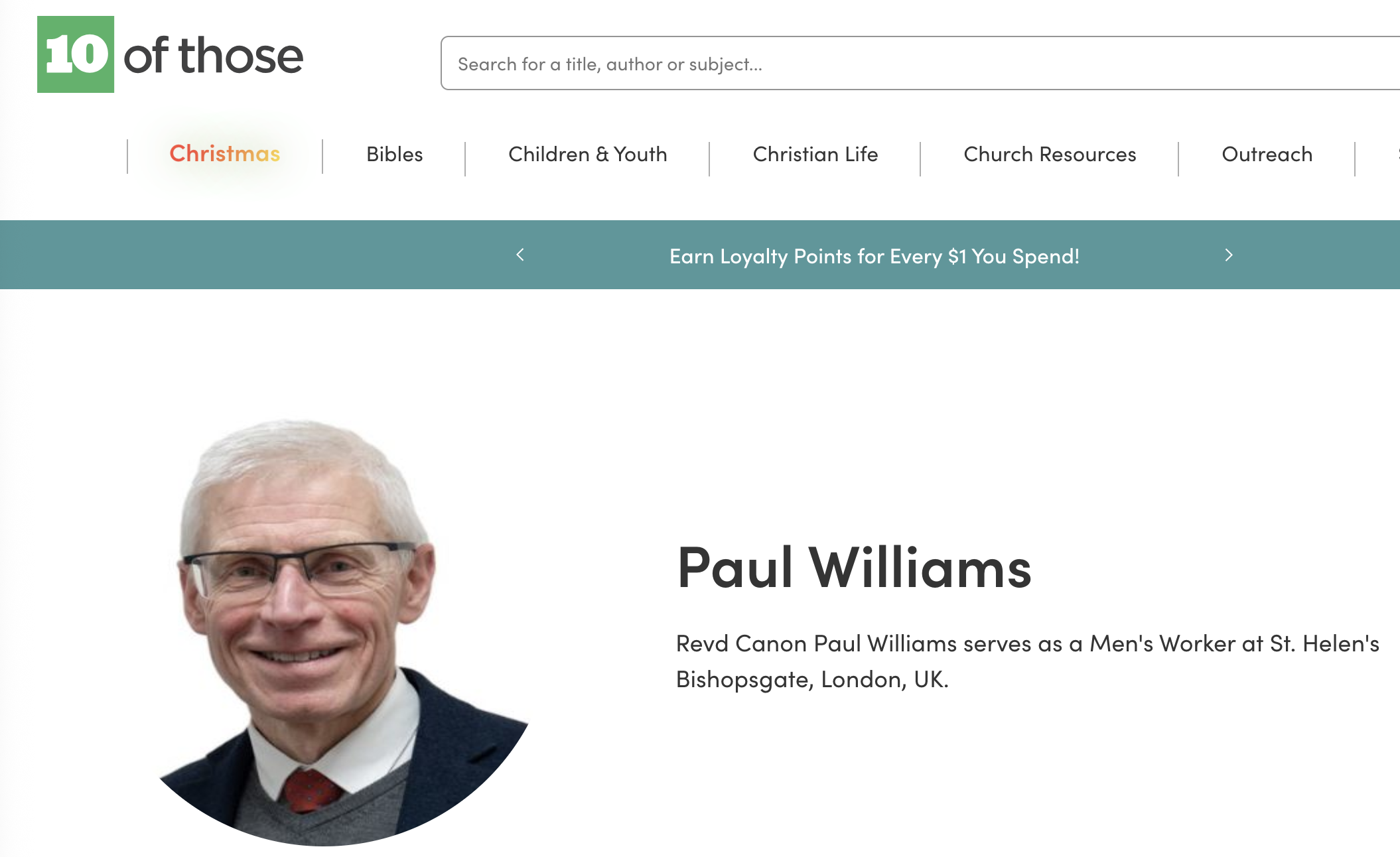
Paul Williams, a men’s worker at St Helen’s Bishopsgate, was previously the lead minister of Christ Church Fulwood. During his pastorship, a senior staff member named Tim Cudmore was found to have abused a female member of the church. According to documents seen by Sheffield’s local newspaper, Cudmore “initiated and pressured her into inappropriate physical contact, including touching her over and under clothes”. Williams allowed Cudmore to quietly step down “without any investigation or disciplinary action”. After these events came to light, Williams himself resigned, although he didn’t issue a public apology. Christ Church’s associate vicar and churchwardens later released a statement about the church’s “culture of secrecy” while Williams was in office. They said, “Our prayer is that with God’s help such a harmful culture will never develop again within our church.” Five months later, Williams began preaching regularly at St Helen’s. In the Bible, regular preaching is associated with the office of elder, and (given his record in Sheffield) Williams manifestly does not meet the necessary character requirements for that office. St Helen’s has been publicly criticised for this unbiblical restoration, but it has never responded, using silence to protect itself and Williams from due scrutiny.
Church Society
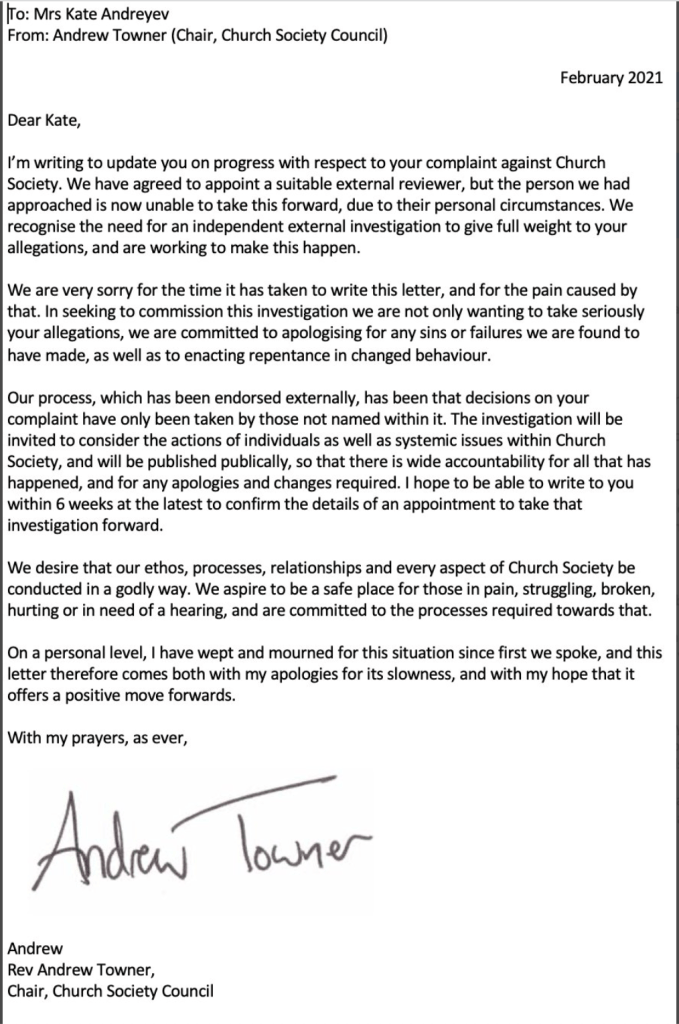
In February 2021, the then Chair of Church Society wrote to Kate Andreyev, a clergyman’s wife, telling her, “We recognise the need for an independent external investigation to give full weight to your allegations, and are working to make this happen.” But the investigation never took place. Instead, Church Society published its own report on the Andreyevs, written by Lee Gatiss, the society’s director. He said the society hadn’t commissioned an investigation because the Andreyevs had “publicly stated that any external investigation should not be commissioned or paid for by [Church Society]”. This was untrue, and the society’s leaders were aware that the Andreyevs were still expecting a Church Society-commissioned external investigation right up until the internal report was sent to them. Gatiss’s falsehood has never been retracted, and Church Society has never publicly addressed this matter. The society’s silence has had the effect of protecting Gatiss from the consequences of his dishonesty.
ReNew
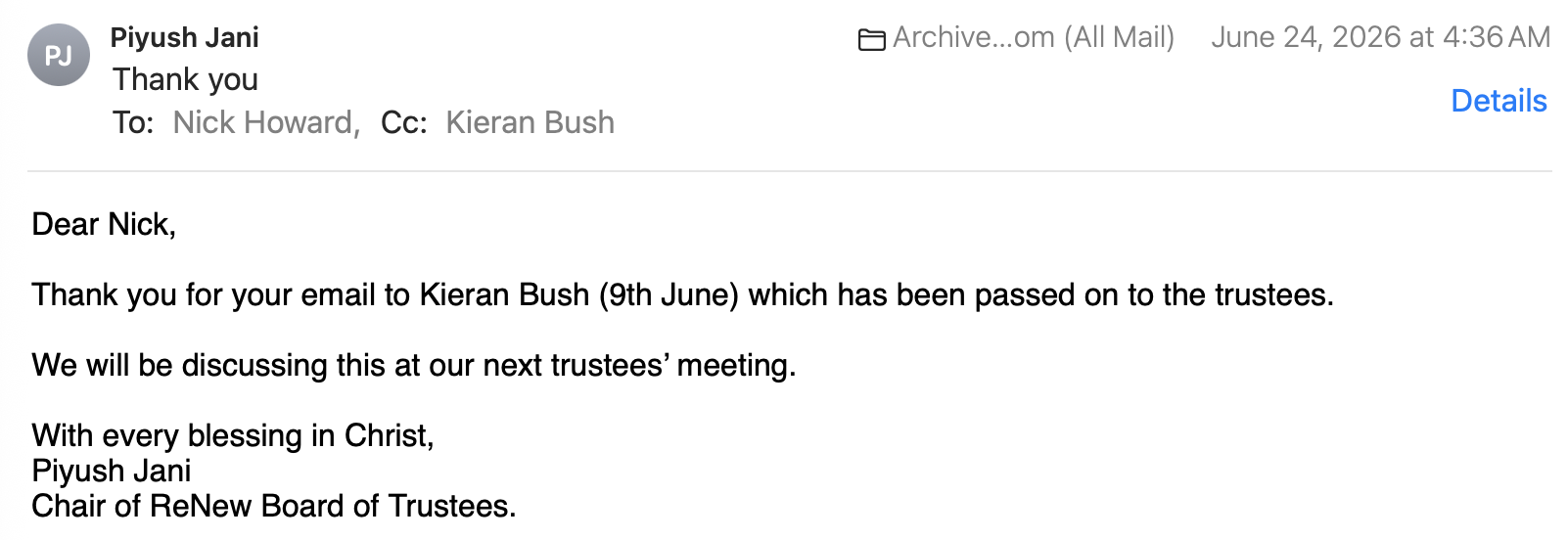
Earlier this year, ReNew declared, “We remain committed to helping foster a different culture: one where safeguarding is taken seriously, where challenge is welcomed, where people are listened to carefully, and where the vulnerable are protected.” In view of that statement, ReNew was asked if Brian O’Donoghue, a member of its planning team, would now explain why he didn’t warn William Taylor – his own church leader – that Jonathan Fletcher represented a safeguarding risk. (O’Donoghue’s conduct caused St Helen’s to commission an external investigation, but the church never issued a public explanation of his actions.) ReNew acknowledged receipt of the request and promised its trustees would discuss it. That promise was made more than four months ago, but nothing has been heard from ReNew since, despite a personal follow-up request. ReNew’s solemn pledge that “challenge is welcomed” has fallen at the very first hurdle. Evidently, O’Donoghue needs the protection afforded by ReNew’s silence.




Leave a Reply